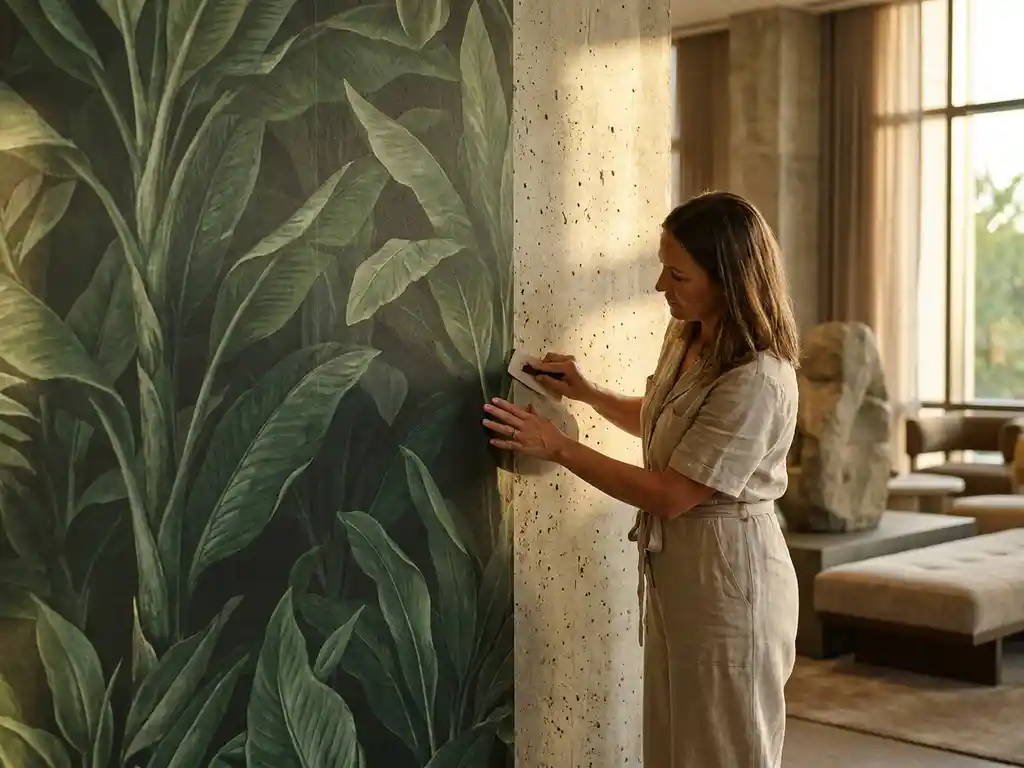
Large-format wallpaper can be seamlessly glued when you choose the right material, carefully prepare the wall, and press the strips precisely instead of overlapping them. The key lies in the combination of the appropriate wallpaper medium, the suitable adhesive, and a clean application technique. The following sections answer the most important questions about gluing large-format wallpaper step by step.
Which materials are suitable for large-format wallpaper?
Vlies wallpaper is particularly suitable for large-format digital printing wallpaper, as it is stable in shape, tear-resistant, and easy to handle. When in contact with adhesive, vlies materials hardly stretch, which significantly facilitates seamless bonding. Additionally, coated paper wallpaper and PVC-free textile media are also used, depending on the requirements for surface quality and durability.
Vinyl wallpaper is today the preferred medium for large-format printing because it is suitable for both dry and wet bonding. With wet bonding, the adhesive is applied directly to the wall, not to the wallpaper. This significantly simplifies the process and reduces the risk of wave formation or warping. PVC-free materials offer an additional advantage: they are PVC-free and therefore meet the requirements of customers who require PVC-free materials.
It is also important to ensure that the printing media is compatible with the ink type used: this means that it must be suitable for latex, solvent, UV or water-based systems. A material that is optimized for latex printing may yield poorer results on an UV printer. Therefore, before printing, check whether the medium is compatible with your printing system.
How is the wall prepared for large-format wallpaper?
The wall must be clean, dry, smooth, and absorbent before applying larger-sized wallpaper. Unevenness, cracks, or old wallpaper layers will affect the final result and can later cause visible seams or bubbles. Thorough wall preparation is the foundation for a professional result.
Follow these steps to prepare:
- Remove old wallpaper and completely wash off any adhesive residue.
- Cracks and unevenness Repair with putty and sand after it has dried.
- Wall priming, To regulate the absorbency. Especially on freshly plastered or very absorbent walls, a primer prevents the adhesive from drying too quickly and the adhesion from fading.
- Follow the dry seasonThe primer and filler must be completely dry before you start tiling.
- Measure the wall and draw the line of the joint, So that the first track is straight and all the other tracks can be aligned neatly.
On smooth, non-absorbent surfaces such as plasterboard or painted walls, a special adhesive primer is recommended. This ensures that the wallpaper adhesive has sufficient hold without the wallpaper later peeling off.
Which adhesive is best for large-format wallpaper?
For large-format vinyl wallpaper, a vinyl wallpaper adhesive based on methylcellulose or starch is best suited, formulated specifically for heavy wallpaper. This adhesive provides sufficient open time for you to align the panels, and also reliably holds even in large sizes. For particularly heavy media or smooth substrates, dispersion adhesives are recommended.
The following types of adhesives are commonly used in large-format printing:
- Non-woven wallpaper adhesive: Standard solution for most vinyl wallcoverings. It is applied to the wall, not to the wallpaper.
- Dispersive adhesiveHigher adhesive strength, suitable for heavy media and difficult substrates such as tiles or painted walls.
- Universal adhesive with increased solids contentFor wallpaper with a high surface weight, when standard adhesive is not sufficient.
Avoid glue that is applied too thinly or dries too quickly. Both of these causes the wallpaper to peel off at the edges or form bubbles. Apply the glue evenly and completely, without gaps at the edges.
How are larger-format wallpaper panels laid down seamlessly?
Larger-format wallpaper is glued seamlessly by pressing it flat: The edges of two adjacent wallpapers are directly adjacent to each other, without overlapping. For a truly invisible result, the wallpapers must be cut precisely, aligned accurately, and pressed evenly.
Here's how to set up the tracks before starting:
- First train to align on the line and press down fully. Start at the top and work your way down.
- Air bubbles with a stenciling brush or a brush spread out from the center outwards.
- Second train hits the first one directly, Without overlapping. Use the printed edge as a reference when the motif has a ratio.
- Press the seam with a seam roller, To ensure that both edges adhere evenly.
- Excess edges at the top and bottom Cut cleanly with a sharp cutter and a metal strip.
A common mistake is overlapping the seams in the hope of camouflaging the seam. This creates a visible crease that becomes even more noticeable after drying. Stamping is the only reliable method for a seamless result.
What to do if seams or bubbles are visible after gluing?
Visible seams or bubbles after gluing usually result from inadequate wall preparation, too little adhesive on the edges, or improper pressing. Bubbles that appear shortly after tiling disappear in many cases on their own when the adhesive dries. If they remain, you will need to make corrections.
Remove the bubbles
Small bubbles that are still visible after complete drying can be punctured with a fine injection needle. Inject some glue into the bubble, press the bubble flat, and smooth the area with a spatula. Then let the area dry completely before assessing it.
Visible seams are corrected
If the seams appear to be lifting after drying, it is often due to the fact that the edges were not sufficiently covered with adhesive. Use a fine brush to apply the adhesive under the open edge, press it down, and fix the area with tape for a short time until the adhesive has dried. On highly absorbent surfaces, it helps to primer the wall areas along the seam before applying the tape.
How do vinyl wallpapers differ from other large-format wallpaper media?
Vinyl wallpaper differs from other large-format wall coverings primarily in its form stability, ease of processing, and suitability for wall gluing without soaking. While paper wallpaper can crack and sag upon contact with adhesive, vinyl wallpaper remains dimensionally stable. This makes it the preferred choice for large-scale wall designs with precise seams.
A direct comparison of the common wallpaper media:
- Non-woven wallpaper: Formable, tear-resistant, adhesive is applied to the wall. Easy to process and remove. Suitable for latex, solvent and UV printing.
- Paper wallpaper: Affordable, but sensitive to moisture. It crumbles when soaked and can distort seams. Rarely used in large-format printing today.
- Textile wallpaperHigh-quality surface, suitable for representative spaces. More difficult to process and more expensive, but with a very elegant appearance.
- PVC-free media: PVC-free alternative to conventional films and plastic wallpaper. Comparable processing properties like fleece, but without PVC.
For professional large-format printing, Vlies is the most versatile medium: it works reliably on most printing systems, can be processed without special tools, and delivers consistent results even with large formats and multi-part motifs.
Large-format vinyl wallpaper: How com2C helps you with it
We know from daily practice that the result when tiling large-format motifs does not depend solely on the processing technique, but is significantly influenced by the material itself. A medium that is not optimized for your printer or ink type will nullify even the most meticulous processing.
- We offer PVC-free vinyl wallpaper designed specifically for digital large-format printing and compatible with latex, solvent and UV printing systems.
- Our materials are designed for form stability and seamless processing, so you can achieve reproducible results even with multi-part wall designs.
- We rely on PVC-free formulations because PVC-free materials no longer have to compromise on quality today.
- Our team provides technical advice: Which medium is suitable for your printer? Which adhesive is suitable for the respective substrate? We answer these questions specifically, not in a general way.
- For special requirements, we develop individual solutions together with you that do not meet standard product ranges.
If you are planning a specific project or are unsure which material is best suited for your application, please contact us. A brief Consultation often helps to get things going faster than trying things out for a long time.