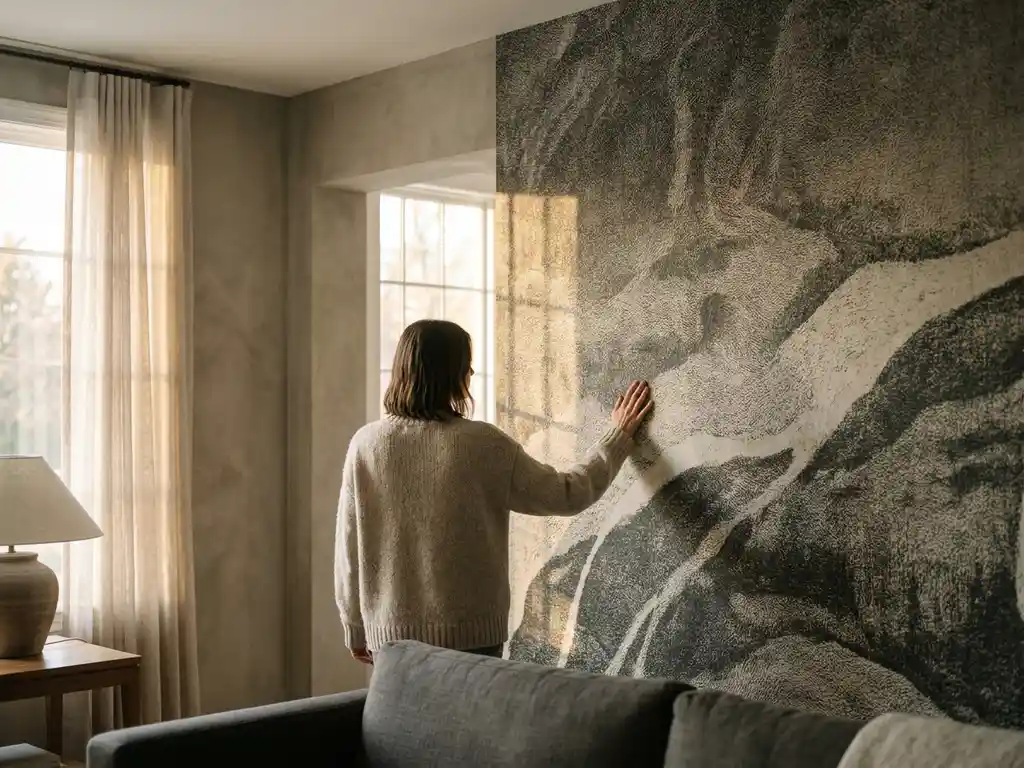
The right wallpaper material for a photo motif depends primarily on three factors: the room in which the wallpaper is to be hung, the desired image quality, and whether residue-free removal must be possible. Vinyl wallpaper is today the most commonly recommended base for photo wallpaper, because it is dimensionally stable, moisture-resistant, and easy to install. The following questions clarify what you should specifically pay attention to when choosing the material.
Which wallpaper materials are suitable for photo printing?
Vellulose wallpaper, paper wallpaper, and specially coated textile wallpaper are particularly suitable for photo printing. Velvulose wallpaper is the most common choice because it remains dimensionally stable, does not absorb moisture, and can be printed evenly. Paper wallpaper is cheaper but more sensitive. Textile wallpaper offers a high-quality feel, but is more complex to process.
In the digital printing sector, photo wallpapers are almost exclusively printed on vinyl wallpaper. The material absorbs ink evenly, does not warp during drying, and can be precisely cut to size. A smooth or slightly textured vinyl surface is particularly suitable for photos with fine details, soft color gradients, or high contrast. Paper wallpaper can become wavy when printing high amounts of ink, which impairs the image clarity. Textile wallpaper is more suited for decorative motifs than for photorealistic shots.
How does surface quality affect image quality?
The surface quality of the wallpaper material directly influences how sharply, vividly, and richly a photographic motif is reproduced. Smooth surfaces allow for more precise ink distribution and are better suited for photorealistic motifs. Textured or embossed surfaces scatter the light more effectively and can visually soften fine details.
With digital printing wallpaper, it’s the inkjet coating that matters: it determines how quickly the ink dries, how strongly it spreads, and whether colors stay cleanly separated from one another. A high-quality coating ensures that even tight color transitions appear sharp and black appears rich and deep. Matte surfaces reduce reflections, which often makes living room lighting more pleasant. Satin-matte surfaces are a good compromise between color brilliance and glare-free viewing. High-gloss coatings enhance contrasts but show fingerprints and light reflections more clearly.
What is the difference between non-woven and paper wallpaper for photos?
The most important difference between non-woven wallpaper and paper wallpaper for photo wallpapers is in their dimensional stability and usability. Non-woven wallpaper does not stretch when applied, can be applied dry to the wall and is much more forgiving of mistakes when applied. Paper wallpaper crumbles when in contact with glue and can curl, which can lead to unevenness in large-format photo montages.
Vinyl wallpaper: benefits for photo printing
Vinyl wallpaper consists of a vinyl backing that remains stable even when it comes into contact with adhesive. This makes it ideal for large-format photo wallpapers, where several strips must be exactly aligned. The strips are placed dry on the wall, and the adhesive is applied to the wall. This greatly simplifies the installation and reduces errors in aligning the motif.
Paper wallpaper: When it still makes sense
Paper wallpaper is cheaper to produce and can be an economical alternative for simple, large-scale designs without fine details. However, it is not suitable for rooms with high humidity and is more demanding to install. For photo wallpaper with high degree of detail or for applications where removal is planned at a later date, non-woven fabric is clearly preferable to paper.
Which material is suitable for rental apartments and for leaving no trace?
For rental apartments, vinyl wallpaper that is processed with removable adhesive is suitable, as are specially developed self-adhesive wallpaper materials. Both variants can be removed without leaving any residue if they are properly applied. It is important that the wall is primed or treated with a primer before applying the wallpaper so that the substrate is not damaged when it is removed.
Vinyl wallpaper can usually be removed from the wall in whole sheets when a suitable adhesive has been used. This is a major advantage over paper wallpaper, which often comes in strips from the wall. Self-adhesive wallpaper materials are even easier to remove, but depending on the product, they have limitations in terms of image quality or durability. For rental properties, the rule of thumb is: Always first stick a small test area and check the peelability before the entire wall is wallpapered.
How does the room climate affect the choice of materials?
The room climate significantly influences the choice of materials for photo wallpapers. In rooms with high humidity, such as kitchens or bathrooms, you should only use moisture-resistant materials that have a water-repellent coating or surface. Standard vinyl wallpaper without protective laminate can soften or peel off over time in these areas.
For kitchen areas, especially as a backsplash behind the stove, you need a material that is easy to wipe clean and heat-resistant. Special laminated wallpaper materials or self-adhesive films with a protective layer are used here. The same applies in the bathroom: Unprotected wallpaper cannot withstand the constant moisture. Living rooms and bedrooms are not critical; a standard vinyl wallpaper suffices without additional protective coating. In rooms with strong sunlight, you should choose UV-resistant materials to ensure that the colors of the photo motif do not fade.
What questions should one ask the printing service provider before placing an order?
Before ordering a photo wallpaper, you should ask the printing service provider at least five questions: What substrate is used? What printing technology is used? Is the material suitable for the intended room? How is the wallpaper delivered and installed? And is the material completely removable?
The substrate determines how the wallpaper behaves, how long it lasts, and whether it can be easily removed later. The printing technology affects color brilliance and durability: Latex and UV printing are generally more durable than water-based inkjet printing. Also, ask about the resolution in which the motif is printed and whether the delivered image is sharp enough for the desired format. A reputable printing service provider will provide clear answers to all these questions and point out any possible limitations before you place your order.
- What wallpaper material is actually used (manufacturer, product name)?
- Is the material suitable for wet rooms or kitchens?
- How is the wallpaper delivered: as a roll, in strips or as a complete set with assembly instructions?
- Which adhesive is recommended and is it included in the delivery?
- Can the material be removed without leaving any residue, and are there any recommendations for preparing the wall for the installation?
Our vinyl wallpaper at com2C: the right material for your photo motif
We know that the choice of material determines the result long before the printer starts. That’s why we develop and produce wallpaper materials that work in practice, not just on the data sheet.
Our PVC-free vinyl wallpaper are specifically designed for digital large-format printing and meet the requirements that print service providers and their end customers face daily:
- Dimensionally stable vinyl backing that does not crack during tiling and allows precise motif connections
- High-quality inkjet coatings from our own chemical laboratory for uniform ink absorption and brilliant color reproduction
- PVC-free materials from the GoGreener line without compromising on quality or durability
- Compatibility with all common printing systems: Latex, UV, Solvent and water-based
- Suitable for living spaces, rental apartments, and more demanding environments with increased humidity
If you are unsure about which material is best suited for your specific project, we are happy to help you. contact us and we advise you directly and without any unnecessary intermediaries.