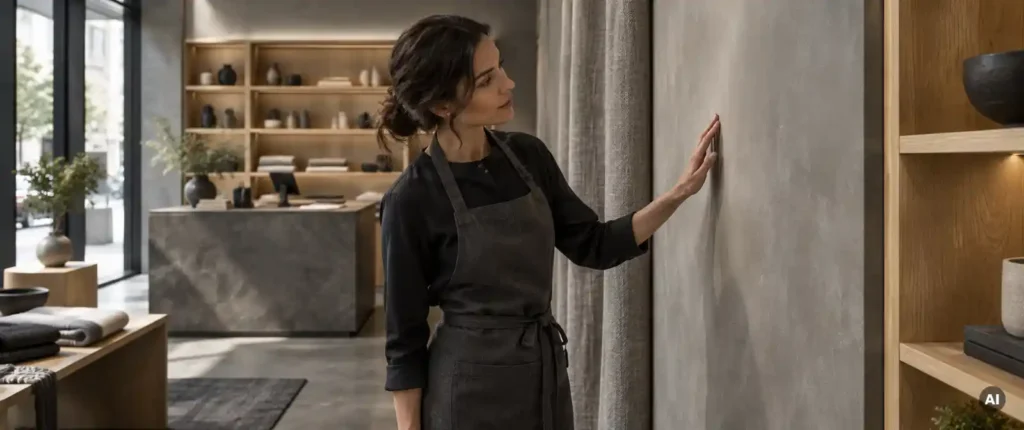
The right textile printing medium for a room installation is selected by evaluating three factors: the planned printing process, the requirements of the installation location, and the desired appearance. Those who know these three points make a well-informed decision and avoid costly subsequent repairs. The following sections answer the most important questions regarding material selection, color systems, and supplier advice.
Which textile printing media are suitable for large-scale spatial installations?
For large-scale room installations, polyester textile banners are particularly suitable, as are printable stretch textiles and woven composite materials with textile-like finishes. The choice depends on whether the material is stretched, hung or framed, and whether it is intended to be installed permanently or temporarily.
Polyester textiles are the most commonly used material in the interior sector. They can be folded, rolled, and transported without leaving permanent creases. Elastic fabrics with a defined degree of stretch are recommended for tension frame systems to ensure uniform tightness of the material. For hanging installations, such as room dividers or ceiling panels, heavier fabrics with good dimensional stability are better suited.
Coated textile fabrics combine a printable surface with a backing material, thereby providing greater rigidity. They are suitable for wall installations where the material is directly bonded or inserted into frames. Lightweight vinyl textiles, on the other hand, work well as decorative wall coverings because they are easy to process and provide a pleasant tactile feel.
How do color systems differ when printing on textiles?
In textile printing, three color systems are mainly used: sublimation ink, latex ink, and solvent-based ink. Each system places different requirements on the substrate material and provides different results in terms of color brilliance, flexibility, and durability.
Sublimation ink
Sublimation ink is used exclusively on polyester textiles with a high polyester content. The color penetrates the fiber directly through heat, resulting in very high wash resistance and vivid colors. This process is particularly suitable for display frames and measurement systems because the back of the textile remains clean and color-free.
Latex and solvent ink
Latex ink adheres to the surface of the textile and is therefore suitable for a wider range of materials, including coated textile banners. The result is robust and weather-resistant. Solvent-based inks provide similar properties but require good ventilation in the printing area and a correspondingly coated material surface. Both systems are suitable for indoor installations where the material is not washed but permanently attached.
Which material characteristics are particularly important for room installations?
For room installations, dimensional stability, light permeability, surface texture, and workability are the most important material characteristics. A material that deforms under heat or tears at edges creates significant additional effort in practice.
- Dimensional stability: The material must not sag or expand at room temperature and normal humidity. Especially with large formats, any instability becomes apparent.
- Light permeability: For backlit installations, you need a material that diffuses light evenly. For opaque wall installations, however, a high opacity is required.
- Surface structure: Smooth surfaces reduce reflections and make interiors look more luxurious with direct lighting. Glossy surfaces enhance color brilliance, but can be distracting when there is indirect light.
- Processability: The material should cut cleanly, sew or weld without tearing or fraying. This saves time in production and ensures clean edges.
- Fire protection class: Fire safety regulations apply in public buildings, hotels, and offices. Be sure to check for appropriate certifications, such as those according to DIN 4102 or EN 13501.
When should one choose PVC-free textile media?
PVC-free textile media are always the right choice when sustainability requirements, indoor air quality or disposal regulations play a role. This is especially true for hotels, offices and public facilities that strive for environmental certifications or place value on a healthy indoor climate.
PVC-containing materials can release volatile organic compounds, which is relevant in enclosed indoor spaces. PVC-free alternatives made of polyester or other synthetic fibers are generally less smelly and easier to recycle or dispose of after use.
In addition, many clients in the hospitality and retail sectors are now requiring proof of the environmental compatibility of the materials used. PVC-free textile media often meet these requirements better and facilitate communication with the end customer. If you produce projects with a sustainability strategy, you should incorporate PVC-free materials into the planning from the outset.
How does printer compatibility affect the choice of material?
Printer compatibility determines which materials you can use at all. Not every textile printing medium is compatible with every ink system or printer architecture. Choosing the wrong material for your printer risks poor color consistency, streaking, or material buildup.
Large-format printers from manufacturers such as HP, Epson, Roland, Mimaki, or Durst are designed for specific ink systems. An HP Latex printer requires a material that is coated with water-based latex inks. A Roland solvent printer requires a surface that absorbs solvent-based inks without bubbling or shrinking.
Always check the ink system used by your printer before choosing a material, and choose a textile printing medium that is explicitly approved for that system. Many material manufacturers provide compatibility lists. If you are unsure, test the material using a small sample print before starting a larger production run.
What questions should one ask the media provider?
Before ordering a textile printing medium for a room installation, you should ask your supplier at least five specific questions. The answers will show whether the supplier truly understands your project or is simply selling a standard product.
- Which tinting systems are compatible with this material? A reputable supplier will provide you with specific printer models and ink systems, not just general categories.
- What fire protection class does the material have? This is a mandatory requirement, especially for hotels, offices and public spaces.
- Is the material PVC-free? If sustainability or indoor air quality are relevant, you need a clear statement, not a marketing phrase.
- How does the material behave when exposed to heat and humidity? Dimensional stability under real conditions is more important than laboratory values.
- Can you provide samples or test prints? A supplier who does not offer you a sample either does not know their material well enough or is not interested in long-term cooperation.
Good suppliers answer these questions without hesitation and provide technical data sheets upon request. If a supplier fails to provide these or only refers to product descriptions, this is a sign that they lack consulting expertise.
Textile printing media for spatial installations: How com2C helps you with this
We know that the selection of materials for space installations is often more complex in practice than product catalogs would suggest. Different printer architectures, fire safety requirements, sustainability guidelines, and tight production schedules rarely occur individually, but rather most often simultaneously.
Our Interior Film Collection on com2C This includes printable textiles and print media for interiors that we have specifically developed for the requirements of hotels, offices, and concept stores. What sets us apart from a mere product supplier in this process:
- We advise you based on your specific printer equipment and toner system, not according to standard recommendations.
- We provide samples and technical data sheets so that you can make an informed decision before production begins.
- We develop coatings in our own laboratory for specific requirements when standard materials are not suitable.
- We manufacture PVC-free textile media from our GoGreener line for projects with sustainability requirements.
- We respond quickly, even to short-notice requests or unusual specifications.
If you are planning a specific project and are unsure which material is best suited, please contact us directly. Consultation It costs you nothing and, in the unlikely event of a mistake, saves you expensive production costs.