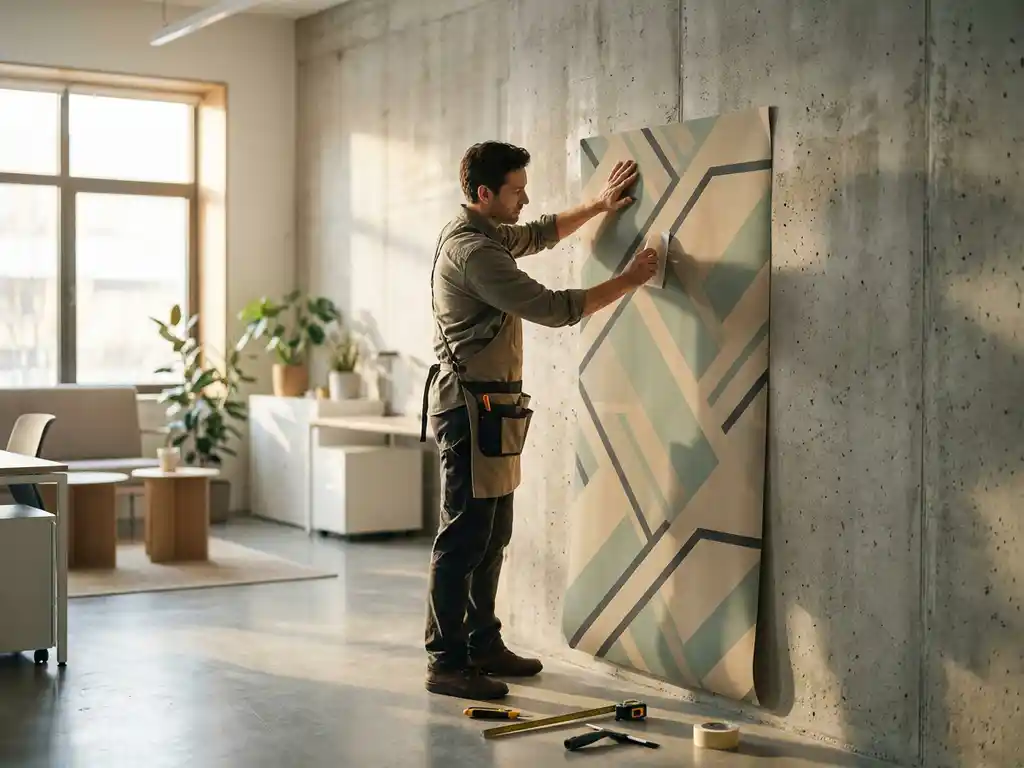
Self-adhesive wallpaper lasts on average between three and ten years indoors, depending on material quality, substrate and usage conditions. High-quality products based on non-woven fabric or made from PVC-free materials reach the upper end of this range, while inexpensive films wear down significantly sooner. The following sections answer the most important questions about durability, care and material selection.
What determines the durability of self-adhesive wallpaper?
The durability of self-adhesive wallpaper depends on four main factors: the quality of the material, the quality of the substrate, the ambient conditions, and the handling during installation. Not a single factor determines the lifespan alone, but poor preparation of the substrate can prematurely cause even the best material to peel off.
The adhesive formulation plays a central role. Acrylic-based adhesives react more consistently to temperature fluctuations than solvent-based variants. At the same time, the substrate layer—whether fleece, film, or textile—influences how flexible the material reacts to movement in the substrate. Otherwise, cracks or stretching in the plaster could directly transfer to the wallpaper.
The humidity in the room also has a measurable effect. In kitchens or bathrooms with permanently elevated humidity, the adhesive ages more quickly than in dry office environments. Direct UV radiation also accelerates material wear, especially in films without UV protection.
How long does self-adhesive wallpaper last indoors?
In the interior, self-adhesive wallpaper, when properly applied and under normal living conditions, lasts between five and ten years. High-quality vinyl wallpapers with a printable self-adhesive coating reliably achieve this value, whereas simple decorative films often show initial signs of wear after three to five years.
In commercial environments such as retail spaces or offices, where the wallpaper is exposed to light, touch, and temperature fluctuations daily, professional companies realistically estimate a lifespan of five to seven years. In less frequented areas such as bedrooms or hallways, the lifespan can be significantly longer.
It is also important to consider whether the wallpaper is designed for temporary or permanent applications. Temporary products are often easily removed without leaving any residue, but are not designed for long-term use. Durable variants offer stronger adhesion and are optimized for durability.
Does self-adhesive wallpaper also work outdoors?
Self-adhesive wallpaper is generally not suitable for outdoor use unless it is explicitly declared as unsuitable for outdoor use. Standard indoor products are not resistant to rain, frost, and direct sunlight and will dissolve within a few weeks or months.
For outdoor applications, there are specially developed self-adhesive films with weatherproof adhesives and UV-stabilized backing materials. These products are certified for outdoor use and can last between two and five years, depending on the product quality and location. North-facing orientations without direct sunlight extend the lifespan, while south-facing façades with intense UV exposure place greater strain on the materials.
Anyone who wants to use self-adhesive materials outdoors should always check the manufacturer's technical data sheets and pay attention to the information regarding outdoor suitability.
Why does self-adhesive wallpaper peel off prematurely?
Self-adhesive wallpaper peels off prematurely if the substrate was not adequately prepared, the ambient temperature was too low during installation, or the material adheres to an unsuitable substrate. These three causes are responsible for the vast majority of adhesion problems.
Specifically, this means that dust, grease, or remnants of old paint on the surface prevent full-surface adhesion. Porous or freshly painted walls absorb the adhesive unevenly. Even temperatures below 15 degrees Celsius during application permanently reduce the adhesive strength, even if the room subsequently becomes warmer again.
Other common causes are:
- Excessive stretching of the material during application, which damages the adhesive structure
- Moist walls, especially in new constructions or after renovations
- Incompatibility between the type of adhesive and the wall paint, for example in silicone-based paints
- Direct sunlight on freshly bonded surfaces during the curing phase
How can the lifespan of self-adhesive wallpaper be extended?
The lifespan of self-adhesive wallpaper can be significantly extended by careful preparation of the substrate, correct installation conditions, and regular maintenance. By consistently implementing these three points, you can get the most out of any material.
Before installation, you should thoroughly clean the surface, degrease it and allow it to dry completely. Smooth, closed surfaces such as glass, painted walls or tiles are particularly suitable. For absorbent surfaces such as self-adhesive wallpaper, a primer is recommended to reduce the absorption capacity.
During installation, the following applies: Room temperature between 18 and 25 degrees Celsius, no direct sunlight on the fresh adhesive and full pressure without air bubbles. After installation, you should not saturate the wallpaper with water or cleaning agents for the first 24 hours.
In normal operation, regular wiping with a slightly damp cloth helps remove dirt deposits that can attack the edges over time. You should avoid aggressive cleaning agents and scouring pads.
Which self-adhesive wallpaper lasts the longest?
Self-adhesive wallpaper based on non-woven fabric with a high-quality acrylic adhesive coating lasts the longest. Non-woven fabric as the carrier material is mold-resistant, tear-resistant, and less sensitive to moisture than paper wallpaper. When combined with a pressure-optimized adhesive, these products reliably achieve eight to ten years in indoor environments.
PVC-free variants have improved significantly in terms of technology in recent years and are hardly inferior to traditional film products in terms of durability. However, they offer the advantage of a PVC-free material composition. For applications in retail, office or hospitality environments, they are a solid choice that combines durability and PVC-free properties.
The following characteristics characterize particularly durable self-adhesive wallpaper:
- Non-woven or polyester backing material instead of paper
- Acrylic-based permanent adhesive with high initial adhesion
- UV stabilization of the printing layer for light-resistant colors
- Moisture-resistant surface that can be wiped clean
- Compatibility with common large-format printing systems for uniform color application
Cheap products without manufacturer information on shelf life should be avoided in professional applications. A technical data sheet with information on adhesion, temperature resistance, and lightfastness is a reliable quality mark.
Self-adhesive vinyl wallpaper from com2C: durable and PVC-free
We develop and produce self-adhesive printing media that work in practice, not just in the data sheet. Our focus is on materials that provide both manufacturers and end customers with the assurance of reliability, precise printing results, and long-lasting durability.
Our self-adhesive wallpaper PVC-free offers you the following benefits in particular:
- PVC-free material composition without compromises in durability
- Nonwoven-based carrier for high form stability and easy processing even on larger surfaces
- Compatible with latex, UV and water-based printing systems from HP, Epson, Roland and other manufacturers
- Optimized for indoor applications in retail, office, hospitality and residential areas
- Technical advice from our expert team, who are familiar with and evaluate your specific application
If you have questions about the material selection or if you have an application that you are unsure about, please contact us. A short Consultation It often helps to make the right decision quickly.