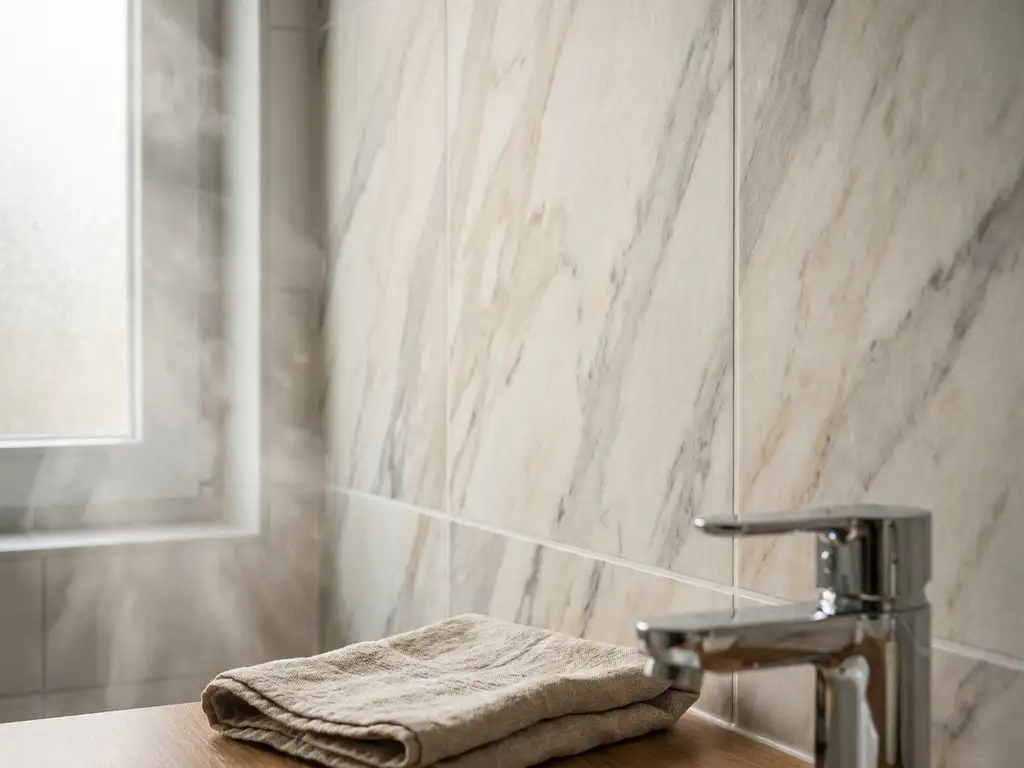
A self-adhesive wall film lasts between three and seven years in the bathroom with good quality and careful workmanship. The actual durability depends strongly on the material quality, the substrate and the humidity in the room. The following sections answer the most important questions about durability, care and replacement of adhesive film in a humid environment.
How many years does a wall panel last in the bathroom?
A high-quality self-adhesive wall film usually lasts three to seven years in the bathroom. Cheaper materials may already show detachment, blistering, or discoloration after one to two years. It is crucial whether the film was specifically designed for humid environments and whether it was applied professionally.
Films developed for use in kitchens and bathrooms have a moisture-resistant adhesive and a water-repellent surface. These properties prevent moisture from seeping into the film and dissolving the adhesive. Anyone who purchases a film that is marketed solely as a general decorative film risks a significantly shorter lifespan in the wet area.
Processing also plays a major role. Even the best material does not last long if air bubbles are trapped during application, the edges are not sealed tightly, or the film adheres to an unsuitable substrate.
Which factors shorten the shelf life in a humid room?
The shelf life of an adhesive film in a humid environment is shortened primarily by persistent high humidity, lack of ventilation, unsuitable substrates, and mechanical stress. Those who are aware of these factors can take targeted action to counteract them and significantly extend the film’s lifespan.
The following points are particularly critical:
- Condensate water: If steam regularly hits the foil during showering or bathing and does not dry off quickly enough, moisture penetrates into the edges.
- Lack of ventilation: Rooms without windows or ventilation have permanently high humidity levels, which permanently attacks the adhesive.
- Direct water jet: Areas that are regularly sprayed directly, such as the wall behind the shower head, are particularly vulnerable.
- Temperature fluctuations: Frequent changes between warm and cold cause the material to expand and contract, which weakens the adhesion.
- Cleaning agents: Aggressive cleaning agents or scouring pads attack the surface and can damage the protective layer.
Anyone who regularly ventilates the bathroom, wipes the film off briefly after showering, and uses gentle cleaning products, noticeably extends the shelf life.
Which substrates are suitable for bathroom films?
Self-adhesive films adhere best to smooth, clean, and grease-free surfaces. Smooth tiles, painted walls, glass, and smooth plastic surfaces are ideal. Rough, porous, or textured surfaces are problematic because the adhesive cannot form a uniform bond.
Before applying the adhesive, the surface should be thoroughly cleaned and degreased. Even invisible soap residues or lime deposits on tiles can cause the film to peel off within a few weeks. A cleaner based on isopropanol is well suited for pre-treatment.
The following substrates are suitable or unsuitable for wall panels in the bathroom:
- Suitable for: Smooth ceramic tiles, enamelled surfaces, glass, smooth-painted walls (gloss paint)
- Suitable for: Matt wall paint (depending on the adhesive strength of the paint itself), PVC surfaces
- Not suitable: Structural plaster, rough natural stone tiles, freshly painted walls (observe the drying time), wallpaper
For rental apartments, it’s worth sticking a small test area in advance and checking after a few days whether the film adheres cleanly and can be removed without leaving any residue.
Can you remove wall film in the bathroom without leaving any residue?
Yes, a high-quality self-adhesive wall film can be removed without leaving any residue in the bathroom if it was designed for this purpose and applied correctly. This makes it particularly interesting for rental properties where structural changes are not permitted.
For a residue-free removal, the following guidelines apply: Slowly and at a flat angle pull the film away from the wall, preferably at room temperature. Cold temperatures make the adhesive brittle, which increases the risk of adhesive residue remaining. A hot air gun can help to gently heat the film and make removal easier.
It is important that the film does not remain on the surface for too long. If you leave a film on the wall for many years, you risk the adhesive hardening over time and leaving behind residues when removed. In rental properties, it is recommended to replace or remove the film no later than after five years.
How do you properly care for wall foil in the bathroom?
Wall paper in the bathroom is best cared for with a damp cloth and mild cleaning agents. Aggressive chemicals, abrasives and high-pressure cleaners should be avoided as they can damage the surface and attack the edges of the paper.
Specific care instructions for long shelf life:
- After showering, briefly wipe the film with a soft cloth to avoid water stains and deposits of lime.
- Use pH-neutral cleaners, no vinegar cleaners or dishwashing liquid.
- Check the edges and corners of the film regularly. If they come loose easily, you can gently press them back together with a film filler or a soft cloth.
- Ventilate the bathroom after showering to quickly reduce the humidity level.
Anyone who consistently implements these simple measures can significantly extend the lifespan of a bathroom film beyond the average three to five years.
When should a bathroom film be replaced?
A bathroom film should be replaced if edges are permanently peeling off, bubbles form that no longer can be pressed down, or the surface visibly fades or is damaged. Mold growth under the film is also a clear sign that replacement is necessary.
Minor imperfections at the edges can often be repaired by cleaning the affected area, drying it, and fixing it with a suitable adhesive strip or film adhesive. However, if larger areas are affected or moisture has accumulated under the film, a complete replacement is more advisable than a repair.
As a rule of thumb, anyone who renews the film every five to seven years always has an aesthetically pleasing and hygienically impeccable surface. This is also economically sensible, as a new film is significantly cheaper than renovating the tiles.
Wall film in the bathroom: How com2C helps you with this
We know that a self-adhesive film in a humidity-controlled environment only truly works if the base material is correct. As a manufacturer of digital printing media, we develop and produce materials that print service providers and signage installers use as the basis for custom-made, individually printed end products. So if you’re looking for a printed wall film for your bathroom, the result is almost as good as the material on which it is printed.
- Our films are specially designed for demanding applications such as wet rooms and have been tested for adhesion, moisture resistance and residue-free performance.
- We offer materials that are compatible with all common large-format printers, so that your printing service provider can accurately apply colors and sharp designs to the film.
- Our self-adhesive media for kitchen walls and bathrooms are easily removed without leaving any residue, making them ideal for rental properties.
- We provide technical advice on which material is best suited for which substrate and for what moisture load.
If you have any questions about suitable materials for your project, we are happy to help. Simply contact us. Contact, and we will find the appropriate solution together.