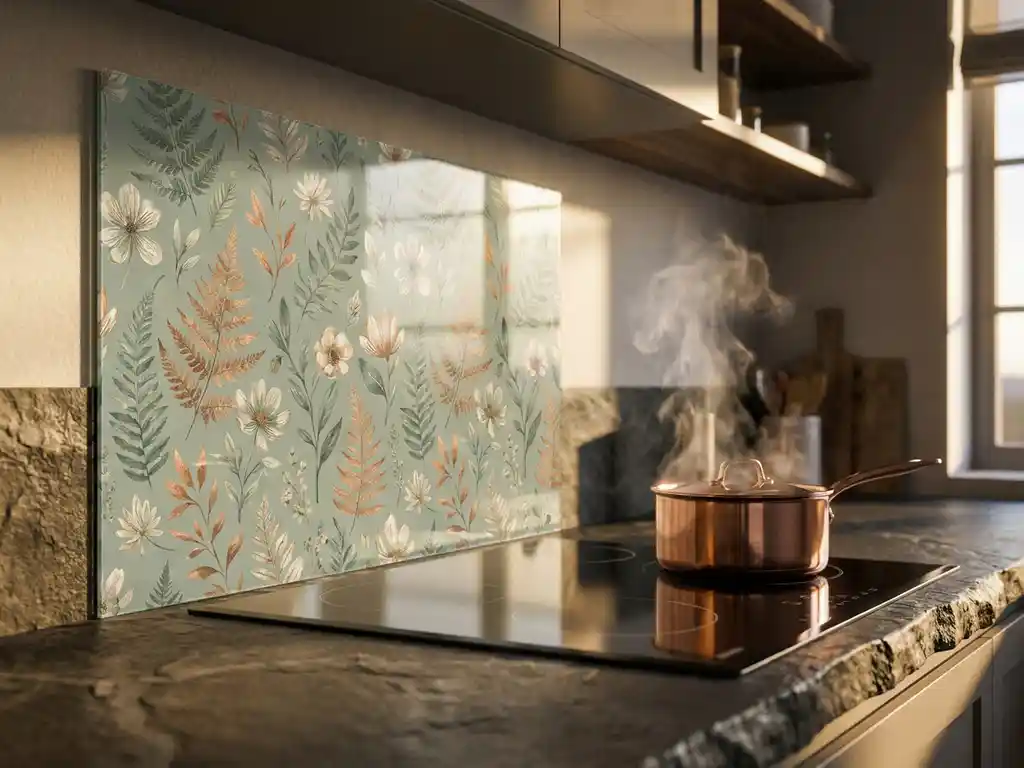
Printed kitchen backsplashes made of film last between three and ten years under normal kitchen use and proper care. The exact lifespan depends primarily on the film material used, the quality of the bonding, and how intensively the area comes into contact with heat, moisture, and cleaning agents on a daily basis. The following sections answer the most important questions about durability, care, and replacement.
What shortens the shelf life of a printed kitchen backsplash?
Heat, humidity, and aggressive cleaning agents are the three biggest factors that shorten the lifespan of a printed kitchen backsplash. The area directly above the stove is particularly critical, where temperature fluctuations, rising steam, and splashes of grease permanently affect the material. Those who are aware of these stresses can take targeted action to counteract them.
In detail, the following influences have a negative effect on the film:
- Direct heat: Cookers and ovens generate temperatures that soften the adhesive layer of the film. Over time, the edges will peel off, especially if the film is glued without sufficient distance from the stove.
- Long-lasting steam: Water that regularly penetrates behind the film edges undermines the adhesive effect. This is especially true for poorly sealed cut edges.
- Oil spatter: Imbedded fat is difficult to remove and encourages cleaning with too much pressure or aggressive products, which damages the pressure.
- Incorrect cleaning products: Solvent-based cleaners, scouring pads or steel wool damage both the printing ink and the film surface.
- Poor ground preparation: Oily, wet, or uneven tiles when glued together mean that the film never adheres properly and peels off prematurely.
A properly prepared substrate and sufficient distance from the heat source are the most important measures to maximize the lifespan from the very beginning.
How long do different types of film last in the kitchen?
The shelf life varies considerably depending on the type of film. Simple self-adhesive standard films often last only two to four years in the kitchen, while high-quality pressure films specifically designed for humid environments with protective laminate can easily last five to ten years. The material is more important than any other factor.
Standard films without lamination
Cheap films without a protective coating are only conditionally suitable for the kitchen area. The printing ink is directly on the surface and is susceptible to mechanical stress and moisture. In areas with low loads, such as on the side next to the stove or behind the sink, they can still last several years if they are cleaned gently and regularly.
High-quality printing films with protective surface
Films specially developed for use in humid environments and kitchens have a structured or coated surface that repels water and withstands mechanical stress better. If these films are additionally laminated, their lifespan is significantly extended. Only materials designed for use directly behind the stove are recommended for this area.
Does laminating extend the lifespan of the kitchen backsplash?
Yes, laminating noticeably extends the lifespan of a printed kitchen backsplash. The protective layer protects the printing ink from moisture, grease, and mechanical wear, making the surface easier to clean. In the kitchen, laminating is not an optional upgrade; it is a practical necessity.
For kitchen backsplashes, two laminate types are particularly suitable:
- Matte Laminates: They reduce light reflections and have a more visually high-quality appearance. They are easy to maintain, but show fingerprints a little more clearly.
- Glossy Laminates: Easy to wipe off and particularly water-repellent. They enhance the color effect of the print and are well suited for heavily used areas.
It is important that the laminate is applied completely and without bubbles. Open edges or air inclusions are entry points for moisture, which in the long term endanger the adhesion of the entire film. A professionally laminated pressure medium lasts much longer in the kitchen than an unlaminated film, even if the base material is of high quality.
How do you clean a printed kitchen backsplash properly?
To clean a printed kitchen backsplash, use a soft, slightly damp cloth and a mild detergent without solvents. Avoid abrasive cleaners, alcohol, and steam cleaners as they can damage the print and the film surface. Regular, gentle cleaning will keep the appearance much longer than occasional intensive cleaning.
Specific recommendations for the cleaning routine:
- Immediately wipe off any fresh traces of grease with a damp cloth before they dry.
- For regular cleaning, use a soft microfiber cloth with lukewarm water and a pH-neutral cleaner.
- Do not rub with circular movements, but wipe in straight strokes to avoid scratching the surface.
- After cleaning, wipe the surface dry to prevent water from accumulating on the edges.
- Do not use emery boards, steel wool or cleaning agents containing abrasive particles.
Laminated kitchen backsplashes are significantly easier to clean than unlaminated ones. The protective layer prevents cleaning agents from penetrating the printing ink directly.
When should a kitchen backsplash be replaced?
A kitchen backsplash made of foil should be replaced if the edges are permanently peeling off, the surface is visibly discolored, or the printing ink fades and cannot be cleaned anymore. Also, the formation of bubbles under the foil or mold formation at the edges are clear signs that a replacement is advisable.
The following signs indicate that the film has reached the end of its lifespan:
- Cutting-off edges: If the film permanently lifts at the corners or cutting edges and cannot be pushed back in, the adhesion is lost.
- Bubbles or waves: They usually arise from penetrating moisture or heat. Small blisters can sometimes still be pressed down, larger ones cannot be pressed down anymore.
- Degradation or fading: This phenomenon occurs especially with cheaper materials after a few years. The appearance can no longer be restored.
- Mildew on the edges: A sign that moisture has permanently penetrated the foil. Cleaning no longer helps here.
- Mechanical damage: Deep scratches or cracks in the surface that can no longer be covered.
The advantage of film over tiles or glass is that the replacement is easy and requires no skilled labor. In most cases, the old film can be removed without leaving any residue, and the underlying surface remains intact.
Kitchen backsplashes with com2C: Materials that really hold up
We know that a kitchen backsplash is subject to daily use and that the material must withstand these stresses over the long term. That’s why we develop and produce printing media that are specifically designed for demanding applications like these.
Our Kitchen backsplashes by com2C offers printing service providers and advertising technology companies a reliable material base for custom-made, individually printed end products:
- Films with moisture-resistant adhesive layers that also adhere permanently in the kitchen
- Materials compatible with solvent, latex, UV, and water-based printing systems
- Removable variants that can be removed without leaving any residue for rental properties without permanent damage
- Precise color reproduction thanks to our own inkjet coatings from our laboratory
- PVC-free options from our self-adhesive film line
If you have any questions about the right materials for your application, we are happy to help. Simply contact us. Contact, we will help you further.