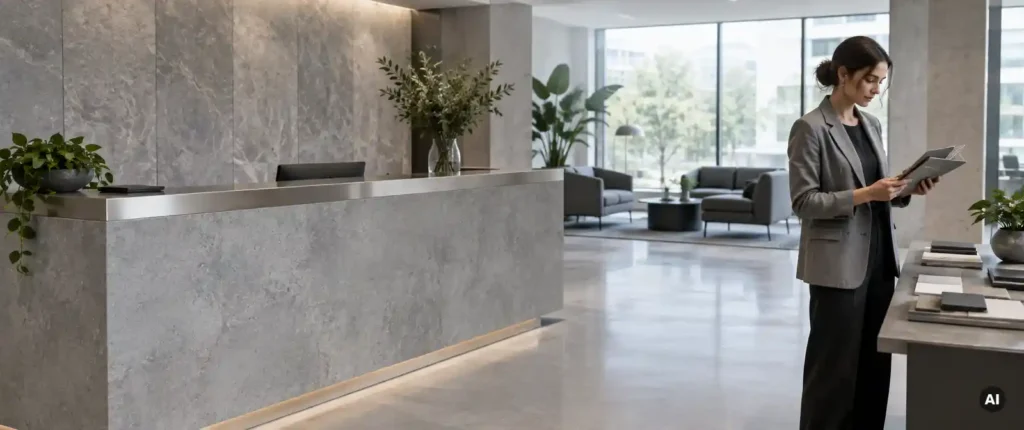
Office design significantly affects employees’ productivity. Studies in work psychology consistently show that factors such as light, noise, spatial layout, and visual design directly affect concentration, well-being, and willingness to perform. By consciously designing their work environment, people can do their work well. The following questions highlight the key connections between office design and employee performance.
Which factors in the office environment have the strongest impact on performance?
Office performance is most strongly influenced by light, acoustics, room temperature, and visual design. These four factors directly affect the nervous system and determine how well people can concentrate, communicate, and make decisions. In addition, ergonomic equipment and the ability to switch between different work modes are also important factors.
Acoustics is often underestimated in this context. Noise caused by conversations, phone calls, or office equipment is one of the most common concentration killers in modern work environments. Even when employees get used to the noise levels, the cognitive effort required for concentrated work measurably increases.
The room temperature also has a noticeable effect on work performance. Too warm rooms promote fatigue, too cold rooms distract and generate physical stress. The optimal range for most people is between 20 and 22 degrees Celsius.
Visual stimuli play an often underestimated role. Bare, monotonous walls create a sense of indifference, while thoughtful spatial design with color, texture, and orientation elements strengthens the sense of belonging and promotes identification with the company.
How does light affect concentration and mood in the office?
Light is one of the strongest biological factors influencing concentration and mood. Daylight regulates the circadian rhythm, promotes the release of serotonin and keeps energy levels stable throughout the workday. Too little light or false artificial light leads to fatigue, headaches and reduced attention.
For office spaces, the rule is: workplaces should be located as close as possible to windows or supplemented with daylight lamps. However, glare from direct sunlight on screens has a negative effect and should be regulated through curtains or privacy screens.
Artistic lighting with a high blue component (cold white light) promotes alertness and concentration during the day. In the afternoon and in meeting rooms used for creative work, warmer light can make the atmosphere more relaxed and communicative. Therefore, in modern offices, flexible lighting control that adapts to the changing day is not a luxury solution but a practical investment in work quality.
What is the difference between an open space and a private office?
The essential difference lies in the balance between communication and concentration. The individual office offers maximum peace and privacy, but makes spontaneous exchange more difficult. The open-space office promotes collaboration and transparency, but often creates significant concentration problems due to noise and visual distractions.
Advantages of the individual office
Employees in individual offices often report higher concentration abilities when performing complex tasks. The acoustic and visual shielding reduces cognitive strain. The individual office is particularly advantageous for activities that require deep thinking, such as programming, writing, or strategic planning.
Advantages of the open-space office
Open-space offices promote spontaneous communication, quick coordination, and a sense of teamwork. They are more flexible to use and easier to adapt to changing team sizes. The disadvantage: Without acoustic zoning and retreat options, productivity suffers significantly when working in a concentrated, individual capacity.
Many companies today are adopting hybrid concepts that combine both worlds: open spaces for team work and communication, combined with closed areas or telephone booths for focused work.
How does the design of the space influence the well-being of employees?
The design of the space influences the well-being of employees because people react emotionally to their visual and spatial environment. Spaces that are well-maintained, thoughtfully designed, and aesthetically pleasing convey appreciation and enhance the sense of working in a good place. This directly impacts motivation and commitment to the company.
Colors play a specific role in this context. Blue tones promote concentration and calmness, green tones have a relaxing and natural effect, while warm colors like orange or yellow stimulate creativity and communication. Neutral, overly sterile color schemes, on the other hand, create emotional distance.
Plants improve air quality and have been shown to have a positive effect on stress levels. Visible corporate identity through wall design, signage or room images strengthens the sense of belonging and makes the workplace a place that employees can identify with.
The quality of the materials and surfaces also sends out signals. High-quality wall decals, individual glass decorative films, or printed textiles show that a company takes its workspace seriously. This translates into the attitude of the employees towards their own work.
What measures improve productivity in the home office era?
In the age of home office, three measures in particular improve productivity in the office: the creation of spaces that intentionally invite people to the office, the provision of flexible work zones for different activities, and the visual enhancement of the corporate identity that is lacking in home office.
When employees have the choice to work from home or from the office, they choose the office when it works better for them than at home. This means that the office must offer more than the home desk. Better lighting, ergonomic equipment, social interaction, and an atmosphere that generates energy are relevant factors here.
Companies that invest in their office design in 2026 are not only doing it for the employees who are present on-site every day. They are creating a focal point that holds together hybrid teams and makes corporate culture tangible. Retreat areas for video conferences, clearly defined collaboration zones, and a pleasant overall atmosphere are not extras; they are functional requirements.
How can companies quickly and flexibly adapt their office design?
Companies can quickly and flexibly adapt their office design by using printed media and foils that can be applied without structural interventions and removed or replaced as needed. Wall decals, glass decorative foils, floor foils, and printed textiles can be installed within a short time and enable significant visual changes without renovation costs.
This approach is particularly relevant for companies that want to implement new campaigns, corporate values or space concepts on a regular basis without having to invest in expensive remodeling projects every time. Display panels, privacy film for glass surfaces, and individual vinyl wallpaper can be replaced as soon as requirements change.
It is important to choose materials that can be removed without leaving any residue and that do not cause damage to walls or glass surfaces. For offices in rental properties, this is an important criterion that should be taken into account from the very beginning when selecting the materials.
Office design with com2C: print media for modern work environments
We understand that office design is not a one-time project but a continuous process. Requirements change, teams grow, and brand appearances continue to evolve. This is where we excel: with print media that can be flexibly deployed, operate technically reliably, and aesthetically appeal.
- Individual vinyl wallpaper and wall panels for reception areas, meeting rooms and open-space areas
- Glass decorative films for privacy, orientation and corporate design on glass surfaces
- Floor films for guidance systems and brand zones
- Printed textiles for a high-quality textile interior atmosphere
- PVC-free materials from our GoGreener line for sustainable office projects
- Fast delivery and personal advice even for complex requirements
Our Interior Film Collection We offer a wide range of materials that have been specially developed for use indoors. Whether you want to design individual glass surfaces or redefine an entire office space: we provide the appropriate media and the technical expertise to do so.
If you have specific requirements or are unsure which material is best suited for your project, we look forward to hearing from you. Consultation.