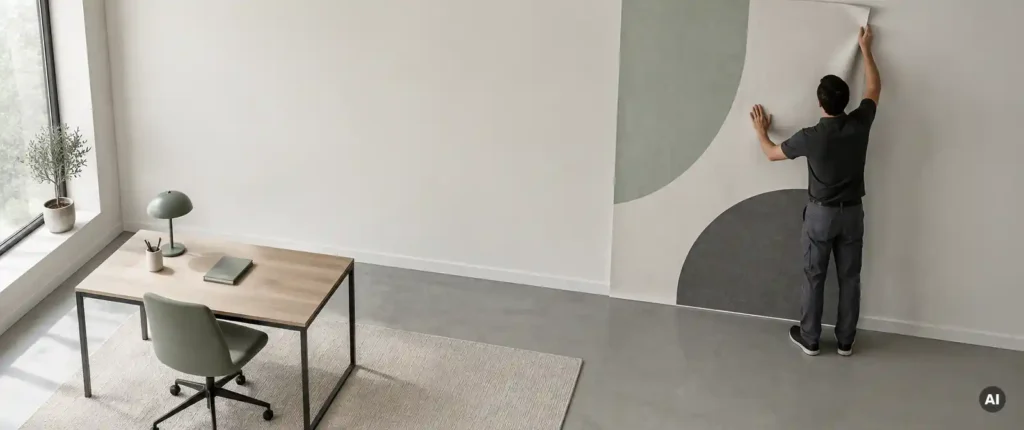
Anyone who wants to remodel their business premises often faces a practical dilemma: the business continues to operate, customers and employees are present, and yet the space is meant to change. Whether it’s a hotel, a concept store or an office, a complete closure is in most cases not a realistic option. The good news is that thoughtful room design is possible without interrupting operations if you choose the right materials and structure the planning consistently.
This article shows you how to redesign business spaces step by step and without downtime. You will learn which print media are suitable for ongoing operations, how to purposefully divide space zones, and what planning mistakes you should avoid from the very beginning.
What does uninterrupted space design mean?
Non-interrupted space design refers to an approach in which renovation and design measures are planned and implemented in such a way that ongoing operations are not affected or only minimally affected. The goal is not speed at any cost, but a smart division of measures into manageable steps.
The difference from traditional renovations lies primarily in the materials used. While conventional renovations often involve noise, dust and multiple days of disruption, maintenance-free concepts rely on materials that can be installed quickly, require no drying time and are immediately ready for use. Self-adhesive films, wall decals and printed textiles are typical examples of this.
A concrete example: A hotel wants to redesign its lobby without interrupting the guest service. Instead of painting and wallpapering over several days, the hotel uses self-adhesive vinyl wallpaper and wall panels that an experienced team installs in a few hours, without any odors, noise, or a no-entry zone.
Which print media are suitable for running businesses?
Not every material is suitable for use in active operation. The choice depends on three factors: processing time, odor load, and adhesion properties on the respective substrate.
Self-adhesive films and wall stickers
Self-adhesive films are among the most flexible materials for room design in ongoing businesses. They can be applied to glass, walls, floors, and many other surfaces without the need to block off the space. Modern films with an air channel-based adhesive layer can also be applied without bubbles and removed residue-free if necessary.
Vinyl wallpaper for wall surfaces
printable vinyl wallpaper is a proven solution for large-scale wall designs. They can be applied in multiple layers, which means that you can work on individual sections of the wall independently of each other. This is particularly useful in reception areas or hallways, where part of the area must remain accessible.
Textile printing and banner systems
Printed textiles and banner systems are the right choice when you want to quickly replace or seasonally adjust design elements. They are produced off-site and installed into existing frame systems on-site. Assembly often takes only a few minutes and leaves no marks on the substrate.
Reorganize space zones in a targeted and gradual manner
Building on the choice of materials, the zoning of the space is the most important strategic step. Instead of tackling the entire room at once, divide it into clearly defined areas that can be worked on in succession.
A proven approach is to prioritize based on frequency and visibility. Areas with high customer traffic, such as entrance areas or checkout areas, should be designed during times of low occupancy, for example early in the morning or after closing time. Less frequently used areas such as storage rooms, stairwells, or side hallways can also be worked on during operation.
- Start with zones that do not have a direct customer function
- Plan each zone as a separate subproject with a clear timeline
- Communicate ongoing work transparently to customers and employees
- Use transition elements such as temporary partitions or cover sheets to separate work areas
A similar principle applies to offices: meeting rooms are usually designed on weekends or during quiet periods, while open-space areas are worked on in sections.
Common mistakes in planning and how to avoid them
Many projects fail not because of execution, but because of planning. The most common mistakes occur when material selection, ground preparation, and time planning are not coordinated with each other.
Underground not tested
Self-adhesive films and wall stickers only adhere reliably if the substrate is clean, dry and free of grease. Anyone who skips this step risks delaminations, blistering or a shortened shelf life. Before ordering, check the type of substrate the material is to be applied to and select the product accordingly.
Not enough buffer in the time schedule
Even fast-processing materials require time for preparation, cutting, and careful assembly. Those who underestimate the time required are put under pressure and make mistakes. Plan at least 20 percent more time for each zone than originally calculated.
Materials ordered without system compatibility
Not every printing medium is compatible with every printer or ink. When you order materials from a service provider, make sure they pre-test the compatibility with their printing system. Errors in this area lead to color deviations or a lack of ink adhesion on the material.
Strengthening brand identity and atmosphere through print media
Interior design is more than decoration. It communicates who you are and what your brand stands for. Print media offer a direct and cost-effective way to make brand identity visible in the space without requiring any structural modifications.
For hotels, this means a consistent appearance from the lobby to the room, achieved through coordinated wall coverings, printed textiles, and backlit displays. For concept stores, it’s changing window displays and themed walls that stage seasonal campaigns, without requiring new furniture or fixtures every time. Offices benefit from glass decors and custom vinyl wallpaper that combine corporate design and orientation in reception areas and meeting rooms.
An important principle here: consistency beats effort. A uniform visual language that extends through all the different spaces creates a more professional impression than individual, elaborate design elements without visual connection. Print media enable just this consistency because colors, motifs, and typography are reproducible and scalable.
- Define a clear design concept in advance, including colors, patterns, and fonts
- Use print media as a vehicle for your brand message, not just as a filler for the page.
- Pay attention to material quality that matches the quality of your brand
- Plan for interchangeability when campaigns or collections change
com2C supports you in room design without interrupting operations
We know that projects in existing operations pose special requirements: tight timeframes, specific substrates, high demands on aesthetics and durability. That’s exactly why we develop and deliver printing media that work in practice.
Our Interior Film Collection Includes self-adhesive foils, vinyl wallpaper, glass decorative foils and other materials specifically designed for interior design in hotels, concept stores and offices. All materials are compatible with common large-format printers and have been tested for solvent, latex and UV ink systems.
- Materials with short processing time that are loadable immediately after assembly
- Removable film for temporary designs and campaigns
- printable vinyl wallpaper for large-area wall designs in patterns
- Technical advice on material selection based on your substrate and printing system
- Fast delivery, so that your time windows are met
If you are planning a specific project or are still in the concept phase, please contact us. We will help you find the appropriate materials and clarify any technical questions in advance. Simply contact us Contact, We respond quickly and without any unnecessary delays.