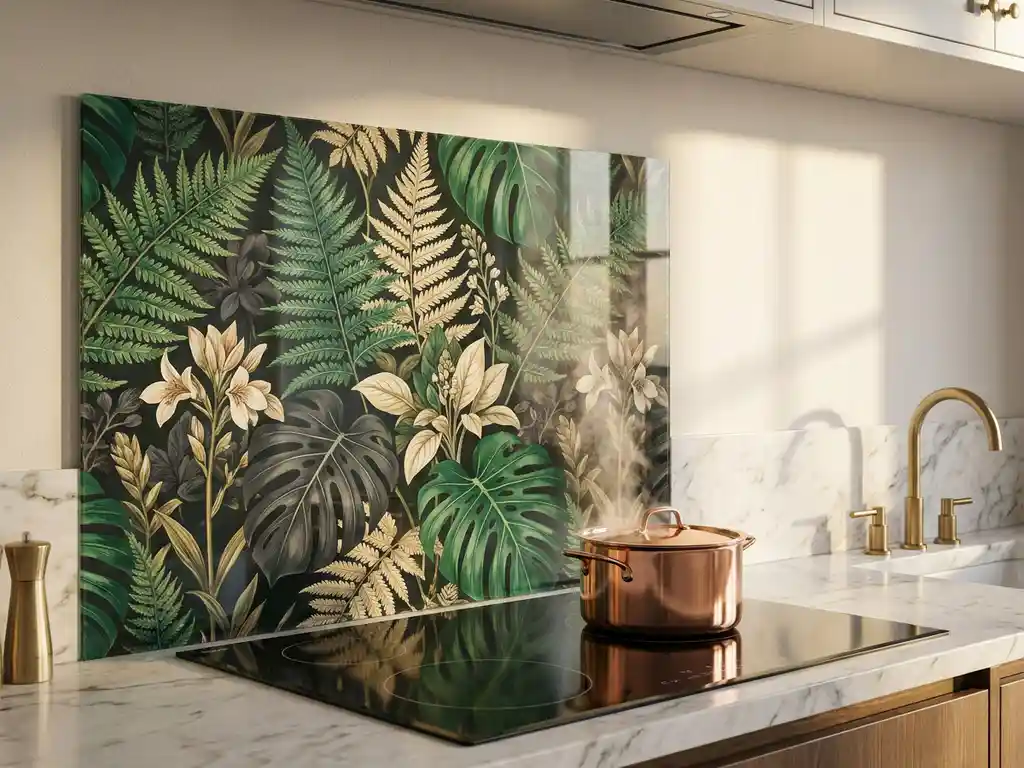
Printed kitchen backsplashes are created through large-format digital printing on self-adhesive films or rigid support panels, which are then custom-fitted to the wall or existing tiles. The result is a custom-made, visually high-quality surface that requires no tile setter and no structural alterations. The following questions explain every step, from material selection to installation and durability.
What materials are used for printed kitchen backsplashes?
For printed kitchen backsplashes, polymer-based self-adhesive films as well as rigid support panels such as acrylic glass or aluminum composite panels are primarily used. Self-adhesive films are the most common choice for rental apartments because they can be removed without leaving any residue. Rigid panels offer greater robustness, but require secure installation.
A distinction is made between PVC-containing and PVC-free variants of self-adhesive films. PVC-free materials for interior applications They are made without PVC-type plasticizers – a criterion that many customers in the kitchen sector pay attention to. It is also important to have a surface coating that protects the printed design from moisture, oil splashes, and cleaning agents.
Materials with increased heat resistance are recommended for the area directly behind the stove. Not every film is suitable for this area, which is why you should specifically ask the print service provider for a kitchen-suitable specification.
How does the printing process for a kitchen backsplash work?
The printing process for kitchen backsplashes takes place in several clearly defined steps: first, the motif is digitally prepared, then printed on the selected medium, and finally, a protective lamination is applied. Modern large-format printers enable precise color reproduction even in large formats.
Digital prepress
Before the printer starts, the image file is adjusted to the exact dimensions of the kitchen backsplash. Resolution plays an important role here: For close-range viewing, which is typical for a kitchen backsplash, the print file should have at least 100 to 150 dpi in the final format. Motifs with fine details or text require higher resolutions. Good print service providers check the file before printing and point out any quality issues.
Printing and lamination
The actual printing is done on a large-format printer which, depending on the print service provider, uses latex, UV, or solvent-based inks. Latex inks are considered particularly low-odor and are well-suited for indoor use. After printing, a transparent protective film is laminated onto the surface, making it smudge-proof, moisture-resistant, and more scratch-resistant. For kitchen backsplashes, this lamination is not an optional extra, but a necessary step for longevity.
How is a printed kitchen backsplash installed on tiles?
A printed kitchen backsplash made of self-adhesive film is applied directly to existing tiles without glue or special tools. The tiles must be clean, grease-free, and dry for this. Grout lines should be flat enough for the film to adhere evenly.
The installation works like this: The film is gradually peeled off starting from one corner and pressed down using a squeegee or a soft card, ensuring no air bubbles are trapped. For larger formats, wet application is recommended, where a mild soapy water solution is sprayed onto the tiles. This gives you more time to align the film precisely before the adhesive finally sets.
Deep tile joints can remain visible if the film is not pressed sufficiently into the recesses. In such cases, a heat gun helps by slightly warming the film and making it more flexible so that it conforms better to the surface.
How long does a printed kitchen backsplash last?
A printed kitchen backsplash made of high-quality laminated film will last for several years under normal kitchen use. Decisive factors for durability are the material quality, the lamination, and correct installation. In the event of direct contact with intense heat or steam, the lifespan may be shorter.
In practice, it has been shown that well-processed films with UV-resistant inks and protective lamination easily last three to five years without colors fading or edges peeling off. The prerequisite is that the area behind the stove is not permanently exposed to direct heat. A minimum distance to the stovetop or the use of a more heat-resistant material is recommended there.
Regular cleaning with a damp cloth and mild detergents will not harm the film. You should avoid abrasive or aggressive cleaners, as they can damage the lamination in the long run.
Can a printed kitchen backsplash be removed without leaving any residue?
Yes, self-adhesive films for kitchen backsplashes can generally be removed without leaving any residue, provided they were designed for this purpose and the film has not adhered to a porous or damaged surface for many years. This makes them an ideal solution for rented apartments.
For clean removal, heat the film with a heat gun to about 40 to 50 degrees Celsius. This softens the adhesive and allows the film to be peeled off slowly and evenly without tearing. Any remaining adhesive residue can be easily removed using isopropyl alcohol or a standard commercial adhesive remover.
Important: Not every self-adhesive film is designed for residue-free removal. Cheap products without repositionable adhesive can leave residues or damage the tile surface. Specifically ask your print service provider for films with repositionable or residue-free removable adhesive.
How much does a custom-printed kitchen backsplash cost?
The price for a custom-printed kitchen backsplash typically ranges between 50 and several hundred euros, depending on the format, material, and print service provider. Small backsplashes up to about 60 x 60 cm are less expensive, while formats that cover an entire row of kitchen cabinets cost correspondingly more.
The costs are made up of several factors:
- Format size: Larger areas mean more material and longer printing times.
- Material selection: PVC-free or specially coated films cost more than standard materials.
- Lamination: High-quality protective lamination increases the price, but noticeably extends durability.
- Subject and file preparation: If the print service provider has to prepare the file or create a design, graphic design costs will be added.
- Assembly service Some suppliers only deliver the finished film, while others also offer installation.
Compared to new tile cladding or a glass back panel, a printed film solution is significantly cheaper and more flexible. You can change the motif at any time without having to commission manual labor.
Kitchen splashbacks made from digital print media: com2C as material partner
We provide the foundation on which print service providers and sign makers produce high-quality kitchen splashbacks for their customers. Our print media are specially developed for demanding interior applications, tested, and optimized for common large-format printers.
- Self-adhesive films with repositionable adhesive that can be removed from tiles without leaving any residue
- PVC-free materials from our GoGreener line
- Coatings that ensure precise color reproduction with leading ink systems from HP, Epson, Roland, and Mimaki
- Materials with proven moisture and grease resistance, suitable for kitchen areas
- Technical consultation by our team of experts when specific requirements such as heat resistance or special surface structures are needed
If you are looking for a print service provider or work in the field of advertising technology yourself and the right material for printed kitchen backsplashes we are happy to assist you. Please contact us if you have specific requirements for which you have not yet found a suitable solution. contact us It's worth it.