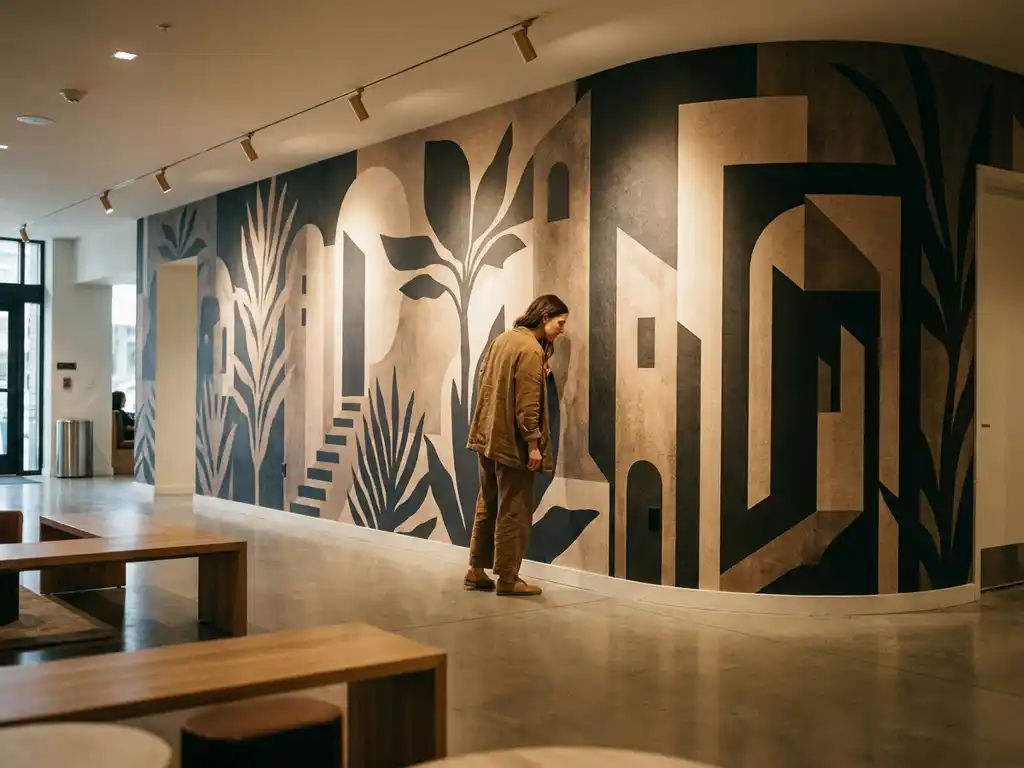
Non-woven wallpapers are good for the indoor climate. Their open-pored structure allows water vapor to diffuse through the wall surface instead of trapping it. This reduces moisture peaks in the indoor air and creates a more balanced living environment. The following sections explain how this effect works, where its limits lie, and when non-woven wallpapers are the better choice compared to other wall coverings.
What makes non-woven wallpaper breathable?
Non-woven wallpapers are breathable because their backing material consists of a network of fine fibers that does not form a closed barrier layer. Water vapor molecules can diffuse through the microstructure of the fleece without moisture accumulating between the wallpaper and the wall. This principle is referred to as vapor permeability or diffusion openness.
The difference compared to conventional PVC wallpapers lies in the material itself. PVC forms a largely vapor-tight film that traps moisture on the wall surface. Non-woven material, on the other hand, typically consists of polyester or cellulose fibers that are needled or bonded together. The resulting pore structure allows for a controlled exchange of moisture between the wall surface and the room air.
Important to understand: Breathability does not mean that the wallpaper actively absorbs or releases moisture like a sponge. It merely does not disrupt the wall's natural diffusion process. The wall can continue to breathe because the wallpaper keeps this pathway open.
How do non-woven wallpapers affect the humidity in a room?
Non-woven wallpapers indirectly influence indoor humidity by not blocking the moisture exchange between the wall and the room air. Walls, especially those made of masonry or lime plaster, can absorb and release moisture. Non-woven wallpapers leave this buffering mechanism intact, which mitigates short-term moisture peaks.
Specifically, this means: When you shower, cook, or simply breathe, the relative humidity in the room increases. A vapor-permeable wall with non-woven wallpaper can temporarily absorb some of this moisture and release it again when the air is dry. While this balancing effect is limited, it is measurably noticeable, especially in smaller rooms with little ventilation.
However, the wallpaper alone is not the only decisive factor for the overall result. The wall structure underneath, the paste used, and the quality of the room ventilation play an equally important role. A non-woven wallpaper on a vapor-tight primer or emulsion paint loses a large part of its climatic advantage because the wall itself is no longer open to diffusion.
Can non-woven wallpapers prevent mold growth?
Non-woven wallpapers can reduce the risk of mold, but they cannot fundamentally prevent it. Mold occurs wherever moisture remains permanently on a surface and the temperature is low enough. Because non-woven wallpapers reduce moisture accumulation on the wall surface, the probability of these conditions occurring decreases.
This is particularly relevant on exterior walls and in rooms with high moisture exposure such as kitchens or bathrooms. If moisture is not trapped behind the wallpaper, mold finds poorer growth conditions. Many non-woven wallpapers are additionally equipped with antimicrobial coatings that further inhibit mold growth on the surface itself.
Nevertheless, the following applies: anyone who has structural moisture problems—such as leaking walls, insufficient insulation, or permanently excessive indoor humidity—will not solve these problems simply by choosing the wallpaper. Non-woven wallpaper is a sensible measure as part of a well-conceived room concept, but it is no substitute for adequate ventilation and an intact building envelope.
Are printed non-woven wallpapers just as environmentally friendly to the indoor climate as unprinted ones?
Printed non-woven wallpapers are generally just as indoor-climate friendly as unprinted ones, provided that the ink used does not completely seal the pore structure of the non-woven material. In professional digital printing processes using water-based or latex inks, the breathability of the backing material is largely preserved.
The printing process itself deposits color pigments and binders onto the surface of the non-woven material. Whether the breathability suffers as a result depends on several factors:
- Ink type: Water-based and latex inks penetrate less deeply into the fiber structure than solvent-based systems and have less of an impact on vapor permeability.
- Print density: Full-surface, opaque prints with a high ink volume can seal the surface more than light, transparent designs.
- Coating of the fleece: Many printable non-woven wallpapers have an inkjet receptive coating specially formulated to absorb ink without significantly reducing vapor permeability.
For professional use in large-format printing, this means: Anyone printing non-woven wallpapers for interior spaces while wanting to maintain indoor climate quality should look for materials explicitly designated as vapor-permeable or breathable. The combination of a suitable backing material and the appropriate ink system is crucial here.
When are non-woven wallpapers the better choice compared to other wall coverings?
Vinyl wallpaper is the better choice compared to other wall media when space climate, ease of installation, and durability are important factors. Compared to self-adhesive films, they offer significantly higher vapor permeability. Compared to PVC wallpaper, they excel by not containing PVC and PVC-type plasticizers.
Non-woven wallpapers are specifically recommended in these situations:
- Living rooms and bedrooms: Where people spend time on a regular basis, a balanced indoor climate is important. Non-woven wallpapers support the natural moisture regulation of the walls.
- Old buildings with lime plaster or natural stone walls: These walls are designed to be vapor-permeable. A vapor-tight wallpaper would disrupt the natural wall structure and promote moisture problems.
- Offices and public spaces: Non-woven wallpapers are easy to work with, tear-resistant when removed, and allow for clean redecoration without wall damage.
- Projects without PVC: Those who prefer PVC-free materials will find non-woven wallpapers to be a technically advanced alternative that contains no plasticizers or chlorine compounds.
Self-adhesive films or coated banner materials have their place for temporary applications, shop windows, or trade fair presentations. For permanent wall designs in inhabited or used spaces, non-woven wallpapers are in most cases the technically more sensible solution.
Non-woven wallpapers by com2C: PVC-free, printable and indoor climate-friendly
We develop and produce printable non-woven wallpapers that are specifically designed for professional wide-format printing. In doing so, we place special emphasis on ensuring that the materials retain their breathability even after printing, because we know that our customers manufacture products for end users that must function in everyday life.
What our Non-woven wallpapers from com2C makes relevant for your production:
- Completely PVC-free and without any plasticizers
- Compatible with water-based and latex ink systems from leading printer manufacturers such as HP, Epson, Roland, and Mimaki
- Optimized inkjet-receiving layer that precisely absorbs ink without significantly impairing the vapor permeability of the substrate material
- Easy processing and residue-free removal, which makes the work easier for processors and end customers
- Developed and tested in our in-house chemical laboratory to ensure the coating is technically matched to the printing conditions
If you have any questions about the right materials for your next project or would like to discuss a specific application, please feel free to contact us. contact us and together we will find the right solution.