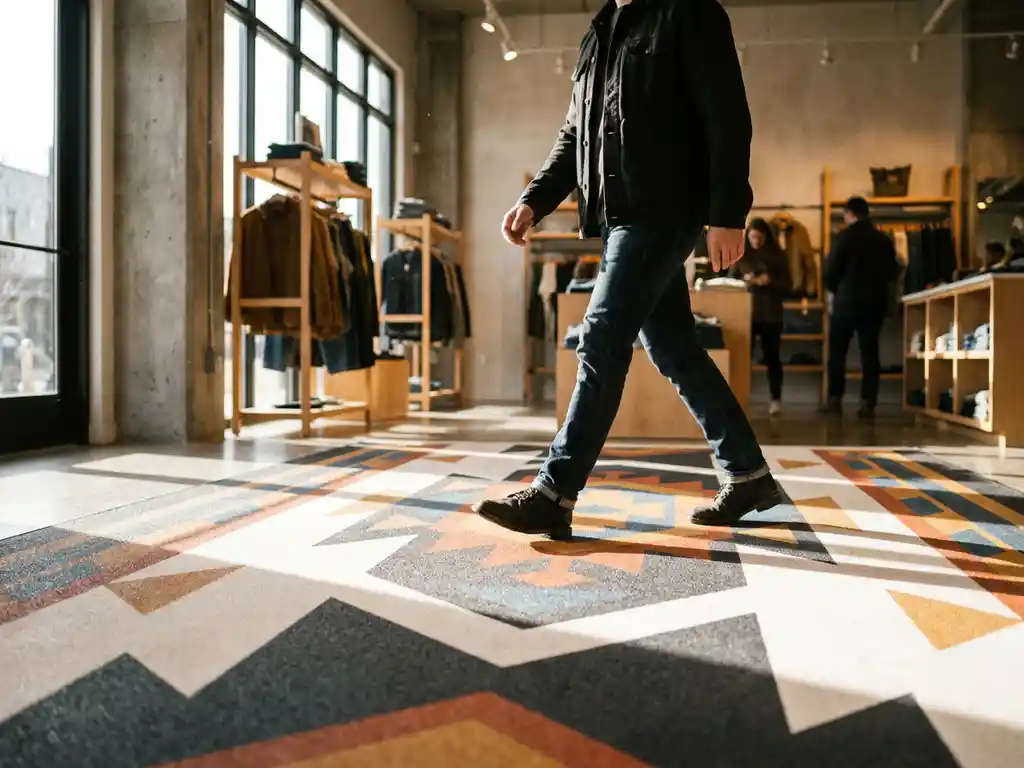
Custom-printed floor graphics are slip-resistant and safe when certified for floor applications. The slip resistance rating of the backing material is the decisive factor, not the printed image. High-quality floor graphics meet the requirements of rating group R9 or higher, making them suitable for use in residential and commercial areas. The following sections address the most important questions regarding safety, certification, and durability.
What slip resistance classes apply to floor graphics?
Floor films are classified into slip resistance ratings from R9 to R13 in accordance with the German standard DIN 51130. R9 is considered the minimum requirement for dry indoor areas such as living spaces or offices. Higher classes such as R10 or R11 are intended for areas with occasional moisture or an increased risk of slipping. For private homes, R9 is generally sufficient.
The classification is based on the angle of inclination at which a test subject can still safely stand on the surface. The higher the angle, the better the slip resistance and the higher the class. For commercial areas such as commercial kitchens or workshops, stricter requirements apply, which are defined in the employer's liability insurance association regulation BGR 181.
In addition to the R classification, there is the separate evaluation group A, B, or C according to DIN 51097 for barefoot areas such as bathrooms or showers. Anyone who self-adhesive floor film wants to use it in a wet area, should ensure that the material is explicitly approved for this purpose and carries the corresponding evaluation group.
How is the slip resistance of a floor graphic tested?
The slip resistance of a floor film is measured using the inclined plane method in accordance with DIN 51130. In this process, a test subject wearing safety shoes walks on an inclined surface covered with the material to be tested. The maximum angle of inclination at which safe walking is still possible determines the slip resistance class of the material.
This method simulates realistic load situations and delivers reproducible results. Manufacturers who offer their floor films for professional use have these tests carried out by accredited testing institutes and report the results in the technical data sheet. When purchasing a digital printing floor film you should always ask for this proof.
For barefoot areas, the wet-sliding method according to DIN 51097 is additionally used. Here, the surface is wetted with water and also tested using the inclined plane method. The result is rating group A, B, or C, with C representing the highest slip resistance for wet barefoot areas.
Does the printing process make floor graphics less safe?
Professional digital printing does not alter the slip resistance of a floor graphic if the material is correctly designed for the printing process. The slip resistance is determined by the surface structure of the backing material, not by the printed motif. The prerequisite is that the printing ink cures completely and does not form a slip-enhancing layer on the surface.
In the case of inferior materials or incorrect inks, it can happen that the printing layer changes the surface texture or forms a smooth layer that reduces the slip resistance. For printed floor graphics Therefore, only materials specifically developed for floor applications and re-tested for slip resistance after printing should be used.
Reputable manufacturers test their floor films in printed condition, not just as raw material. That is an important difference: a material may achieve an R9 rating as a raw film, but fall below this value after printing. When purchasing, make sure that the slip resistance class is specified for the printed end product.
Where can printed floor graphics be used?
Printed floor graphics with an R9 slip resistance rating may be used in dry indoor areas, including living spaces, hallways, offices, and retail areas. For areas prone to occasional moisture, such as entranceways or kitchens, at least R10 is recommended. In wet areas such as bathrooms or showers, only materials with a rating group of B or C according to DIN 51097 are permitted.
Self-adhesive floor films are particularly practical in rental apartments because they can be removed without leaving any residue and do not damage the structure of the building. They are suitable for kitchens, bathrooms, hallways, and living areas, as long as the material is approved for the respective level of moisture. For kitchen areas with frequent contact with water, the film should be explicitly designated as water-resistant.
Stricter regulations apply to commercial applications. In the hospitality industry, hospitals, or manufacturing plants, employers' liability insurance associations and building codes prescribe specific slip resistance classes. Anyone who ground sheet wants to use in such environments should check the applicable regulations before ordering.
How long does the slip resistance of a floor graphic last?
The slip resistance of a high-quality floor graphic is maintained over its entire service life with proper care and normal wear and tear. However, abrasive wear from dirt, harsh cleaning agents, or mechanical damage can alter the surface structure and reduce slip resistance over time.
For a long lifespan, regular cleaning with mild, pH-neutral cleaners and a soft mop or cloth is recommended. Aggressive abrasives, steam cleaners, or solvent-based cleaners can damage the print layer and surface structure. Manufacturers generally provide care instructions that you should follow strictly.
In heavily frequented areas such as entrance zones or hallways, the film wears out faster than in less used rooms. High-quality floor graphics are equipped with a protective lamination that shields the print layer and extends the lifespan. This lamination also helps ensure that the slip resistance remains more stable.
Which floor film is the right one for rental apartments?
For rental apartments, self-adhesive floor film with residue-free removability, a slip resistance rating of at least R9, and robust protective lamination is suitable. The material should adhere to smooth surfaces such as tiles, laminate, or vinyl floors without leaving adhesive residue or damaging the substrate.
Important criteria for the selection are:
- Slip resistance class: At least R9 for living areas, R10 for kitchens or hallways prone to moisture
- Adhesive technology Air duct systems or bubble-free adhesive layers facilitate assembly and disassembly
- Protective lamination: Protects the print image from abrasion and extends the service life
- Material thickness: Thick enough for durability, but thin enough for door clearances
- Certification: Verification of slip resistance in the printed state
For bathrooms in rented apartments, you should also pay attention to water resistance and the classification group according to DIN 51097. A film that is not approved for wet areas can become a hazard in the bathroom, even if it looks visually appealing. Have the exact areas of application confirmed in writing by the print service provider or material manufacturer.
Floor films for rental apartments: What we at com2C offer
We at com2C develop and supply floor graphics specifically designed for digital printing that meet the requirements for slip resistance, durability, and residue-free removal. Our materials are tested in printed condition, not just as raw material.
- Floor films with certified slip resistance classes R9 and R10 for various application areas
- Materials with bubble-free adhesive technology for easy installation and clean removal
- Durable protective laminations that preserve the print image and surface structure in the long term
- Technical data sheets with all relevant test certificates for every application area
- Personal consultation on material selection depending on the substrate, moisture level, and intensity of use
If you are unsure which material is the right one for your specific application, we are happy to help you. Just take Contact and describe your situation to us.