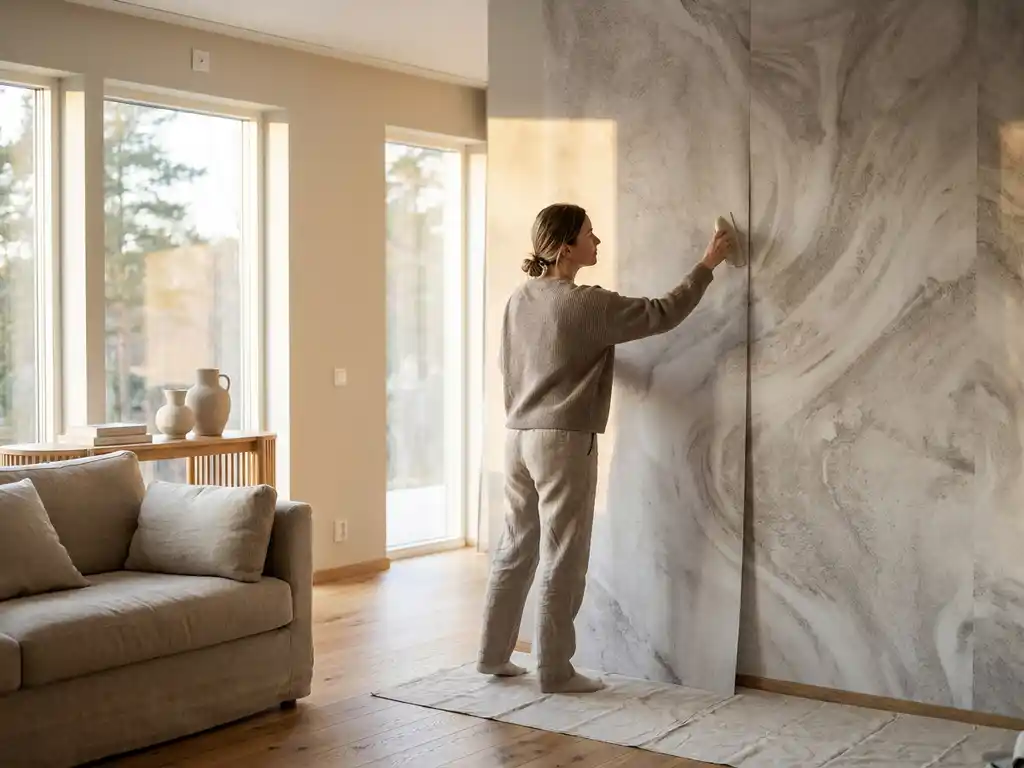
Yes, vinyl wallpaper can be easily cut and adjusted by yourself. The material is form-stable, does not tear easily during cutting, and can be precisely worked with simple tools. The following sections show you which tool you need, how to cut cleanly, and what to consider for difficult areas such as corners or sockets.
What tool do you need to trim vinyl wallpaper?
To cut vinyl wallpaper, a sharp carpet knife or a cutting knife with a fresh blade, a steel ruler, and a cutting mat are all you need. These three tools form the basic equipment for clean, straight cuts. A blunt blade is the most common reason for jagged cutting edges; therefore, replace the blade once too often rather than once too little.
For longer runs, a cutting ruler with at least 100 cm length is recommended so that you can cut the entire width in one go. Those who regularly work with vinyl wallpaper often resort to a roll cutter, as they are familiar with it from the cutting shop. This glides smoothly through the material and produces particularly clean edges without pulling or pressure.
A sheet of sandpaper not only protects the substrate but also keeps the material steady when cutting. Alternatively, a smooth, hard surface such as a chipboard or a glass sheet works well. It is important that the vinyl wallpaper lies flat when being cut and does not slip.
How exactly can custom-sized vinyl wallpaper be cut?
Vinyl wallpaper can be cut to size very precisely if you measure and mark it carefully. With a pencil or a sharpener, mark the cutting line directly on the back of the material. A steel ruler as a guide prevents the knife from deviating. With clean tools, you can achieve tolerances of less than one millimeter.
Always measure the wall area at multiple points, as walls are rarely perfectly perpendicular. Use the smallest measurement as a basis and plan for an overhang of about two to three centimeters at the edges. After applying the wallpaper, cut off this overhang flush with the wall. This prevents unsightly gaps on the ceiling or skirting board.
If you are working with a pattern, mark the pattern offset before cutting. Lay the strips side by side and check the alignment before cutting. This saves material and prevents errors that only show up on the wall.
Can you trim or shorten vinyl wallpaper afterwards?
Yes, vinyl wallpaper can still be trimmed after installation. As soon as the wallpaper is on the wall and has dried slightly, you can trim the excess edges on the ceiling, skirting board, or door frame with a utility knife and a cutting knife. The material will not tear as long as the blade is sharp.
To do this, firmly press the cutting blade against the edge you want to cut and run the blade along in a steady motion. Do not repeatedly apply pressure as this will result in uneven edges. If the cut does not come out immediately, change the blade and repeat the process.
You can also shorten the length of the strips that have become too long before gluing them down. Vinyl wallpaper adheres to the wall, not to the backing tape itself. This gives you more time and flexibility when positioning and cutting.
How do you handle corners, sockets, and door frames?
At corners, outlets, and door frames, cut the vinyl wallpaper with cuts to make it easy to install without wrinkles. At interior corners, guide the tape a few centimeters around the corner and cut off the excess after pressing it down. At exterior corners, cut the wallpaper flush with the edge or place it with a short overhang.
Sockets and switches
Switch off the electricity before work. Stick the wallpaper over the socket, press the material lightly and then cut a cross over the middle of the can. Fold back the four resulting triangles and cut them flush with the can frame. Alternatively, mark the socket’s position from the rear by lightly pressing down and cut the opening before installation.
Door frames and window joinery
On the door frame, run the wallpaper along the frame and cut off the excess with a utility knife right at the edge of the frame. For window trim, cut the trim at the top of the window and insert the lower part into the trim. Cut off the excess edges after pressing down. Always work with a fresh blade to avoid tearing or curling the material.
Can vinyl wallpaper be removed without leaving any residue?
Vinyl wallpaper can be removed without leaving any residue in most cases if you pull it off in one piece. Vinyl has a stable support structure that prevents tearing into pieces. Start at an upper corner, carefully tear off the strip and pull it slowly and evenly from the wall.
Whether the substrate remains intact after removal depends on the wall's structure and the adhesive used. On well-prepared, painted walls with normal dispersion paint, removal is usually easily accomplished. On freshly painted walls, high-pile carpeting, or sensitive substrates, the baseboard may come off or paint layers may peel off.
If you want to be sure, test the removal on an inconspicuous area before you start taping the entire surface. For rental properties: Before taping, primer the wall with a suitable primer. This protects the underlying surface and greatly facilitates the subsequent removal of the wallpaper.
Custom-made vinyl wallpaper: What com2C has to offer for you
We develop and produce printable vinyl wallpaper designed specifically for digital large-format printing. Our materials are designed so that print service providers and signage installers can produce custom-made end products that are easy to process, precisely cut, and easily removed cleanly.
- Formable non-woven material that cuts cleanly and does not tear during processing
- PVC-free materials from our GoGreener line without compromising on print quality
- Compatible with all common large-format printers and ink systems, from latex to UV
- Precise color reproduction for individual motifs, patterns, and photorealistic wall designs
- Materials that adhere to normal living room surfaces and easily peel off without leaving residue
Our com2C Vinyl Wallpapers These are the starting materials for printing service providers who want to offer their customers individual wall designs in high quality. If you have any questions about the material selection or the processing, we are happy to help. Simply contact us. Contact and we will help you further.