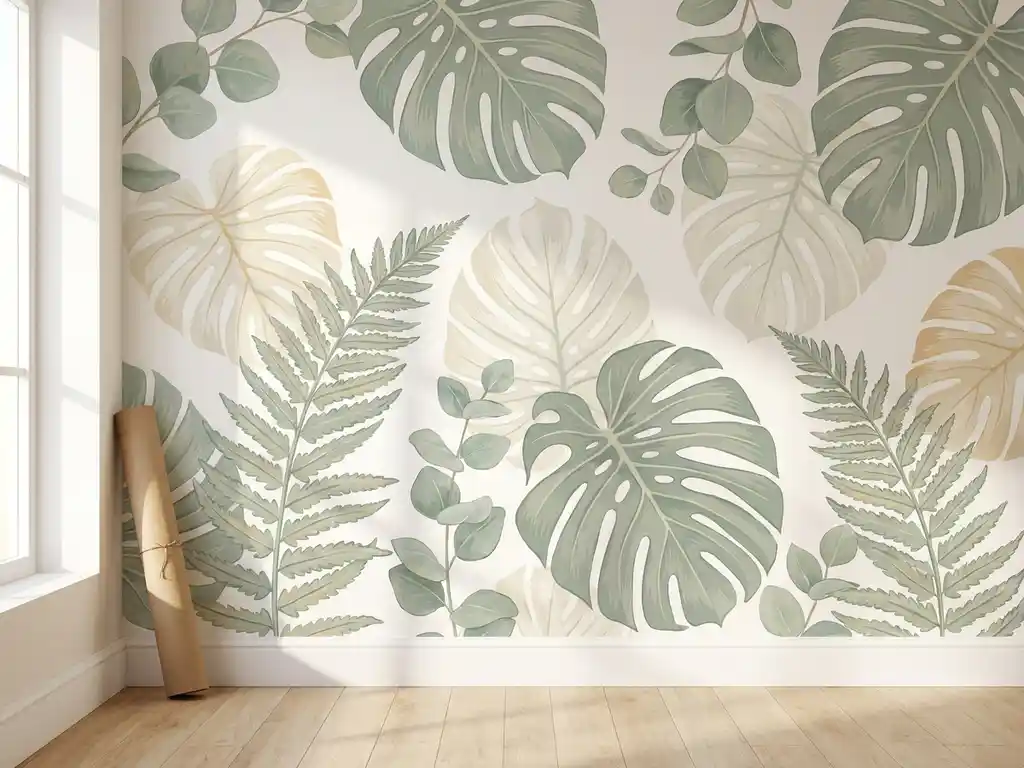
Eco-friendly wall design relies on PVC-free materials, solvent-free printing techniques, and certified print media that can be recycled or composted after use. For professional large-format printing, this specifically means: PVC-free films, non-woven wallpapers, and printable textiles replace conventional plastic materials without compromising on print quality. The following sections answer the most important questions regarding sustainable wall media, printing techniques, and economical use in everyday production.
Which materials are considered environmentally friendly for wall design?
Wall materials are considered eco-friendly if they do not contain PVC, are based on renewable or recycled raw materials, and can be cleanly disposed of after use. These include PVC-free self-adhesive films based on polyester, non-woven wallpapers made of cellulose and polyester fibers, and printable textiles. What matters is not only the raw material, but also the coating and the printing inks used.
In large-format printing, the following material groups have established themselves as particularly environmentally friendly:
- PVC-free self-adhesive films: Based on polyester or PP, free of chlorine-containing plasticizers, often recyclable
- Non-woven wallpapers: Made of cellulose and synthetic fibers, they can be processed without solvents and are easily removable without leaving residue.
- Printable textiles: Polyester or natural fiber fabric without PVC coating, suitable for latex printing
- Paper-based wall media: Fully recyclable, but less durable at high humidity
It is important that materials are environmentally friendly not only in their production, but also in their application: solvent resistance, easy processing, and clean disassembly without adhesive residue contribute to the overall balance.
What is the difference between PVC film and PVC-free film for walls?
PVC films contain polyvinyl chloride, which releases chlorine-containing compounds during production and disposal. PVC-free films instead rely on polyester, polypropylene, or other plastics without chlorine, which significantly reduces environmental impact throughout the product lifecycle. For wall applications, both variants are suitable for printing, but differ in disposal and certifiability.
Specifically, the difference means for practice:
- Disposal: PVC films must be treated as special waste; pure PVC-free monomaterials can be partially recycled in terms of material, but composite materials usually cannot.
- Certifications: PVC-free materials more easily meet requirements such as Blue Angel, REACH or Cradle-to-Cradle
- Indoor air PVC films can release plasticizers (phthalates), which is relevant for indoor applications.
- Print compatibility: PVC-free films are available today for solvent, latex, and UV printing and deliver comparable print results
For projects in public buildings, schools, or healthcare facilities, switching to PVC-free wall films is often not only ecologically sensible, but also required by regulations.
Are non-woven wallpapers really more sustainable than conventional foils?
Non-woven wallpapers are more sustainable than conventional PVC films in most application scenarios because they do not contain chlorine, require less adhesive, and can be removed from the wall without leaving any residue. For large-format printing, non-woven wallpapers also offer the advantage that they can be printed with water-based inks, which reduces emissions during the printing process.
The sustainability benefits of non-woven wallpaper at a glance:
- No PVC, no plasticizers, no chlorine-containing compounds
- Compatible with water-based and latex inks, which emit significantly fewer VOCs (volatile organic compounds) than solvent inks
- Easy disassembly without adhesive residue, which facilitates renovation work
- Many non-woven wallpapers are recyclable or can at least be disposed of in the residual waste bin
- Lower weight than PVC films, which relieves pressure on transport and logistics
A relevant note for practical application: The sustainability of a non-woven wallpaper also depends on the coating. Not every non-woven wallpaper is automatically environmentally friendly. Look for products without solvent-based coatings and with proven recyclability.
Which printing techniques are best suited for eco-friendly wall design?
For environmentally friendly wall decoration, latex printing and water-based inkjet printing are best suited because they do not require solvent-based inks and produce low VOC emissions. UV printing is also an option if solvent-free UV inks are used. Solvent printing is technically possible, but from an environmental perspective, it is the weakest choice for interior applications.
Latex printing
HP or Epson latex printers use water-based inks with latex polymers. The inks are low-odor, GREENGUARD-certified, and suitable for indoor use. Latex printing works well on non-woven wallpaper, PVC-free films, and textiles, delivering lightfast, durable results.
Water-based inkjet printing
Water-based inks have the lowest emission levels of all printing techniques. They are particularly suitable for non-woven wallpapers and paper-based wall media. The limitation: water-based prints are less water- and scratch-resistant than solvent or UV prints, which should be taken into account for heavily used wall surfaces.
How do you identify truly sustainable print media for wall applications?
Truly sustainable print media for wall applications can be identified by independent certifications, traceable raw material information, and a clear statement regarding disposal. Marketing terms like eco or green without evidence are not a reliable criterion. Meaningful certificates and technical data sheets are the more reliable benchmark.
You should pay attention to the following points when shopping:
- Certifications: Blue Angel, GREENGUARD Gold, Cradle-to-Cradle, or ISO 14001 are relevant certificates
- Material Declaration: The data sheet should transparently indicate raw materials, coating type, and plasticizer content.
- PVC-free: Explicit „PVC-free“ specification with proof, not just „environmentally friendly“
- Disposal instructions: Clear information on whether the material is recyclable or which waste category it belongs to
- Ink system compatibility: Sustainable media should work with water-based or latex inks
Ask your supplier specifically for safety data sheets and certificates. A reputable provider will provide this information without any unnecessary delays.
How can environmentally friendly wall media in large format printing be used economically?
Environmentally friendly wall media can be economically used when you coordinate material, printing technology, and application case. PVC-free alternatives cost a little more at the time of purchase, but they reduce disposal costs and allow access to tenders that require sustainability proof. In the long run, the calculation is often cheaper than it seems at first glance.
Practical approaches for economic use:
- Material selection based on usage duration: For short-term installations, lighter, more affordable PVC-free films are sufficient; for long-term projects, more robust vinyl wallpaper is worth considering.
- Adjust printer ink settings: Latex printers that you already use are directly compatible with most PVC-free wall media.
- Calculate disposal costs: PVC-free materials save on disposal, which becomes visible in the overall calculation
- Certified materials as an argument: Customers from the public sector, the education sector or the healthcare sector are actively seeking sustainability certificates
- Standardization in the range: Few, well-tested sustainable media reduce lead times and risk of complaints
Switching to sustainable wall media doesn't have to come at the expense of margins. With the right material selection and clear communication with your customers, sustainability becomes a competitive advantage.
PVC-free wall design with com2C: PVC-free media developed in-house
We develop and produce printing media for large-format printing that function technically – many of them PVC-free. Our GoGreener line includes PVC-free materials for wall applications, which we test in our own laboratory and continuously develop.
For wall design projects, we offer, among other things:
- Self-adhesive wallpaper PVC-free For direct wall bonding without adhesive, removable without residue
- Non-self-adhesive wallpaper PVC-free For classic tile installation applications with water-based adhesives
- Self-adhesive textile PVC-free for textile wall decoration with a soft feel
All materials are compatible with latex, UV and water-based printing systems from HP, Epson, Roland, Mimaki and other leading manufacturers. We not only supply the material, but also provide technical advice on the correct printing settings, profiling and processing.
If you would like to integrate PVC-free wall media into your production and have specific questions about material selection or print compatibility, please feel free to contact us. contact us It is worth doing before you invest.