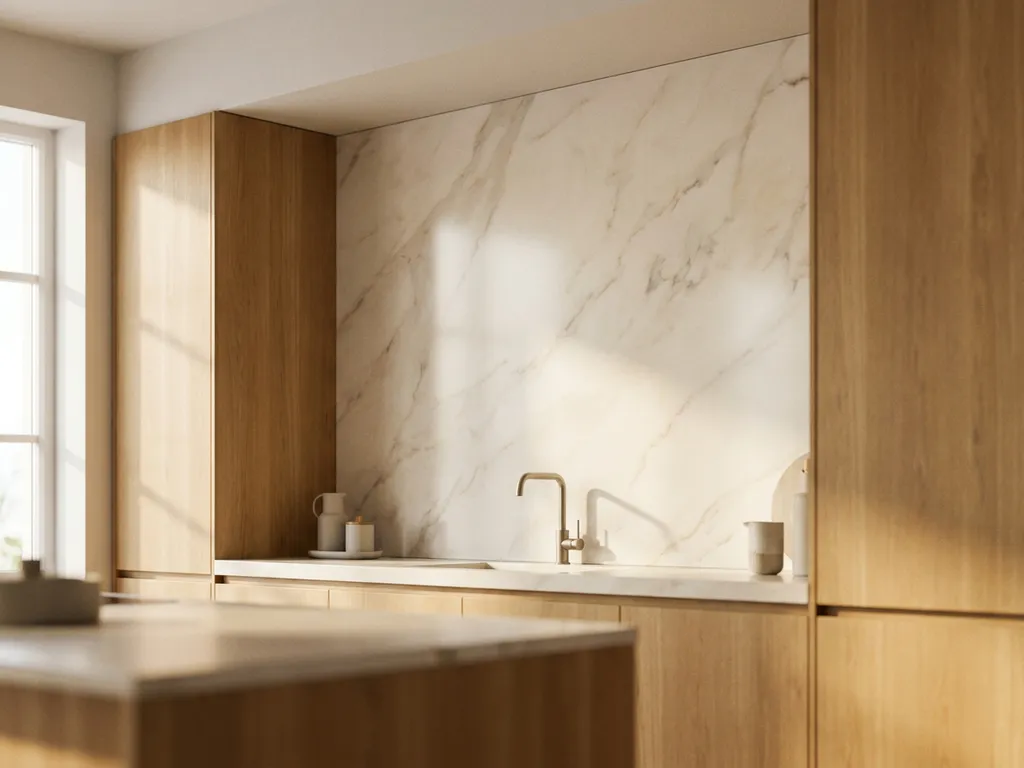
The kitchen backsplash is one of the most-used surfaces in the entire living area. Grease, steam, splashes of water, and daily cleaning routines place high demands on the material. At the same time, the backsplash behind the stove or work surface is a design focal point of the kitchen that significantly shapes the overall impression of the room.
Anyone who wants to redesign a kitchen backsplash faces a multitude of material options: tiles, glass, acrylic, natural stone, or self-adhesive film. Which material is the right one depends on the structural conditions, the usage patterns, and not least on whether it is a rental property. This article guides you step by step through the most important decision-making criteria.
What requirements must a kitchen backsplash meet?
Before choosing a material, it is worth clearly defining the functional requirements. A kitchen backsplash must first and foremost be wipe-resistant and moisture-resistant. Grease splashes from frying, steam from cooking, and occasional water droplets are part of everyday life.
In addition, heat resistance plays a role, especially in the area directly behind the stove. Temperatures can be generated here that permanently damage sensitive materials. A material that is visually beautiful but shows discoloration or peeling after just a few months is not a good choice.
Another requirement applies to rental apartments: The material must be easily removed without damaging the underlying wall or the existing tiles. Many tenants shy away from permanent interventions in the building structure because they are obliged to restore the original state when they move out.
- Moisture resistance: The material must withstand spray water and steam without swelling or separating.
- Heat resistance: Especially in the heating sector, temperatures of 60 to 80 degrees Celsius are not uncommon.
- Cleaning friendliness: Smooth, closed surfaces are easier to clean than porous or textured materials.
- Reversibility: For tenants, the ability to remove the waste without leaving any trace is an important criterion.
- Optical quality: The back wall should match the overall design of the room and look appealing on a long-term basis.
Which materials are suitable for the kitchen backsplash?
There are several established materials on the market for kitchen backsplashes, which differ significantly in terms of processing, cost, appearance, and suitability for different situations.
Ceramic tiles
Tiles are the classic solution. They are extremely robust, heat-resistant, and durable. The disadvantage lies in the complex manufacturing process: installing them requires skilled craftsmanship, and the joints can turn yellow or mold over time. For tenants, this option is usually ruled out, as installing tiles involves a permanent alteration to the building structure.
Glass and acrylic
Glass back panels are high-quality and very easy to clean. They are heat-resistant and offer a sealed surface without gaps. However, installation is time-consuming, and custom-made glass panels are comparatively expensive. Acrylic is a cheaper alternative, but less scratch-resistant and not as heat-resistant as real glass.
Natural stone and composite panels
Materials such as slate, marble or compact slabs made from mineral materials are visually appealing but are heavy, expensive and also only feasible with a fixed installation.
Self-adhesive films
Self-adhesive kitchen films have evolved considerably in recent years. High-quality digital printing films allow for individual designs, can be applied to existing tiles or smooth walls, and can be removed without leaving any residue. This makes them particularly attractive for rental properties.
Self-adhesive films as kitchen back panels: functionality and construction
Self-adhesive kitchen film consists of several layers that together provide the necessary properties for the kitchen area. Understanding this structure helps you better assess the quality of a product.
The carrier film forms the base and determines the mechanical properties such as tear resistance and dimensional stability. It is topped with a glue layer, the quality of which determines how well the film adheres and whether it can be removed without leaving any residue later on. For printed films, an inkjet coating is added that absorbs the printing ink and ensures precise, color-accurate reproduction. A final lamination protects the print from moisture, cleaning agents, and mechanical stress.
The following properties are particularly relevant for use as kitchen back panels:
- Heat resistance of the adhesive layer: Cheap films can peel off in the heating range when exposed to heat. High-quality products are designed for temperatures up to 80 degrees Celsius.
- Moisture-resistant lamination: A closed surface prevents moisture from penetrating the film.
- Air channels in the adhesive layer: Modern films feature a structured adhesive layer that facilitates bubble-free assembly.
- PVC-free materials: They are recommended for living spaces self-adhesive films without harmful plasticizers, Because they do not contain any harmful plasticizers.
Film, glass or tiles: Which material suits which situation?
No material is universally the best. The right choice depends on your specific situation. Three questions can help narrow down the options: Is it a rental apartment? How much is the budget? And how important is an individual design to you?
Tiles are the most durable long-term solution for owners who plan for the long term and aren’t afraid to do the work themselves. Glass is ideal for anyone who prefers a low-maintenance, seamless surface and is willing to invest more. Self-adhesive films are the most flexible option: they can be quickly installed, individually printed, and removed if needed.
For rental properties, the film is in most cases the only practical option that does not require any structural changes. Applied to existing tiles, it fundamentally changes the appearance of the kitchen without damaging the tiles themselves. Upon removal, the film can be removed without leaving any residue.
- Rental apartment, no budget for tradespeople: Self-adhesive film on existing tiles
- Apartment, mid-range budget: Glass back panel or high-quality film with lamination
- New construction or core renovation: Tiles or compact slabs as a permanent solution
- Customized design requested: Printed digital printing film, customized
Typical mistakes in material selection and how to avoid them
When choosing the right material for the kitchen backsplash, there are some mistakes that can easily be avoided with some background knowledge.
Error 1: Underestimating heat resistance. Many buyers choose a foil without checking whether the adhesive layer is suitable for the area directly next to the stove. The result: The foil peels off at the edges after a few weeks. Be sure to check the manufacturer’s information regarding temperature resistance and maintain a minimum distance of 10 to 15 centimeters from open flames.
Mistake 2: Not preparing the substrate properly. A film only adheres as well as the substrate on which it is attached. Grease, dust, or loose paint prevent reliable adhesion. Clean the surface thoroughly and allow it to dry completely before starting assembly.
Error 3: Using cheap films without lamination. Unprotected printing surfaces are not suitable for the kitchen area. Cleaning agents and moisture damage the print within a short time. High-quality lamination is not an optional extra, but a basic requirement for the kitchen area.
Mistake 4: Calculate measurements incorrectly. Anyone who measures the back panel area too narrowly has no room for overlaps or adjustments during assembly. Plan for an overlap of at least two centimeters on all sides.
Finding the right material: step by step to the decision
With the basic principles developed so far, you can now proceed in a systematic manner. The following step-by-step logic will guide you to the correct material choice for your specific situation.
- Clarify usage situation: Apartment rental or ownership? Permanent solution or temporary arrangement? This question excludes certain materials from the outset.
- Check substrate: Are there any existing tiles that can be covered with a film? Is the wall smooth and clean? Rough plaster or highly textured surfaces require special measures.
- Identify the range of temperatures: Mark the area with direct heat exposure. Higher requirements apply here regarding the heat resistance of the material.
- Set design requirements: Do you want an individual design, a uniform color scheme, or an imitation of natural stone or concrete? Printed digital printing films offer the greatest freedom of design in this regard.
- Check the material quality: Ask about laminating, temperature resistance, and whether the material is PVC-free. Any reputable supplier should be able to provide this information.
- Appreciate the assembly realistically: Are you willing to handle the installation yourself, or do you need assistance from a signage technician or interior designer? High-quality films can usually be installed by skilled DIYers if the surface is well prepared.
Anyone who follows these steps consistently will make a well-informed decision that not only looks impressive but also works reliably in everyday life.
Kitchen backsplashes with com2C: Materials that work in practice
We at com2C We develop and produce digital printing films that are specifically designed for demanding applications such as kitchen backsplashes. Our goal is not to offer as many products as possible, but to provide materials that reliably function in practice.
What we specifically bring to this area of application:
- Self-adhesive films with heat-resistant adhesive coating, suitable for the area next to and behind the stove
- Moisture-resistant laminates that withstand detergents and steam
- PVC-free materials from our GoGreener range for a healthy living space
- Precise inkjet coatings from our own laboratory for true-to-color, detailed print reproduction
- Customized solutions that are tailored to your exact dimensions and design ideas
- Technical advice that helps you find the right material for your specific substrate and usage situation
If you are unsure about which material is best suited for your kitchen backsplash, we are happy to help you. Simply Contact, and we discuss together which solution suits your situation.