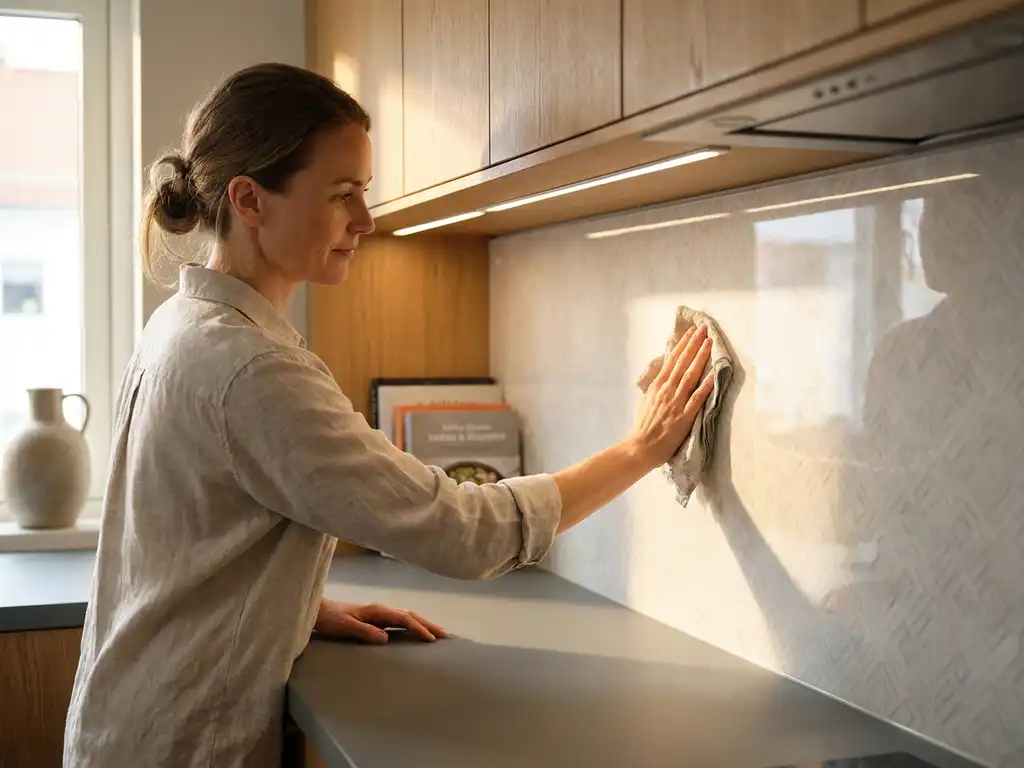
The easiest to maintain are kitchen fronts without gaps and with a smooth, water-repellent surface. Self-adhesive films, glass and composite panels cut particularly well here, as grease and splashes can be wiped away without a trace with a damp cloth. The following sections explain what really matters when it comes to maintenance and which solution is best suited for your situation.
Which material is the easiest to clean on kitchen backsplashes?
Seamless materials with a smooth surface are the easiest to clean on kitchen backsplashes. These include glass, acrylic panels, composite panels, and self-adhesive foils. All of these options can be wiped clean with a damp cloth or a mild household cleaner without allowing dirt to penetrate the crevices or joints.
Tiles are robust, but their joints are the real problem when it comes to maintenance. Oil, cooking spatter, and steam can build up there and are only removed with a brush and special cleaner. Anyone who wants to avoid this effort should opt for a continuous, seamless surface.
Self-adhesive films have significantly improved in quality in recent years. High-quality digital printing films with protective laminate are water-repellent, heat-resistant, and can be cleaned with commercial cleaning agents without the surface becoming dull or the colors fading.
Why are gaps around kitchen backsplashes a maintenance problem?
Sealing gaps around kitchen backsplashes is a maintenance problem because they provide a porous surface where grease, lime deposits, and food scraps can settle. Even freshly sealed gaps lose their protective effect over time and turn yellow or gray, which is visually and hygienically disturbing.
When cooking, a combination of heat, steam, and fat particles forms in the kitchen. This mixture penetrates open-pore grout, especially when the sealing is compromised. Regular re-sealing helps, but is time-consuming and must be carried out consistently.
Mold formation in joints is another problem that occurs especially in poorly ventilated kitchens. Moisture residues after cooking or washing up provide ideal conditions for mold spores. Once infected, joints are difficult to clean completely without mechanically removing them and refitting them.
How do you clean a self-adhesive kitchen backsplash film properly?
To clean a self-adhesive kitchen backsplash film, use a soft, slightly damp microfiber cloth and a mild all-purpose cleaner. Avoid abrasive cleaners, scouring pads, and solvent-based cleaners as they can damage the laminate’s protective layer and permanently damage the surface.
Fresh cooking splashes can be wiped up immediately with a damp cloth, leaving no residue. For dried-on fat, a commercially available water-based kitchen cleaner usually suffices. It is important to briefly wipe the foil dry after cleaning to prevent water marks from forming.
Pay special attention to the edges and transitions of the film. Moisture can penetrate there if the film is not properly glued. You can gently press down on the dissolved edges with a fingernail or a soft object before water seeps in.
Is a kitchen backsplash made of foil suitable for heat and steam?
Yes, high-quality kitchen backsplash films are suitable for use behind the stove and sink, provided they are specifically designed for this purpose. It is crucial that the film has sufficient heat resistance and is equipped with a protective laminate that resists steam and moisture.
Very high temperatures are created briefly just behind a gas stove or an induction hob. Simple decorative films from the DIY store are often not designed for this purpose. Professional digital printing films with the appropriate coating, however, can withstand continuous temperatures of up to 80 to 90 degrees without warping, turning yellow, or peeling off.
Steam is another burden that many underestimate. People who cook every day expose the back wall to high humidity on a regular basis. A film with a water-repellent surface and cleanly glued edges reliably protects the wall behind it, as long as the bonding was done properly.
Which kitchen backsplash is best for a rental apartment?
A self-adhesive film is best suited for renting an apartment, as it can be removed without leaving any residue, without damaging the underlying surface. It does not alter the building structure, can be completely removed upon removal, and leaves no adhesive residue on tiles or painted walls.
Glass or composite panels would also be easy to maintain, but they require installation with screws or strong adhesive, which is problematic in rental apartments. Tiles are also not an option, as installation involves structural work that usually requires the consent of the landlord.
Self-adhesive films also offer the advantage of being individually printed. This allows for the realization of motifs, colors, or patterns that perfectly match one’s own interior style, without being permanently fixed. Those who are moving or want to change their style can simply peel off the film and redesign it.
What does a low-maintenance kitchen backsplash cost in comparison?
The cost of a maintenance-friendly kitchen backsplash varies significantly depending on the material. Self-adhesive films are the cheapest option and range from the two-digit to the low three-digit range per typical kitchen backsplash depending on quality and printing. Glass panels and composite panels cost significantly more but offer a longer lifespan.
Cost overview by material
- Self-adhesive film (printed): Affordable entry point, individually customizable, easily removed without leaving any residue. Ideal for renters and anyone who wants to remain flexible.
- Composite panels (e.g. Alu-Dibond): Robust and durable, but more expensive to purchase and install. Well suited for owners.
- Glass panels: High-quality optics, very easy to maintain, but relatively expensive and difficult to install.
- Tiles: Economical in material terms, but with high assembly costs and complex maintenance due to gaps.
Realistically assess total costs
When comparing costs, you should not only consider the material price, but also factor in assembly, maintenance, and any dismantling costs. A film that you can install yourself and remove without residue if necessary is often the most economical solution in the overall bill, especially in rental apartments.
Kitchen backsplashes from com2C: Quality that works in everyday life
At com2C, we develop and produce digital printing media that serve as the basis for high-quality, individually printed kitchen backsplashes. Our foils are processed by specialized printing service providers and advertising technicians and offered as finished end products. What is important to us in this process: The materials must work in practice, not just on paper.
Our Kitchen backsplashes are specifically designed for use in kitchens:
- Heat and steam resistant: Suitable for the area behind the stove and sink, even during daily cooking operations.
- Seamless surface: No dirt can settle in the crevices; cleaning with a damp cloth is sufficient.
- Removable without residue: Ideal for rental properties, without leaving any damage to the underground infrastructure.
- Individually printable: Every motif, every color, every format, precisely implemented by our printing partners.
- PVC-free material options: On request from our GoGreener line without PVC.
If you have questions about materials, application possibilities or the right solution for your kitchen, we are happy to help. contact us It is worth it; we are helping in a concrete way and without any unnecessary delays.