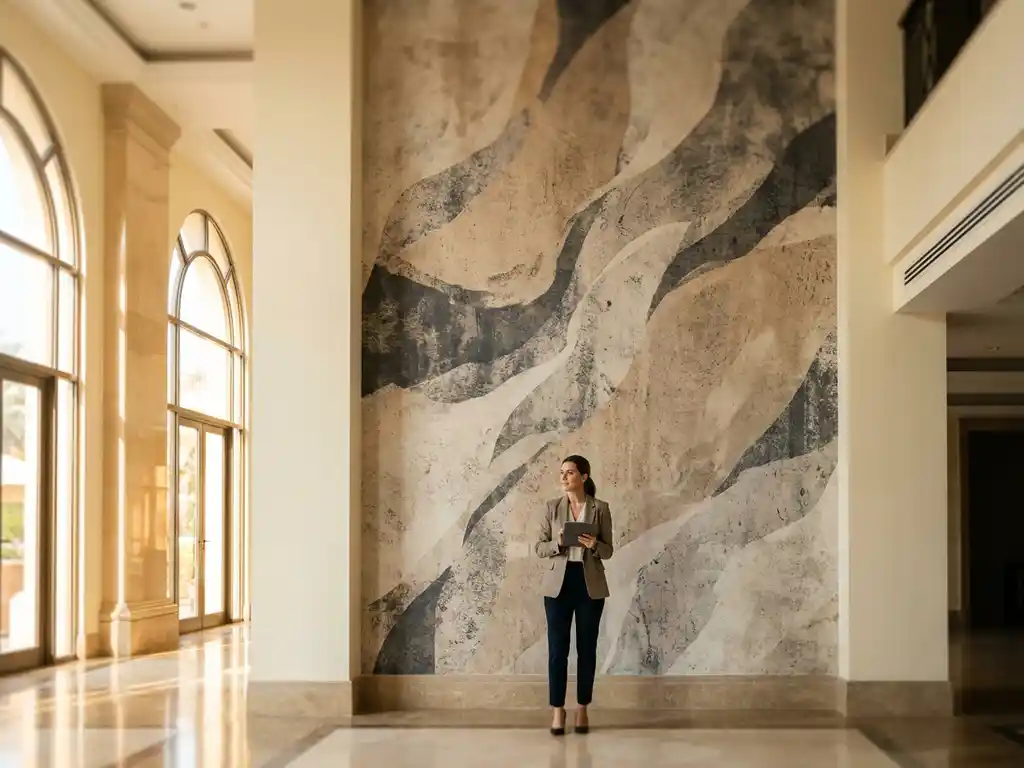
Non-woven wallpaper is the better choice if you want to enhance walls aesthetically, conceal imperfections, or print large-format designs. Wall paint is suitable for simple, uniform surfaces, but quickly reaches its limits with sophisticated designs or textured substrates. This article answers the most important questions about non-woven wallpaper compared to wall paint and shows when which material is the right decision.
What are the advantages of non-woven wallpaper compared to wall paint?
Non-woven wallpaper offers clear advantages over wall paint, especially when it comes to design variety, processing quality, and durability. It enables photorealistic motifs, reliably covers uneven walls, and can be removed without leaving any residue. Wall paint cannot achieve any of this.
In detail, the following points speak in favor of non-woven wallpaper:
- Creative freedom Non-woven wallpaper carries any motif you can print. Whether a corporate logo, landscape photography, or abstract pattern, the print quality is unachievable with wall paint.
- Concealment of wall imperfections: The non-woven backing material smooths out minor unevenness, cracks, and uneven surfaces. Wall paint tends to visually emphasize such flaws rather than hide them.
- Simple renewal: Non-woven wallpaper can be dry-peeled without leaving any residue. This is a real practical advantage, especially for rental properties, exhibition spaces, or frequently changing room concepts.
- Stability in large-format printing: Non-woven material barely warps during printing, absorbs ink evenly, and dries quickly. This results in clean, color-accurate results even on large areas.
- Acoustic effect: Thicker non-woven wallpapers measurably dampen sound. In offices, conference rooms, or hospitality establishments, this is a useful side effect.
When is wall paint the better choice?
Wall paint is the better choice if you want to create a uniform, single-colored surface without a motif and the substrate is already smooth and even. It is quick to apply, cost-effective, and fully sufficient for many standard applications.
Specifically, wall paint appeals when:
- no design requirements going beyond a primary color
- the wall is in very good condition and does not require lamination
- frequent color changes are planned that need to be implemented quickly and cost-effectively
- the room is only supposed to have a specific look for a short period of time
- no printing equipment or processing effort for wallpaper is available
For private households without any special design requirements, wall paint remains the most practical solution. As soon as brand communication, interior design concepts, or individual visual motifs come into play, however, wall paint quickly loses its relevance.
For which rooms and applications are non-woven wallpapers particularly suitable?
Non-woven wallpaper is particularly suitable for commercial spaces, exhibition areas, offices, and hotel lobbies where design and brand presence play a role. It is also a proven solution in trade fair construction, retail stores, and temporary spatial installations.
Commercial and public spaces
In reception areas, conference rooms, and retail spaces, non-woven wallpaper communicates brand identity directly via the wall. Large-scale motifs, company logos, or mood-setting photographs can be implemented precisely and reproducibly. This looks more professional than any wall paint and can be easily replaced if needed.
Exhibition stand construction and temporary installations
Non-woven wallpaper has been a standard material in trade fair construction for years. It is quick to apply, reliable to remove, and leaves no residue. This saves time during assembly and dismantling and protects rented spaces. For events with changing themes or seasonal campaigns, this is a clear advantage over permanent solutions.
Living spaces with sophisticated design
Non-woven wallpaper is also gaining popularity in private spaces, especially as an accent wall with a custom motif. Children's rooms, living rooms, and bedrooms benefit from the opportunity to bring personal images or design patterns onto the wall in high quality without being permanently committed.
How are non-woven wallpapers processed and applied in large-format printing?
In large-format printing, non-woven wallpaper is printed on roll printers that use latex, UV, or water-based inks. The material is dimensionally stable, runs straight through the printer, and delivers consistent results. Installation is done using wallpaper paste applied directly to the wall.
The typical processing workflow looks like this:
- Prepress: The file is being prepared for large-format printing. Color profiles, resolution, and web width are adjusted to match the material.
- Pressure The non-woven material is printed on the large-format printer. Good non-woven wallpapers are compatible with common printers from HP, Epson, Roland, Mimaki, or Durst and are suitable for various ink systems.
- Assembly The printed panels are cut to size and prepared for installation.
- Wall preparation: The wall must be clean, dry, and structurally sound. Major unevenness should be leveled out beforehand.
- Glue application: With non-woven wallpaper, the paste is applied to the wall, not to the wallpaper. This significantly simplifies the application and prevents the material from stretching.
- Installation: The lengths are placed butt-jointed. Non-woven wallpaper is easy to shift and adjust as long as the paste is still fresh.
An important practical note: The quality of the coating on the non-woven material directly influences how well the ink adheres and how color-accurate the result will be. Not every non-woven material is equally well-suited for every printer or ink system.
Are there sustainable alternatives to conventional non-woven wallpaper?
Yes, there are sustainable alternatives to conventional vinyl wallpaper. PVC-free vinyl wallpaper based on polyester or natural fibers offers comparable print properties, but is free of PVC and plasticizers. It is suitable for all common ink systems and meets the requirements of modern large-format printers.
Traditional non-woven wallpapers often contain plastic components or are provided with coatings that are problematic during disposal. PVC-free alternatives avoid these ingredients and can in many cases be recycled or composted. For companies pursuing sustainability goals or aiming for corresponding certifications, this is a relevant factor in material selection.
What to look for in sustainable non-woven wallpapers:
- PVC-free: Ensure that the backing and coating do not contain any PVC components.
- Ink compatibility: Sustainable materials must print just as reliably as conventional ones. Test ink adhesion and drying behavior in advance.
- Certifications: Materials with GREENGUARD or similar certifications are tested for indoor use and provide safety when used in sensitive environments such as schools or hospitals.
- Disposal method: Clarify whether the material must be recycled after use or disposed of in the residual waste.
Non-woven wallpaper for large-format printing: com2C supports you in material selection
We know from daily practice that choosing the right fleece material can have a significant impact on the outcome of a printing project. Therefore, we have specifically aligned our product range to the requirements of professional large-format printers, with a special focus on quality, print compatibility, and PVC-free materials.
Our PVC-free non-woven wallpaper from com2C are specially developed for digital wide-format printing and are compatible with standard printers and ink systems. What is important to us in this regard:
- All our vinyl wallpapers are PVC-free – an alternative to conventional PVC materials
- We develop and coat our media in our own laboratory, which gives us direct control over quality and print properties
- Our materials are compatible with latex, UV and water-based ink systems from leading printer manufacturers.
- We provide technically sound advice on which material is best suited for your printer, your ink, and your application.
- For special requirements, we develop individual solutions together with you
If you are unsure which non-woven wallpaper is the right one for your next project, please contact us. We will be happy to help you., Contact It's worth it.