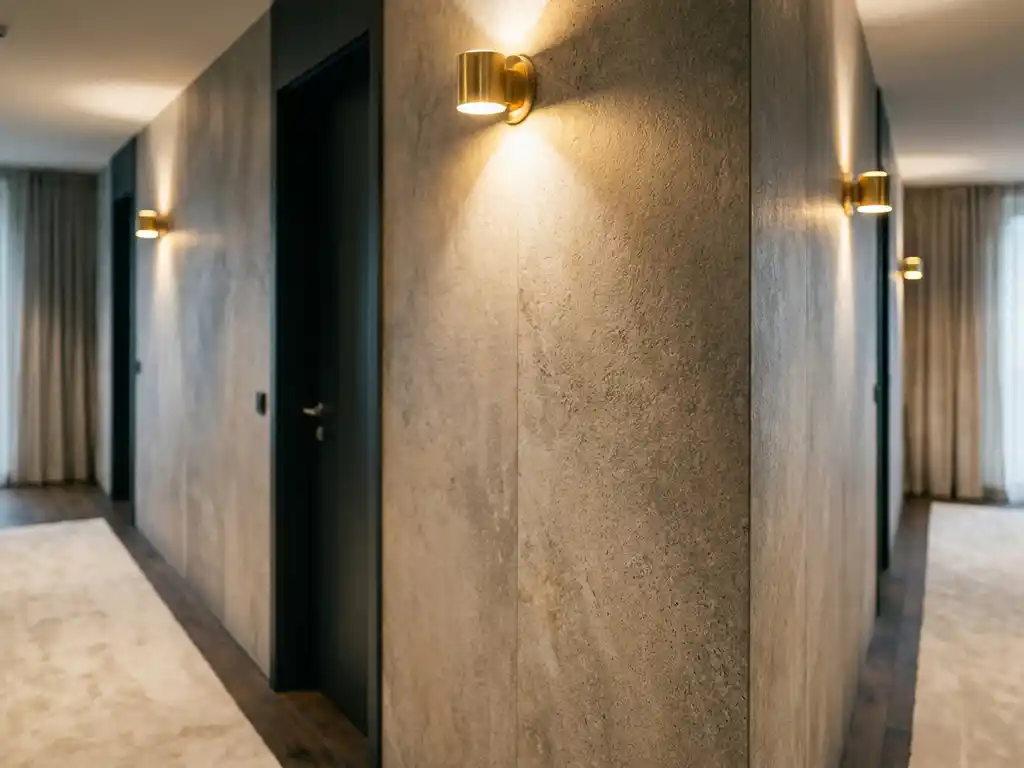
Hotel floors must generally have at least the fire safety class B1 (highly flammable) In accordance with DIN 4102, more stringent requirements often apply in escape routes and public areas. The specific class that is required depends on the state, the building class, and the specific area within the hotel. This article answers the most important questions about fire safety classes, wall materials, and the documentation for hotel designs.
Which standards set the fire protection requirements for hotel walls?
The fire safety requirements for hotel walls are regulated in Germany by the model building regulations (MBO), the respective state building regulations (LBO), and the model accommodation facility regulations (MBeVO). These regulations define which fire safety classes wall surfaces must comply with, depending on building class, use, and area.
In addition, two technical standards are central: DIN 4102 This is the classic German classification system for the fire behavior of building materials. In parallel, the European standard has been in effect for several years. EN 13501-1, These systems divide building materials into Euro classes and are increasingly used as a reference in tenders and approvals. Both systems exist side by side, and many product certificates now display both classifications.
For hotels as special structures, stricter requirements apply compared to residential buildings. The MBeVO sets detailed requirements for construction materials, escape routes, and fire zones for accommodation facilities with a certain number of beds. Anyone who designs or renovates a hotel should involve the competent building authority and, if necessary, a fire protection expert early on.
What do the fire protection classes B1, B2 and Euro classes mean for wall materials?
According to DIN 4102, building materials are divided into three classes: B1 (highly flammable), B2 (normally flammable) and B3 (slightly flammable). For wall surfaces in publicly used buildings such as hotels, at least B1 is required. B3 materials are generally not permitted in the construction sector.
The European Euro classes according to EN 13501-1 offer a finer gradation:
- A1 and A2: non-combustible or very low-flammable, typical of mineral materials and metals
- B: Very limited fire spread, approximately equivalent to B1 according to DIN 4102
- C and D: limited or acceptable fire spread, roughly corresponds to B2
- E and F: slightly flammable; not classified; not suitable for hotel walls
In addition to the main class, the Euro classes also take into account smoke development (s1, s2, s3) and burning droplets (d0, d1, d2). For wall materials in hotels, in addition to flame spread, smoke development is particularly relevant, since dense smoke blocks escape routes and increases the risk to people. A material with the classification B-s1,d0 is considered very safe: limited smoke spread, minimal smoke development, no burning droplets.
Which fire safety class is required in which hotel area?
The requirements for the fire protection class of wall surfaces vary depending on the area of the hotel. As a general rule of thumb, the higher the usage of an area as an escape route or a publicly accessible area, the higher the requirements.
Corridors, stairwells and escape routes
In hallways, stairwells and necessary escape routes, most state building codes and the MBeVO require class Wandovers. B1 according to DIN 4102 or at least Euro class C-s2,d1, These areas must remain smoke- and flame-free for as long as possible in the event of a fire, so that people can safely leave the building.
Hotel rooms, lobby and public areas
In hotel rooms, B1 is generally also required, although the exact requirements may vary depending on the state and building class. Similar requirements apply in the lobby, restaurants, and conference rooms, as these areas are used by many people simultaneously. For decorative wall designs, wallpaper, and film in these areas, this means that standard materials without a fire safety certificate are generally not permitted.
Do printed wall foils and vinyl wallpaper meet the fire safety requirements?
Yes, printed wall panels and vinyl wallpaper can meet the fire protection requirements for hotels if they are certified accordingly. The key is that the material itself, not just the substrate, demonstrates the required fire protection class. A product is only considered B1 compliant if it has been tested and certified as a complete system.
At Vinyl wallpaper B1 certified variants are available on the market and are specifically designed for use in hotels, offices and public buildings. Important: The adhesive used to apply the wallpaper must also be fire-resistant. An untested adhesive system can render the certification of the wallpaper material ineffective.
At self-adhesive wall foils The same principle applies to printable film for wall decoration. Products intended for use in public buildings are supplied with corresponding fire safety certificates. When purchasing, be sure to ask about the fire safety certificate and check whether the certification applies to the intended use, i.e., for wall mounting and not just for other installation situations.
Printability and fire protection are not mutually exclusive. Many materials suitable for digital large-format printing are now offered with B1 certification. The printing itself usually does not alter the fire protection properties, provided that solvent-free or water-based inks are used.
How is the fire safety certificate for wall designs in the hotel provided?
The fire protection certificate for wall materials in the hotel is provided by a valid inspection certificate or a general building inspection certificate (abP), issued by an accredited inspection body. This document certifies that the material meets the required fire protection class under defined testing conditions.
The following steps are relevant in practice:
- Request product documentation: Require the supplier to provide the full test certificate, not just a product description with class ratings. The certificate must specify the tested application, the substrate and, if applicable, the adhesive system.
- Check application compliance: Does the tested installation situation match your intended use? A certificate of approval for a specific wall construction does not automatically apply to every other construction.
- Keep documentation: As part of the building permit or during inspections by the building department, you must be able to prove which materials were installed. Keep inspection certificates, delivery receipts, and product data sheets carefully stored.
- Involving fire protection experts: For larger projects or uncertainties, it is recommended to consult with an accredited fire protection expert who assesses the material selection in the context of the overall concept.
What happens if the wall materials in a hotel do not have the correct fire protection class?
If wall materials in a hotel do not meet the required fire protection class, legal, financial, and safety consequences threaten. In the worst case, the wall design must be completely removed and replaced, which causes significant costs and operational disruptions.
In particular, the following consequences may occur:
- Building regulations: The competent authority may order the removal of non-compliant materials and impose a use ban until the appropriate condition is restored.
- Insurance-related consequences: In the event of damage, the insurance company may refuse to provide services or reduce the coverage if it is proven that unauthorized materials were installed.
- Liability risks: Operators, planners, and contractors can be held personally liable in the event of a fire damage if the cause can be traced back to non-compliant materials.
- Reputation damage: Official inspections and findings of deficiencies can become public and have a lasting impact on the reputation of the hotel.
The consequences show: fire protection on wall surfaces is not a bureaucratic formality, but a central component of safe hotel operations. By relying from the outset on certified materials and maintaining meticulous documentation, one avoids time-consuming follow-up work and protects guests, employees, and the business.
Fire-resistant wall design with com2C
We know that hotel design is much more than aesthetics. Materials must be technically reliable, meet regulatory requirements, and at the same time make the brand identity of the hotel visible. This is exactly where we can help you.
Our Interior Film Collection Includes wall films and printable materials specially developed for use in public buildings, including products with B1 certification according to DIN 4102. What we specifically provide for your hotel project:
- Material advice based on the applicable fire safety requirements of your state
- Providing complete test certificates and technical documentation for your documents
- Adjust the settings on your printer and ink system to ensure compatibility between printability and fire safety
- Quick response in ongoing projects when materials need to be changed or supplemented at short notice
If you are planning a hotel project and want to ensure that your wall materials meet all requirements, please feel free to Contact. We help you make the right choice before it becomes expensive.