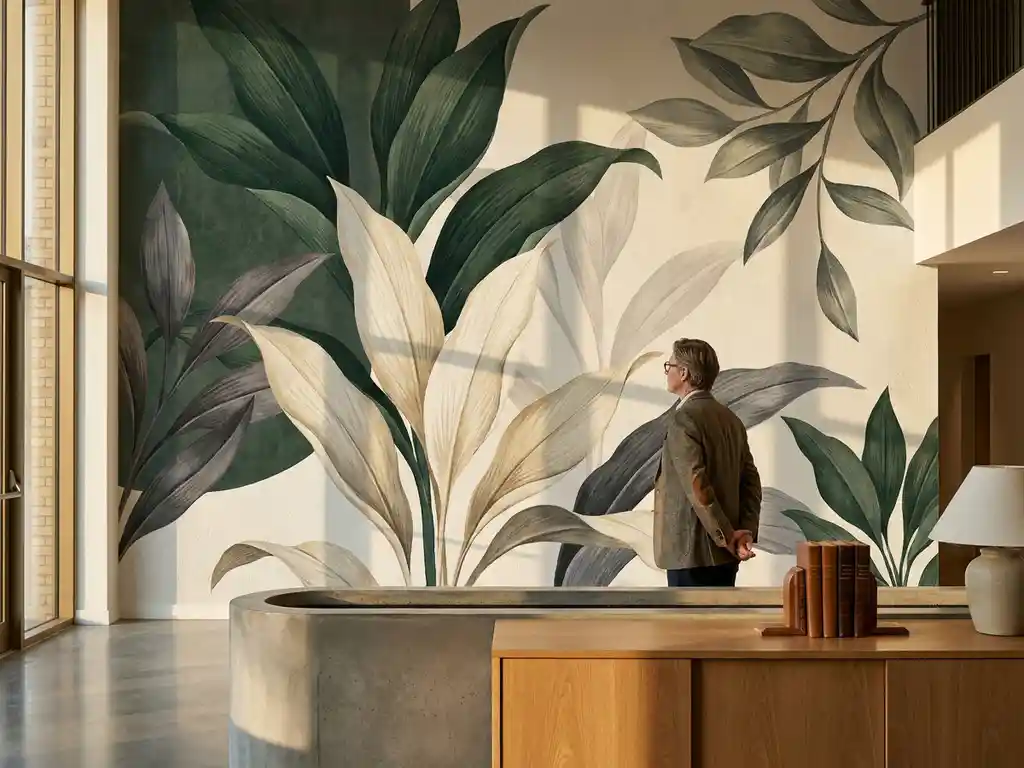
Whether wallpaper or wall paint is the better choice depends on the desired look, the substrate, the use of the space, and the technical requirements. Both solutions have specific strengths and limitations. This article compares wallpaper and paint based on specific characteristics and helps you make the appropriate decision for different applications.
What are the fundamental differences between wallpaper and wall paint?
Wallpaper and wall paint differ fundamentally in their material structure, processing, and surface effect. Wall paint is applied in liquid form and forms a thin, smooth, or slightly textured layer on the substrate after drying. Wallpaper, on the other hand, is a standalone surface material that is applied to the wall and offers a significantly more pronounced surface texture and more diverse design options.
Wall paint is particularly suitable for smooth, well-prepared surfaces. It is easy to apply, dries quickly and allows for easy color changes. Wallpaper, on the other hand, can conceal unevenness, cracks and irregular wall surfaces without the need for complex preparations such as priming. This makes wallpaper a more practical solution in many renovation situations.
Another essential difference lies in the depth of design. Wall paint offers almost unlimited color choices, but a flat, two-dimensional effect. Wallpaper, through its structure, patterns, textures, and in the digital printing area also through individual image motifs, enables a significantly more three-dimensional and varied wall design.
What material properties do different types of wallpaper have?
The market offers a wide selection of wallpaper types, which differ significantly in material, surface, processing, and application area. Choosing the right type of wallpaper depends on the requirements of the specific room and the desired look.
Overview of wallpaper types
- Non-woven wallpapers: Consists of a mixture of polyester and cellulose fibers. They are form-stable, tear-resistant, and can be removed from the wall dry. Vinyl wallpaper is applied to the wall dry during installation, while the adhesive is applied directly to the wall. This greatly simplifies the process.
- Paper wallpaper: The classic wallpaper format is lightweight and easy to install. They are less durable than vinyl wallpaper and are more sensitive to moisture. Suitable for low-traffic living spaces.
- Vinyl and plastic wallpaper: Very robust, washable and moisture resistant. Often used in kitchens, bathrooms and commercial areas with high demands.
- Natural fiber wallpaper: Surfaces made of grass, jute, sisal or bamboo on a paper or vinyl backing. They offer a distinctive, natural texture but are less moisture-resistant and more difficult to clean.
- Digital printing wallpaper: Media specially designed for large-format printing that allow for individual motifs, photographs, or graphics on wall surfaces. Available in various substrate materials, including PVC-free vinyl wallpaper.
How are processing and work steps different?
The processing of wall paint is usually less time-consuming than wallpapering, but requires a carefully prepared substrate. Cracks, holes, and unevenness must be patched and sanded before painting. Subsequently, in most cases, a primer is applied before the actual paint is applied in one or more coats.
In the case of wallpapering, the time-consuming preparation of the substrate is often eliminated, as the wallpaper covers up minor wall imperfections. With vinyl wallpaper, the adhesive is applied to the wall, the tape is cut to size and applied. This reduces the time required and facilitates precise application, especially for large-format tapes. Paper wallpaper, on the other hand, must be soaked or painted, which makes the process more demanding.
Professional large-format printing adds additional requirements. Printed wallpaper panels must be aligned precisely, bonded without bubbles, and cleanly trimmed at edges and corners. This requires both craftsmanship and the choice of a suitable substrate that remains dimensionally stable and can be processed uniformly.
How do durability and wearability differ?
Wall paint and wallpaper differ significantly in their resistance to mechanical stress. Textured walls show faster signs of wear and tear, abrasion, and discoloration in highly frequented areas such as hallways, stairwells, or offices. Repainting is regularly required in such areas.
High-quality vinyl wallpaper is usually more robust and abrasion-resistant than a simple paint coating. They withstand mechanical stress better and are therefore particularly suitable for areas with high levels of footfall. Vinyl and plastic wallpaper can also be wiped clean, making them suitable for rooms with increased hygiene requirements or frequent cleaning.
However, the durability depends not only on the material, but also on proper workmanship. A poorly glued wallpaper or an insufficiently primed paint finish loses its properties much sooner than a carefully executed result.
How easy is it to remove or replace wallpaper and paint?
Wall paint can usually be renewed by simply reapplying it. Complete removal is rarely necessary, and then it is time-consuming, for example when layers have cracked or a material change is imminent. This makes paint a flexible solution for frequent color changes.
With wallpaper, the removability depends heavily on the type of wallpaper. Vinyl wallpaper can usually be removed dry and in one piece from the wall, which significantly simplifies the renovation process. Paper wallpaper, on the other hand, must be soaked and peeled off, which requires significantly more effort and puts a greater strain on the underlying surface. Vinyl wallpaper can often be removed in the upper layer, while the backing remains on the wall and must be removed separately.
For applications where regular renewal or change of motif is planned, dry-applied vinyl wallpaper offer a clear practical advantage over other types of wallpaper.
Which rooms and applications are suitable for wallpaper and paint?
The suitability of wallpaper or paint depends largely on the use of the space, the humidity level, and the design requirements.
Wall paint is particularly suitable for:
- Wet rooms such as bathrooms and kitchens: Special moisture-resistant paints are designed for these conditions and are easier to clean than many types of wallpaper.
- Frequent color changes: Anyone who wants to adjust the wall paint regularly has more flexibility and speed when it comes to painting.
- Smooth, well-prepared substrates: On flat walls, color unfolds its optimal effect without any additional preparation.
- Ceilings and hard-to-reach areas: Color can be applied more easily to irregular or complex surfaces than wallpaper.
Wallpaper is particularly suitable for:
- Walls with unevenness: Wallpaper, especially vinyl wallpaper, bridges over minor wall imperfections without requiring any complex preparations.
- Areas that are heavily used: Robust vinyl wallpaper offers a more durable surface in hallways, offices and public spaces than paint.
- Individual design with motifs: Printed wallpaper allows for image motifs, graphics and brand communication on wall surfaces.
- Structured surfaces: Natural fiber and vinyl wallpaper offer a tactile and visual depth that cannot be achieved with color alone.
What are the options for individually printed wallpaper?
Individually printable wallpapers have established themselves primarily in the commercial sector, in exhibition halls, in the hotel industry and in the retail segment as a versatile design tool. They allow for the creation of wall surfaces with precise image motifs, corporate logos, architectural visualizations or decorative graphics.
Unlike prefabricated patterned wallpaper, digital printing wallpaper is produced to order and can be realized in almost any size and with any motif. This opens up possibilities that are fundamentally unattainable with wall paint: high-ceiling photo motifs, seamless panoramas, or precise brand presentations on large surfaces.
For professional use, the material properties of the carrier are crucial. The carrier material must be dimensionally stable, ensure uniform ink absorption and allow for easy processing without bubbles. Vinyl wallpaper has proven to be an especially suitable carrier material in the digital printing sector, as it is form-stable, tear-resistant and easy to process.
What requirements does professional large-format printing place on wallpaper materials?
Professional large-format printing involves specific requirements for the substrate material that go beyond the usual criteria for home users. Printing service providers, advertising technicians, and room designers require materials that are reliably compatible with their printing systems and ink technologies.
The most important technical requirements include:
- Printer compatibility: The material must be compatible with the large-format printers used, such as devices from HP, Epson, Roland, Mimaki, or Durst.
- Ink compatibility: Depending on the printing system, latex, UV or water-based inks are used. The carrier material must be suitable for the respective ink system and ensure uniform color reproduction.
- Accuracy: The material must not sag during printing or processing, as otherwise imperfections in the fit will appear on multi-track motifs.
- Processability: The material must cut cleanly, bond without bubbles, and seal precisely around edges.
- Surface quality: A uniform surface is essential for consistent color brilliance and detail sharpness in printing.
PVC-free vinyl wallpaper from com2C: technically reliable for large-format printing
We develop and produce printing media for large-format digital printing, including printable vinyl wallpaper that completely eliminates the use of PVC. For printing service providers, advertising specialists, and room designers who want to offer their customers PVC-free wall decoration, we offer technically reliable materials.
Our PVC-free non-woven wallpaper from com2C are compatible with the popular large-format printers from HP, Epson, Roland, Mimaki and Durst and work reliably with latex, UV and water-based ink systems. What is important to us in this context:
- No PVC: Our vinyl wallpaper is made from PVC-free material and contains no chlorine compounds or plasticizers.
- Durability and stability: The material is tear-resistant, form-stable and removable without leaving any residue, which simplifies the processing and subsequent renovation.
- Print quality without compromise: The choice of PVC-free materials means no loss in color brilliance, detail sharpness, or usability for us.
- Technical consulting included: We help you choose the right material for your specific application, your printer, and your ink type.
If you have specific questions about our vinyl wallpaper or would like to know which material is best suited for your project, we are happy to assist you. Consultation available.