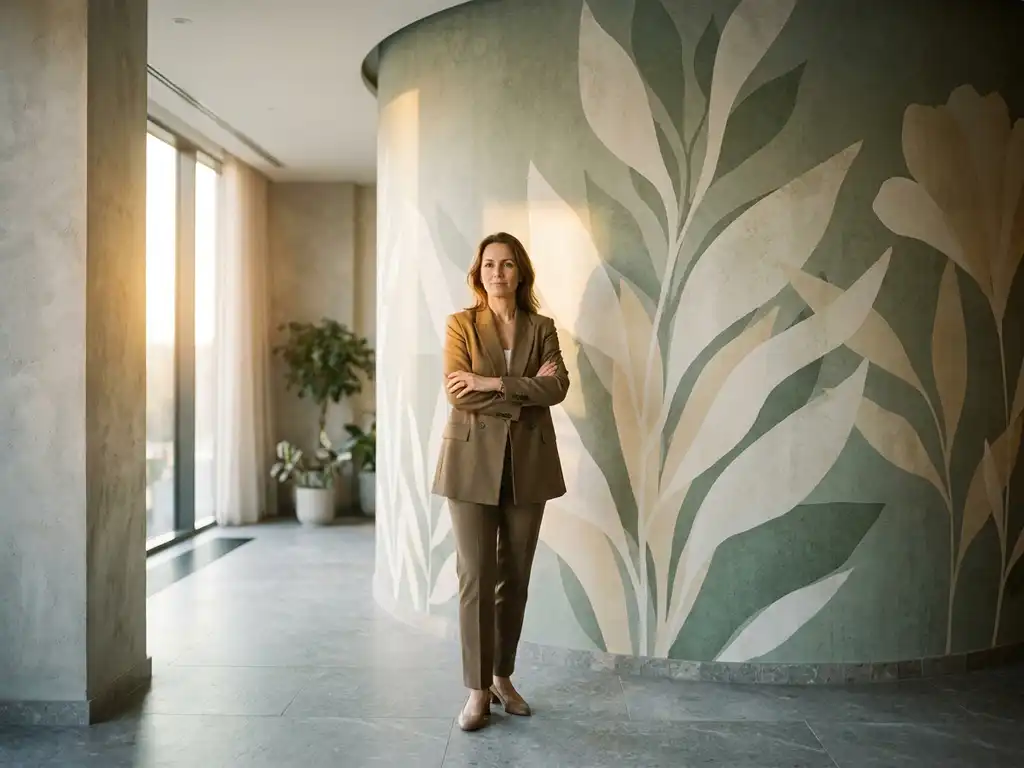
For small rooms, non-woven wallpapers in light colors, with small to medium-sized patterns, and a weight between 100 and 160 g/m² are suitable, as they are also easy to work with in tight corners. The right choice depends on the room size, lighting conditions, and the desired printing process. The following questions will help you find the matching non-woven wallpaper step by step.
Which non-woven wallpaper is best suited for small rooms?
For small rooms, non-woven wallpapers with a basis weight of 100 to 160 g/m² are suitable, as they are easy to cut and can be applied without bubbles. Also important is a matte or slightly textured surface that diffusely reflects light and visually opens up the room without being glossy.
Printable non-woven wallpapers consist of a non-woven backing material that is more stable and dimensionally stable than traditional paper wallpapers. This makes them particularly practical in tight spaces: they can be applied dry to the wall because the paste is applied directly to the wall, not to the wallpaper. This reduces the risk of the material tearing or warping in cramped conditions.
For interiors with low ceilings, wallpaper with vertical structures or patterns is also recommended, as it visually raises the ceiling. Horizontal patterns, on the other hand, can make a small room look even more compact.
Which patterns and colors make small rooms look larger?
Bright, cool colors such as white, light gray, or soft pastel tones make small rooms appear visually larger. Patterns with vertical lines or small, evenly distributed motifs support this effect, while large-scale, high-contrast patterns make the room look smaller.
The following design principles have proven effective in practice:
- Light base colors: The lighter the wall surface, the more light is reflected, which makes the room appear larger and more airy.
- Vertical patterns: Stripes or elongated patterns draw the eye upward and emphasize the height of the room.
- Short reports: Subtle, repetitive patterns look calmer and do not make the wall appear to advance visually.
- Accent wall instead of wallpapering the whole room: A single wallpapered wall creates a focal point without cluttering the room.
Dark or strongly saturated colors are not fundamentally ruled out. A single dark accent wall can even create depth in a small room if the remaining walls are kept bright. The decisive factor is the balance between contrast and brightness.
How does the grammage of a non-woven wallpaper affect its application in tight spaces?
The grammage of a non-woven wallpaper directly influences how stiff or flexible the material is. Lighter non-wovens with 100 to 130 g/m² are easier to handle in tight spaces because they are easier to bend and fit into corners. Heavier non-wovens starting at 200 g/m² are more stable, but harder to position in cramped conditions.
In practice, this means:
- Lightweight non-woven wallpapers (100 to 130 g/m²) are well-suited for small rooms because they are flexible and easy to cut.
- Medium-weight fleeces (130 to 180 g/m²) offer a good balance of stability and manageability and are suitable for most indoor applications.
- Heavy non-woven wallpapers (over 200 g/m²) are generally used for large-scale installations or high-traffic areas where durability is more important than easy handling.
Another aspect: heavier non-wovens require more paste and longer soaking times, which can be a disadvantage in tight spaces with little room for maneuver. Anyone hanging wallpaper in small bathrooms, stairwells, or alcoves is better off using a light to medium-weight non-woven.
Which printing technology is suitable for printable non-woven wallpaper?
Printable non-woven wallpapers are compatible with common large-format printing technologies, including latex, solvent, UV, and water-based ink systems. The choice of printing technology directly influences color brilliance, odor emissions, and suitability for interior spaces.
Latex printing is particularly recommended for interior applications. Latex inks are low-odor, contain no volatile organic compounds (VOCs), and are dry immediately after printing. This makes them especially suitable for living spaces, offices, and public buildings. In addition, latex ink adheres well to non-woven surfaces and delivers color-accurate results.
Water-based ink systems are also suitable for indoor spaces, but require a specially coated non-woven wallpaper that quickly absorbs and fixes the ink. Solvent and UV inks are technically possible, but less ideal for living spaces, as solvent inks emit higher levels of outgassing and UV inks produce a harder surface that is less flexible on non-woven wallpapers.
It is important that the non-woven wallpaper is certified or approved for the respective ink system. Not every coating is compatible with every type of ink, which can lead to issues such as ink bleeding, poor adhesion, or uneven color reproduction.
Should PVC-free non-woven wallpapers be preferred for interiors?
Yes, for interior spaces, PVC-free vinyl wallpaper is clearly preferable. PVC-containing materials can contain plasticizers and other additives that emit gases in enclosed spaces. PVC-free vinyl wallpaper is free of PVC and the typical plasticizers that come with it.
Strict requirements regarding indoor air quality often apply to living spaces, children's rooms, offices, and public buildings. PVC-free materials meet these requirements more easily and are frequently certified according to recognized environmental labels. This provides planners and installers with additional security when selecting materials.
From a practical standpoint, high-quality PVC-free non-woven wallpapers hardly differ from PVC-containing variants in terms of print quality, durability, or workability. Therefore, dispensing with PVC is not a compromise, but a sensible decision for interior applications.
How do you calculate the material requirement of a non-woven wallpaper for small rooms?
You calculate the material requirement of a non-woven wallpaper by multiplying the perimeter of the room by the room height, while subtracting window and door areas. For patterns with a repeat, add at least one repeat length per strip as waste.
A simple formula for the calculation:
- Measure the room perimeter (all wall lengths added together) in meters.
- Multiply the perimeter by the room height to get the total wall area.
- Subtract the areas of the windows and doors (depending on number and size).
- Divide the remaining area by the usable panel width of your non-woven wallpaper (usually 1.06 m or 1.37 m) to determine the number of panels required.
- Multiply the number of lengths by the room height to get the required running meters.
- Plan for 10 to 15 % of extra material; for patterned wallpaper, allow for a corresponding amount more.
In small rooms with many corners, nooks, or slanted surfaces, it is recommended to allow for a more generous margin of up to 20 %, since each corner requires a new strip and mistakes are more common in tight spaces. It’s better to plan for a little extra material than to have to reorder in the middle of the job.
Non-woven wallpapers for small rooms: How com2C helps you make the right choice
Selecting the right non-woven wallpaper for small rooms presents many processors with concrete questions: Which grammage suits the printing system? Which coating delivers the best results with latex ink? And which materials are truly low-emission enough for interiors? We know these questions from daily cooperation with digital printers and sign makers.
- We offer printable non-woven wallpapers from com2C in various weights and widths, optimized for latex, solvent, and water-based ink systems.
- Our materials are PVC-free and suitable for indoor use, without compromising on print quality or processability.
- We support you in material selection based on your printing system and specific application, rather than by catalog.
- For questions regarding compatibility, coating, or processing, our experts are directly at your disposal.
If you are unsure which non-woven wallpaper is best suited for your next project, we look forward to a Consultation.