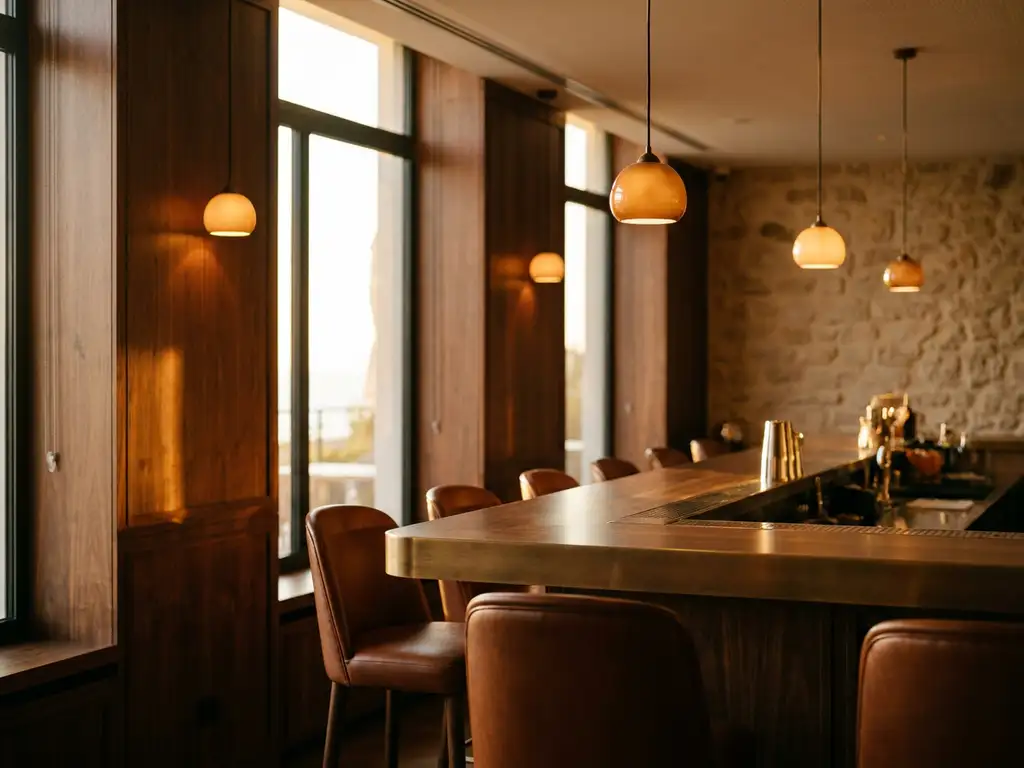
A hotel bar that invites guests to linger is created through the interplay of light, materials, color palette, and visual design. What matters is not the size of the space, but the feeling it conveys: warmth, identity, and an atmosphere that fits the hotel’s brand. The following questions highlight what really matters in bar design in a hotel.
Which design elements create atmosphere in a hotel bar?
The atmosphere in a hotel bar is created through the targeted interplay of lighting, materials, color schemes, and visual focal points. No single element acts alone. It is only when light, surfaces, and room divisions are coordinated with each other that a space is created where guests feel comfortable and want to stay longer.
Warm indirect light is one of the most powerful tools. It fundamentally changes the perception of a space and creates intimacy without visually reducing it in size. This is complemented by material contrasts: rough natural stone alongside soft textiles, matte wood alongside glossy surfaces. These contrasts create depth and make a space visually interesting.
Visual anchor points such as a designed back wall behind the counter, large-format wall motifs or illuminated graphic elements draw the eye and immediately convey what this bar stands for. They are the first message a guest perceives before they have even taken a seat.
How does wall design influence the experience of drinking in a hotel bar?
The design of a hotel bar directly influences the experience of drinking in the space because walls make up the largest visual surface area of a room. Thoughtful wall design creates identity, draws attention, and gives the space an emotional tone that guests unconsciously perceive and transfer to their well-being.
An empty or generic-looking wall looks neutral but is also interchangeable. Guests don’t remember it and it doesn’t contribute anything to the hotel’s brand perception. Things are different with individually designed wall surfaces: a large-format motif that fits the hotel’s history, a textured structured wallpaper or a backlit element behind the bar transform a surface into an experience.
The combination of wall design and lighting is particularly effective. Backlit print motifs, so-called backlit displays, create a depth and luminosity that cannot be achieved with conventional wall paints. They catch the eye and stay in the memory. For hotels that want to convey a specific mood or brand identity, the wall is the strongest design element in the room.
Which printing materials are suitable for displaying cash in a hotel?
For display applications in the hotel, vinyl wallpaper, self-adhesive wall panels, backlit media and printable textiles are particularly suitable. The choice of the right printing material depends on the application, the substrate and the requirements for durability and appearance.
Vinyl wallpaper for large-scale wall designs
Printed vinyl wallpaper is the first choice for large-format wall designs in hotel bars. They are precisely processable, flat on the wall and enable photorealistic print quality in almost any size. Vinyl wallpaper is breathable, residue-free and therefore suitable for rented commercial spaces.
Backlit media for bright accents
Backlit printed media, so-called backlit foils, are suitable for light frames and lightboxes behind the counter or in niches on the wall. They convey motifs with a brightness and depth of color that appear as vivid as day and night during the day. Especially in bars with subdued ambient lighting, they create strong visual accents.
Self-adhesive films for flexible design
Self-adhesive films offer maximum flexibility: they can be applied to smooth surfaces such as glass, tiles, or furniture and removed again if necessary. For hotel bars that want to adapt their appearance seasonally or thematically, they are a practical and cost-effective solution.
How often should the visual concept of a hotel bar be updated?
The visual concept of a hotel bar should be thoroughly reviewed and updated as necessary every three to five years. Minor visual adjustments, such as seasonal accents or the replacement of individual graphic elements, can be made annually or on an occasion-specific basis without changing the overall concept.
Hotel bars that regularly welcome regular patrons benefit from visual changes because they give returners the feeling that the house remains vibrant and contemporary. At the same time, the core identity should remain recognizable. Anyone who changes the entire appearance with every renovation loses its recognizability.
In practical terms, this means that structural elements such as wall murals or fixed-installation graphic elements are less frequently replaced, while flexible media such as foil stickers, backlit motifs or textile prints can be updated more frequently. Modern printing materials make this change easier and more cost-effective than before because they are easily removable and can be replaced quickly without leaving any residue.
What distinguishes an inviting hotel bar from an average dining area?
An inviting hotel bar differs from an average dining area through a recognizable visual identity that is consistently aligned with the hotel’s brand. Average dining areas often appear generic because design elements are not coordinated or do not tell a story.
What truly makes guests feel at a hotel bar is the sense of being in a special place. This feeling is not created by expensive furniture alone, but by consistency: When light, materials, wall design, and color scheme speak a common language, the room feels like it was designed together.
Another difference lies in the level of detail. Welcoming hotel bars have thoughtful transitions between zones, clear visual hierarchies, and areas that invite people to linger without being intrusive. Seating areas with back panel designs, illuminated niches, or visually striking counter walls create orientation and quality of stay at the same time.
After all, consistency across all touchpoints plays an important role. A hotel bar whose design seamlessly connects with the lobby, the rooms, and the hotel’s overall appearance conveys professionalism and brand identity. Guests perceive this, even if they cannot consciously name it.
Designing hotel bars with com2C: Print media transforms spaces
We know that hotel projects are under pressure and that design requirements are often very specific. Standard materials rarely fit exactly, and suppliers that only offer catalog products are not helpful in complex applications. This is where we come in.
Our com2C Interior Film Collection offers printing media specifically designed for sophisticated interior design applications, including vinyl wallpaper, backlit media, self-adhesive films, and printable textiles for large-format printing.
- Print media for all common large format printers (HP, Epson, Roland, Mimaki and others)
- Compatible with solvent, latex, UV and water-based ink systems
- Materials for wall designs, backlit applications, glass decor and floor coverings
- PVC-free alternatives from our GoGreener line for sustainable hotel projects
- Rapid product development for individual requirements that do not meet standard ranges
- Technical advice from our team with over 20 years of industry experience
If you are planning a hotel project and are looking for the press to reliably implement your creative vision, please contact us. A brief Consultation quickly shows which materials are best suited for your specific application.