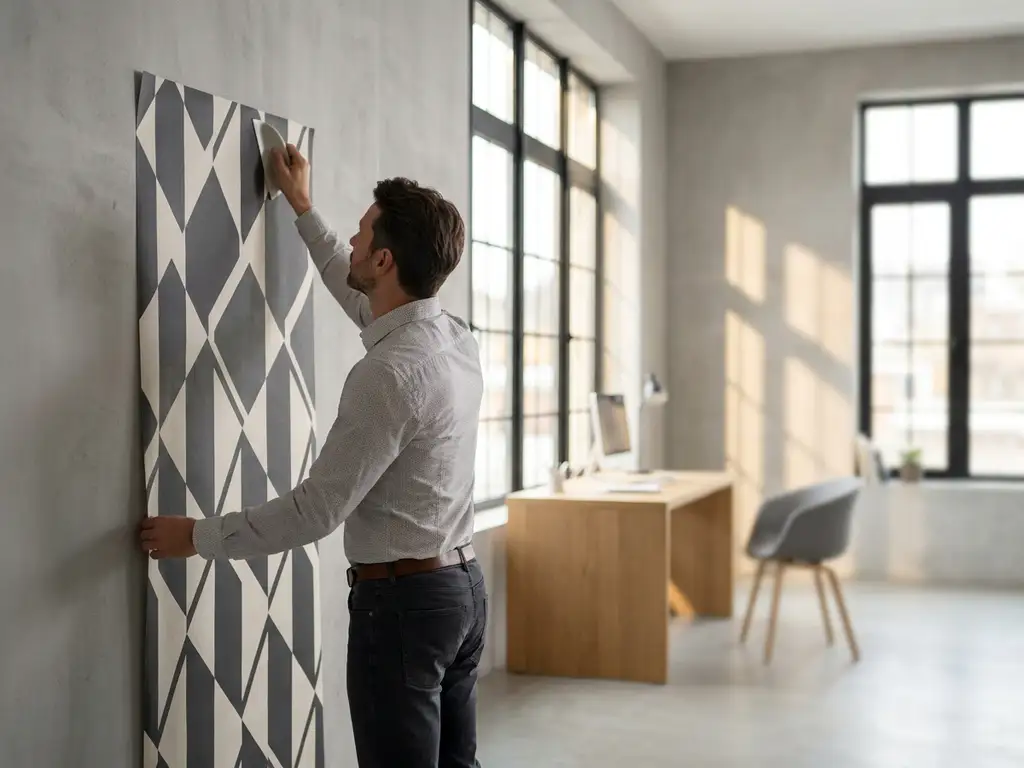
Self-adhesive wallpaper is suitable for a wide variety of applications indoors and outdoors: from temporary wall decoration in offices and retail spaces to trade fair stands to decorative projects in the private and commercial sectors. They can be removed without leaving any residue, are quick to apply and offer virtually unlimited design possibilities thanks to digital large-format printing. The following questions clarify where self-adhesive wallpaper is used in practice, which surfaces are suitable, and what you should consider when choosing the material.
Where are self-adhesive wallpapers most commonly used?
Self-adhesive wallpaper is most commonly used in interior design for retail stores, restaurants, offices, and at trade shows. They enable quick, clean wall decoration without glue, and can be removed without leaving any residue after use, making them particularly attractive for temporary or changing applications.
In the field Advertising and brand communication Printed self-adhesive wallpaper is a proven means: shop window displays, exhibition stands, event decoration, and branding areas in corporate offices benefit from the combination of high-quality printing quality and easy assembly. Retail self-adhesive wallpaper is used for seasonal wall designs that change with the range or campaign rhythm.
Furthermore, interior designers and room decorators are using self-adhesive wallpaper for individual wall designs in hotels, restaurants, and offices. The ability to apply large-scale motifs without gaps to wall surfaces makes it the preferred solution when a strong visual impact is required. Self-adhesive wallpaper is also gaining importance in the private sector as an alternative to traditional wallpaper, as it can be applied without any handcrafting skills.
Which surfaces are suitable for self-adhesive wallpaper?
Self-adhesive wallpaper adheres reliably to smooth, clean, and dry surfaces. Suitable surfaces include painted walls, plasterboard, glass, wood, and many plastic surfaces. Strongly textured, porous, or wet surfaces reduce the adhesive strength and should be avoided or treated beforehand.
The quality of the adhesion depends largely on the surface condition. Freshly painted walls should harden for at least two to four weeks before a self-adhesive wallpaper is applied, as solvents from the paint can affect the adhesive layer. Rugged or highly textured surfaces They are generally not suitable, as the adhesive surface is too small and air inclusions can occur.
For more demanding substrates, such as slightly textured walls or surfaces with roughness, a material with a stronger adhesive system or a pretreatment of the substrate is recommended. Those who regularly work on different substrates should adjust the material choice to the respective application and, in case of doubt, perform a test run before applying the entire surface.
How do self-adhesive wallpapers differ from conventional wallpaper?
The main difference lies in the processing: Self-adhesive wallpaper have an integrated adhesive layer and do not require any glue. They can be applied dry, are immediately loadable and, in most cases, can be removed without leaving any residue. Conventional wallpaper require glue, soaking time and careful preparation of the substrate.
From the perspective of printing production, another difference is relevant: Self-adhesive wallpaper for digital large-format printing is specially coated to absorb inks from solvent, latex, or UV printing systems. The printing surface is smooth and uniform, which enables precise color reproduction. Conventional wallpapers, on the other hand, are often textured and not designed for digital printing.
For professional users in signage and exhibition construction, this means: Self-adhesive wallpaper is faster to produce, easier to install, and more flexible in use. They are suitable for short-term projects as well as permanent installations, provided that the material and the substrate match each other. Conventional wallpaper, on the other hand, remains relevant more often in the classic living area, where no printing finishing is required.
Which printing techniques are compatible with self-adhesive wallpaper?
Self-adhesive wallpaper is compatible with the common printing techniques in large-format printing: Latex, solvent, eco-solvent and UV printing work reliably on suitable materials. The compatibility depends on the material’s coating, not the adhesive layer.
In professional digital printing, self-adhesive wallpaper is most commonly used with Latex and eco-solvent printers are processed, as these systems are particularly suited for indoor applications and deliver odor-free results. Printers from HP, Epson, Roland, Mimaki, and Durst are widely used in practice, and high-quality printing media are tailored to these systems.
UV printing It is also suitable, but requires materials with a UV-compatible coating, as the ink hardens immediately and requires a corresponding absorption capacity of the surface. Water-based inks are less commonly used, but are possible with special vinyl wallpaper materials. Those who regularly print self-adhesive wallpaper should compare the manufacturer’s material specifications with the requirements of their own printing system to achieve optimal printing results.
When are PVC-free self-adhesive wallpapers the better choice?
PVC-free self-adhesive wallpaper is the better choice when interior spaces are designed to meet strict requirements regarding air quality, when sustainability certifications are required, or when the material is intended to be recycled after use. They are particularly suitable for schools, hospitals, offices, and public buildings.
PVC-containing materials can release problematic substances during processing and disposal. For companies that operate sustainably or serve customers with specific requirements, therefore, PVC-free alternatives are not only an ecological but also a financially sensible decision. More and more tenders and project requirements explicitly exclude PVC-containing materials.
From a technical perspective, PVC-free self-adhesive wallpaper is no match for its PVC-containing counterparts in terms of print quality and adhesion, provided the material is carefully developed. The processing is hardly different, and the printing results are comparable with good coating. So, anyone who wants to avoid PVC does not have to compromise on quality.
How long do self-adhesive wallpapers actually last in practice?
The shelf life of self-adhesive wallpaper indoors is between two and five years, depending on the material and substrate. The quality of the adhesive layer, the nature of the substrate, the lighting conditions, and whether the material is exposed to mechanical stress are all factors that play a role.
For temporary applications Like exhibitions, events or seasonal decorations, self-adhesive wallpaper is designed for short periods of use and can be removed without leaving any trace after just a few days or weeks. For Permanent installations In offices or restaurants, a material with a durable adhesive layer and a UV-resistant printing surface should be chosen to avoid fading or peeling off.
Moist environments, direct sunlight, and frequent cleaning with aggressive agents significantly shorten the lifespan. Those who use self-adhesive wallpaper in kitchens, bathrooms, or highly frequented areas should be careful to choose materials with appropriate moisture resistance and a more durable surface. Laminating the print can additionally extend the durability in such applications.
Self-adhesive vinyl wallpaper from com2C: materials for the practice
We develop and produce self-adhesive wallpapers that perform well in daily printing production, and that not only look good in the sample book. Our range includes materials for different requirements, from temporary exhibition applications to permanent interior installations.
- Our self-adhesive wallpaper PVC-free It is specifically designed for applications where PVC-free materials are required without compromising on print quality or adhesion.
- The materials are compatible with latex, solvent, eco-solvent and UV printing systems from leading manufacturers such as HP, Epson, Roland and Mimaki.
- We offer technical advice on material selection, tailored to your printer, substrate and application.
- Fast delivery times and reliable availability, so your production doesn't have to wait.
- Our team can also assist you with specific requirements, for example if you require materials for special substrates or specific certifications.
If you have specific questions about materials, print compatibility, or PVC-free alternatives, we are happy to help. Simply contact us. Contact, We will find the appropriate solution for your project together.