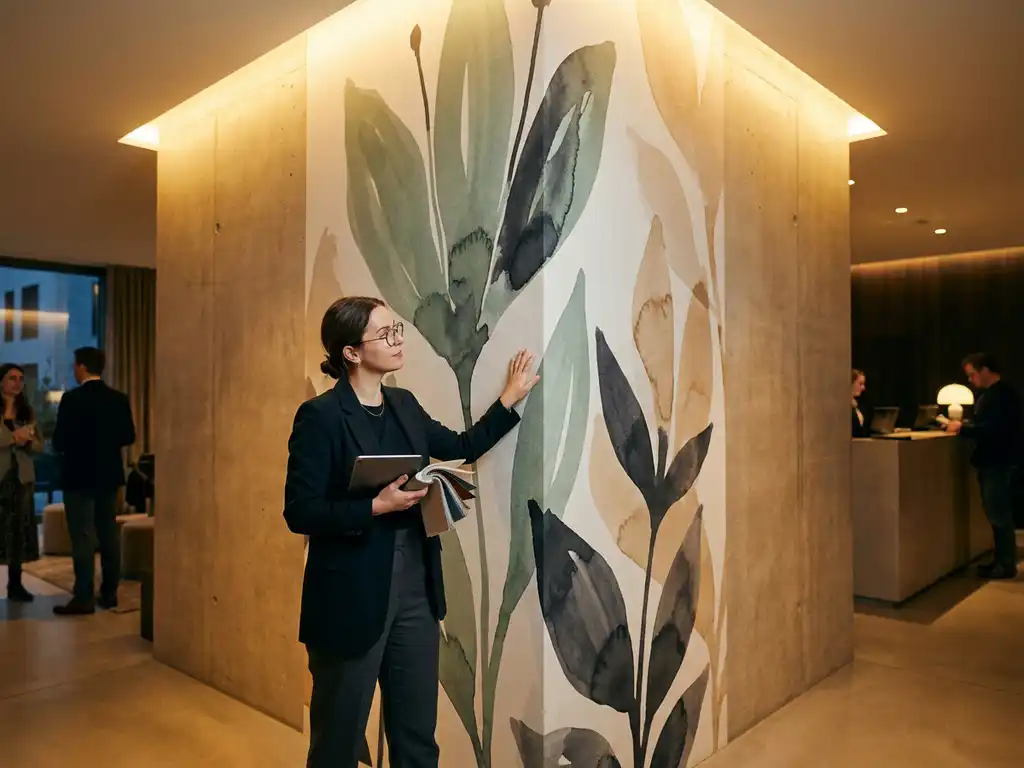
Anyone who wants to Non-woven wallpaper When buying for digital large-format printing, there are more decisions to make than might seem at first glance. The material must not only look good but also function reliably: in print quality, in processing, and in the intended use. The following five points will help you make the right choice and avoid costly mistakes.
What really matters when buying vinyl wallpaper
Vinyl wallpaper differs significantly in grammage, surface texture, ink compatibility, and processing properties. Those who know and properly evaluate these parameters choose the material that best suits the project, rather than relying on general product descriptions. The following five criteria provide a practical foundation for your purchasing decision.
1: Properly assess the grammar and material thickness
The grammage of a vinyl wallpaper, expressed in grams per square meter (g/m²), significantly determines how stable the material is and how it behaves under pressure. Lighter wallpapers with lower grammages are suitable for temporary applications or interior spaces with low mechanical requirements. Heavier qualities offer more dimensional stability and are less prone to stretching or shrinking under pressure.
For large-format motifs, such as room-high wall designs or exhibition walls, a higher weight per unit area is recommended. The material adheres better to the wall when hung and exhibits less waves or tension. For small-format applications or when the weight of the final product matters, a lighter quality may be the better choice.
Also pay attention to the material thickness in millimeters, as this affects the printing process in the printer. Not every large-format printer can handle very thick materials without problems. Check the specifications of your printing system before ordering a product.
2: Check ink compatibility with the printing system
A vinyl wallpaper that is combined with the wrong ink system will not provide satisfactory results. The coating of the material must match the type of ink used, whether latex, solvent, UV-curing, or water-based. Each of these systems places different requirements on the surface’s absorbency and adhesion.
For example, latex inks require a coating that can tolerate the heat of the drying process while ensuring good ink absorption. UV inks adhere to surfaces differently from solvent inks. If the coating does not match the ink, problems such as poor color density, abrasion, or uneven drying occur.
When purchasing a product, be sure to specifically inquire about the ink compatibility. Serious manufacturers indicate which printing systems and ink types the product is suitable for. If you are working with printers from different manufacturers such as HP, Epson, Roland, or Mimaki, check the compatibility for each device separately.
3: Choose the surface structure for the print motif
Vinyl wallpaper is available in various surface structures: smooth, slightly textured, fabric-like, or with a pronounced texture. The choice of surface directly influences how the printed design looks. A smooth surface is suitable for detailed graphics, photographs, and fine fonts. A textured surface gives the finished product a decorative character, but can visually diminish fine details.
For interior designs where the material is intended to appear like a classic wallpaper, a light texture is often the better choice. It hides minor irregularities on the wall and creates a more natural effect. For exhibition graphics, display stands or presentation walls where image clarity and color reproduction are paramount, a smooth or satin surface is recommended.
Also pay attention to the gloss level: matte surfaces reduce reflections and are more pleasant to the eye in well-lit rooms. Satin or high-gloss variants enhance color brightness and contrast, but can appear dazzling in direct light.
4: Processing properties and adhesive compatibility
Vinyl wallpaper must not only print well but also be easy to handle. Important processing properties include dimensional stability when glued, tear resistance when handling, and resistance to moisture. Vinyl has the advantage over paper wallpaper that it does not swell when soaked with glue and can therefore be processed more precisely.
Check whether the material is designed for the adhesive-on-wall method or for direct application of the material. Most high-quality vinyl wallpaper are processed using the adhesive-on-wall method, which significantly simplifies the installation process. Also, be sure to check which adhesive types the manufacturer recommends, as not all adhesives are compatible with every coating.
For projects where the material is to be removed after use, for example at trade shows or temporary space arrangements, removability is an important criterion. Some vinyl wallpaper can be removed from the wall dry and without leaving any residue, which ensures the material can be reused.
5: Evaluate sustainability and certifications
Sustainability is not a trend in the print media industry; it is an increasingly concrete requirement. Many end customers and clients are actively asking for environmentally friendly materials, and in certain industries such as trade fair construction or public procurement, sustainability certification is already mandatory. When purchasing vinyl wallpaper, be sure to check whether the product is PVC-free and what certifications the manufacturer can provide.
Relevant certifications for indoor applications include the Blue Angel, OEKO-TEX, and ISO standards-compliant certificates for low emission levels. These certifications prove that the material does not emit any health-hazardous substances and is suitable for use indoors. This is an important criterion, especially for children’s rooms, offices, or public buildings.
PVC-free vinyl wallpaper offers clear advantages over traditional plastic materials: they contain no chlorine or PVC-type plasticizers. Ask the manufacturer specifically about the ingredients contained in the material and the disposal methods recommended.
Find the right vinyl wallpaper for any project
The five criteria together paint a clear picture: a good vinyl wallpaper fits your printing system, the intended application, and the requirements of your customers. No single product is equally suitable for all projects. Those who systematically examine the grammage, ink compatibility, surface structure, processing properties, and sustainability credentials make a more informed decision than a random one.
If you regularly work on different projects, it pays to have several qualities in stock. A lightweight, smooth quality for detailed graphics, a structured variant for decorative interior designs, and a PVC-free option for clients with sustainability requirements – this way you are well prepared for most requests.
Vinyl wallpaper by com2C: PVC-free, ready to print, proven in practice
We develop and produce vinyl wallpaper that works in everyday printing production. Not on the paper, but in the printer, on the wall, and with the end customer. Our Non-woven wallpapers from com2C are PVC-free, optimized for various ink systems, and available in different grammages and surface structures.
- PVC-free materials for indoor applications with low emissions
- Compatible with latex, solvent, UV and water-based printing systems from leading manufacturers
- Different grammages and surface structures for different project requirements
- Processing using the glue-on-wall method for easy and precise handling
- Technical advice from our experienced team, who are familiar with the realities of production
- Quick availability and individual solutions when standard products are not suitable
If you have a project where the choice of materials is not clear, please contact us. We will help you find the right product without any unnecessary steps. Simply Contact.