

Solnhofen: What limestone from Middle Franconia means for the printing industry
The small, tranquil town of Solnhofen and its quarry had a decisive influence on the history of printing. Why? Just keep reading!
Alois Senefelder was working as an actor and writing plays himself in the late 18th century when he began to work with printing techniques. His initial goal was to print his own works at low cost.
His observation of a leaf imprint on limestone during a rainy walk was the reason for the first attempts at "Steyndruck".
Solnhofener Plattenkalk is a particularly fine-grained limestone that is well suited for stone printing. Senefelder first drew the motif to be printed in reverse with greasy chalk on the flat-ground limestone plates. During the subsequent moistening with an aqueous solution, the vacant areas retained the water and were thus given a grease-repellent finish. The greasy ink that was then rolled on only adhered to the print motif and could be transferred to a pressed sheet of paper.
Senefelder had thus invented lithography in 1798 (lithos = stone, -graphy = drawing, writing) - at that time the first printing process with which colored templates could also be duplicated.

The chemical reaction printing process described is based on the repulsion of fat and water and was significantly cheaper than the printing processes that were common at the time, such as copperplate engraving. It is the first planographic printing process in which, in contrast to letterpress with moveable type (lead type) or intaglio (copper engraving), printing and non-printing areas are on one level. The new method of flat printing revolutionized printing technology. Previously, the printing elements were always offset in height
arranged to separate the printing from the non-printing elements. In letterpress, the characters to be printed are significantly raised so that only they absorb ink. In gravure printing, the parts of the image to be printed are deepened; they hold the ink while a squeegee removes excess ink. For the first time in planographic printing, printing and non-printing elements are placed next to each other and chemical processes between the aqueous acid solution and greasy chalk or ink control ink absorption. For
multicolored prints are worked with several stone slabs.
Only around 1930 was lithography increasingly replaced by offset printing. Offset printing – also a flat printing process – is still the dominant printing technique in production runs. Senefelder has with his
Experiments in lithography invented the direct forerunner of offset printing and made a crucial contribution to the development of this high-volume printing process.
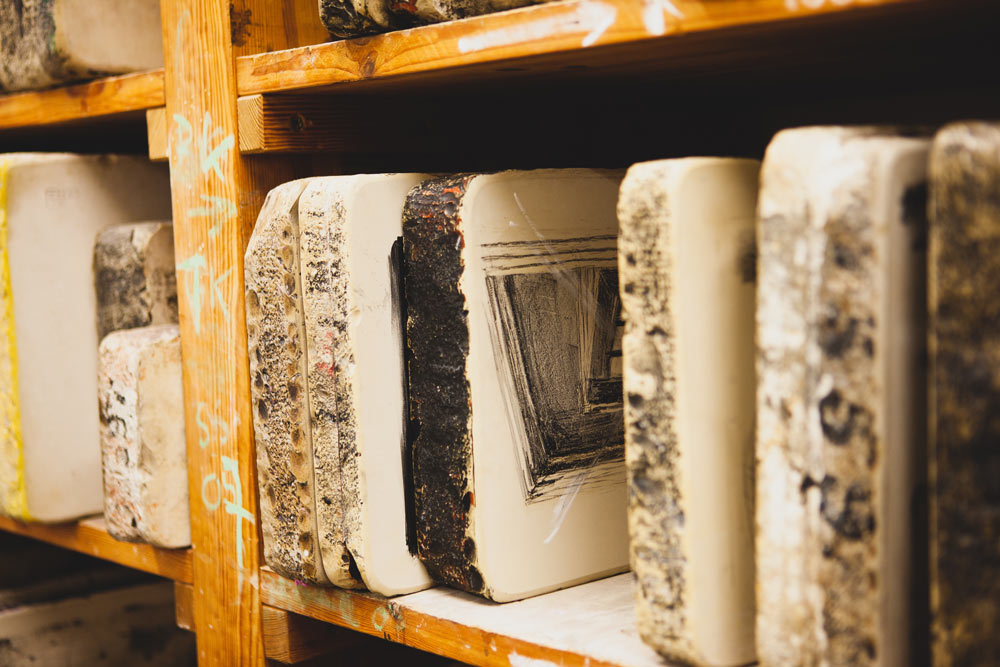
Solnhofen limestone
Solnhofen limestone is a natural stone from the Altmühljura of the Franconian Jura in Bavaria. The type of rock was formed by layers of deposits in lagoons of the tropical primordial sea that were flooded with salt water. The
dense, cream-colored limestone cannot be mined with machines in quarries to this day. It had been quarried for centuries as a building material for floors, stairs and walls before it became more famous in 1798 with the invention of Alois Senefelder as "Lithographic Slate from Solnhofen".
obtained.
The high salt content of the lagoon water during the formation of Solnhofen limestone ensured that an exceptionally large number of animals were preserved as fossils. The rock is therefore also a significant
fossil deposit. In 2006, the Altmühltal and Solnhofener Plattenkalke were awarded the status of "national geotope".




 English
  German