





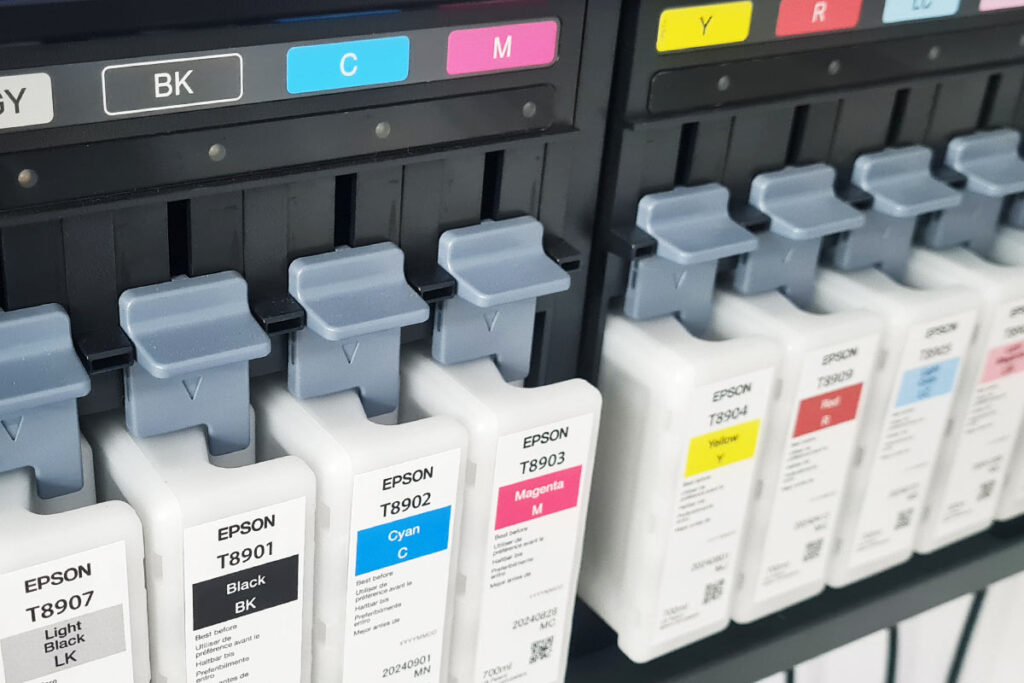
Their differences and uses as well as the advantages and disadvantages are explained below.
Very high qualities (in terms of color space and resolution) are achieved with water-based ink systems - ideal for art reproductions, proofing and generally for indoor applications and for rather short viewing distances. However, water-based inks only last really well on specially coated surfaces and are only suitable for outdoor use to a limited extent. On the other hand, the printers are easy to handle and can be found not only in machine halls, but often also in offices.
↔ Print widths: 61 cm to 152.4 cm
Main areas of application: fine art, posters, indoor banners
Advantages of water-based inks (waterbased)
➕ large color space
➕ Simple processing, harmless to health
➕ cheap
Disadvantages of water-based inks (waterbased)
➖ low UV stability
➖ low water resistance (limited outdoor use)
➖ only print media with special coating
An ideal printing medium for water-based inks (water-based), for example, is this Blockout 175 PET WBL SM W
If the prints are to be particularly durable and are used outdoors, printing with solvent or real solvent, ie solvent-based inks, is used. These inks dissolve the substrate and combine with the print medium, making solvent prints very durable.
The drying process is carried out with a heater (pre-, main and post-heating). However, solvent inks are not harmless to health and cannot be processed in rooms without special ventilation equipment.
↔ Print widths: 137.2 cm to 500 cm
Main areas of use: tarpaulin for outdoor use, vehicle wrapping, signs
Advantages of solvent inks (solvent)
➕ extremely durable (UV-resistant, waterproof, scratch-resistant)
➕ Suitable for outdoor use
➕ high printing speed
➕ short drying time
Disadvantages of solvent inks (solvent)
➖ relatively expensive printers
➖ Processing requires protective measures
➖ Can only be processed with a suction device
➖ Inks are hazardous to health
An ideal printing medium for solvent inks (solvent) is, for example, this Blockout 450 LUVESS SM W
EcoSolvent or mild solvent printers partially solve the emission problem of solvent printers: The inks here are much less harmful to the environment and health with similar drying properties and durability.
↔ Print widths: 75 cm to 260 cm
Main areas of use: tarpaulin for outdoor use, vehicle wrapping, wallpaper, flags, signs, stickers
Benefits of Eco Solvent Inks (eco-solvent)
➕ very good to extremely durable (UV-resistant, waterproof, scratch-resistant)
➕ Suitable for indoor and outdoor use
➕ high printing speed
Disadvantages of Eco Solvent Inks (eco-solvent)
➖ Inks are hazardous to health (although less so than solvent inks)
An ideal printing medium for eco-solvent inks (eco-solvent), for example, is the self-adhesive Digitalvlies 180 LUVESS SM W FR.
So-called latex inks were established on the market by Hewlett-Packard (HP) and other printer manufacturers.
How do latex inks work? These inks are mainly water-based, but in addition to the coloring components, water and some co-solvents and additives, they also contain one thing in particular: a binder ("latex"), which hardens through thermal cross-linking (heating in the printer!) and thus the printed ink is anchored to the substrate to a small extent.
In practice, however, this effect is not strong enough to be able to print on uncoated media - exception: PVC and relatively absorbent, porous substrates, although the latex ink is "absorbed" very quickly and strongly on uncoated, porous substrates and the print result appears rather dull and not very brilliant.
↔ Print widths: 51.4 to 264 cm
Main use: Indoor and outdoor applications
Benefits of Latex Ink:
➕ easy processing
➕ harmless to health
➕ Suitable for outdoor use
➕ very good to extremely durable
➕ no drying time
Disadvantages of latex ink:
➖ limited choice of materials (because the ink has to be fixed under heat)
➖ rather few printer manufacturers
An ideal digital printing medium for latex inks is, for example, this Blockout 180 PP LUVESS SM W
Which print media can be printed with which inks?
You can find this information in our product names.
L = suitable for latex inks
UV= suitable for UV-curing inks
ES = suitable for EcoSolvent inks
S = suitable for solvent inks
WB = suitable for water-based inks
for example:
Digitalvlies 180 LUVESS SM W FR
Suitable for latex, UV, EcoSolvent and Solvent
Would you like to get to know com2C in person or do you have any questions?
Gladly! We look forward to seeing you.

Your contact person
Heiko Kienast
Consulting & Sales