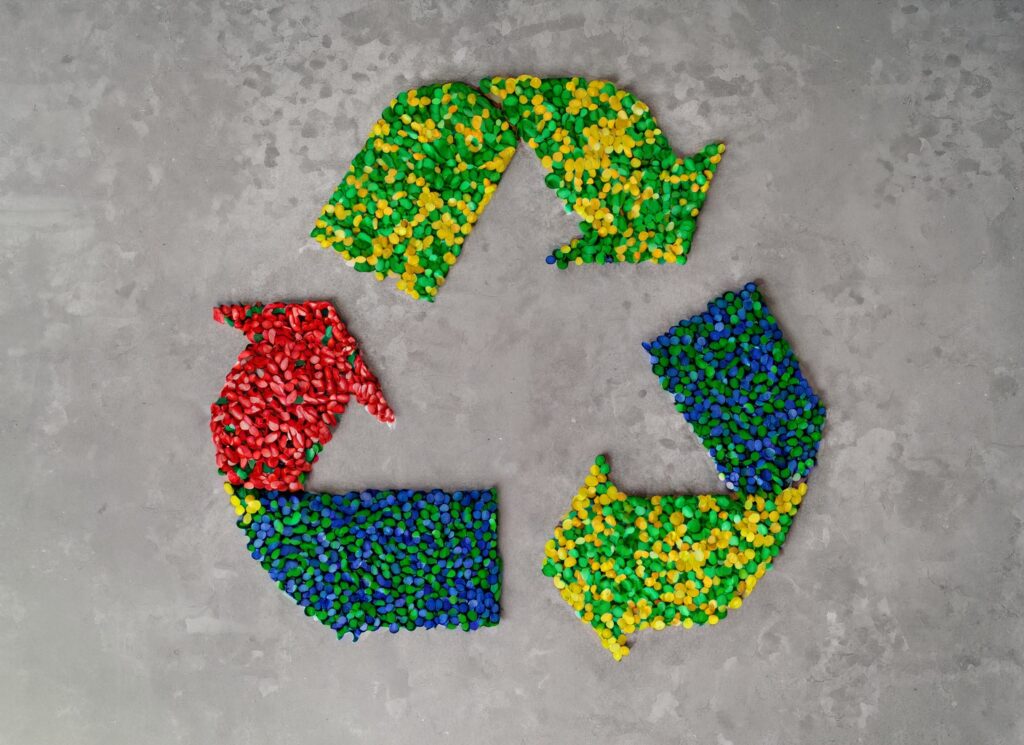
Sustainable and environmentally conscious management of printed media after their use phase is increasingly in focus. What happens to banners, pop-up panels, self-adhesive films, etc. after their end of life? The recycling of printed media is still in its infancy, with numerous challenges to overcome.
The connection between com2C and professionals in the recycling industry is close and focused, with the clear goal of developing recyclable print media. Markus Sprung, Managing Director of S & B Kunststoffrecycling GmbH, provides an exciting insight into the recycling of polypropylene (PP) and polyvinyl chloride (PVC).
Interview with Markus Sprung, Managing Director of S & B Kunststoffrecycling GmbH

Markus Sprung is the Managing Director of S & B Kunststoffrecycling GmbH
What forms of recycling are there?
The legislator agreed with the Circular Economy Act of 2012 that waste prevention has the highest priority. This means that the further use, reuse and recycling come before actual recycling. In plastic recycling, the material recycling begins, in which we try to recover the raw material through various forms of sorting, separation, crushing, melting filtration, and even the so-called pyrolysis. Only when all these measures fail or are economically unfeasible does thermal recycling begin, at least extracting the energy from the waste to use for the production of new products.
Can a polypropylene film (PP) be recycled?
Polypropylene film has been successfully recycled for decades and is now used in the form of flakes and granules in a wide variety of products such as bumpers, battery boxes, pipes, and other products. It is important that the raw material to be recycled is delivered in its purest form. A PP film that is, for example, stabilised with polyester fleece cannot be processed into a material form. Blockout 180 PP LUVESS SM W Therefore, it is one of the printed media that can be easily recycled.
How do PP and PVC compare in terms of their recyclability?
Both plastics are basically recyclable – provided that they are in their purest form. Both types of plastic have been processed in material form for decades and find a second life in various recycling products. However, PVC burns at a lower temperature than PP (although the melting point of PVC is lower than that of PP), which can release harmful chlorine compounds. This can lead to massive damage to the processing machinery. Therefore, it must be ruled out that PVC comes into contact with other plastics during the recycling process.
How do PP and PVC perform in terms of thermal utilization?
Polypropylene (PP) is better suited for thermal utilization for several reasons compared to polyvinyl chloride (PVC):
PP has a high calorific value, which offers an advantage for waste incineration plants when burning waste with a low calorific value. Additionally, PVC has the disadvantage that oxygen is removed from the fire by the formation of hydrogen chloride. In short, the fire goes out, and this is not desirable for combustion plants. Furthermore, the wear and tear of the combustion plants caused by the incineration of PVC is significantly higher, leading to frequent and costly revisions and thus downtime. In addition to the environmental impacts, the combustion of PVC generates additional emissions control measures. In contrast, the thermal valorization of PP generates fewer environmentally harmful emissions.
Due to the high risk, many recyclers do not accept PVC at all. Since only a few facilities are suitable for the safe recycling of PVC, this process is also more expensive.
Overall, these factors make polypropylene (PP) a more cost-effective option for thermal recycling compared to PVC, which enables a more efficient waste disposal process.
What about recycling self-adhesive PP films that still have a layer of adhesive?
Self-adhesive films made of PP are suitable for thermal recycling. Self-adhesive films generally pose a problem for recycling or the recycling process. Firstly, the process of shredding is made more difficult by the adhesive. As a rule, the process generates heat during shredding. This further intensifies the adhesive effect and contaminates the machines, potentially leading to a standstill of the plant. Furthermore, the adhesive would, depending on the dosage, show up as a rough surface in the final product and alter the technical properties of the plastic.
Printed media are predominantly printed when they are supplied to the recycling process. Are the printing inks an obstacle to recycling?
No, the printer inks are not problematic, as they do not weigh very much in proportion. In our tests, we tested media with extremely high ink load and found that recycling exclusively full-color black-printed material exhibits slight differences. In practice, however, we always use a mixture of media that are differently heavily printed. Here, the inks do not alter the process.
In large-format printing, printing media are used from different base substrates. How do PP, PET, PES, and PVC perform in recycling?
All the above-mentioned plastic types are recyclable. The crucial question is whether there are any applications for the recycled material resulting from the recycling process. In this case, the answer to the question regarding PP and PVC is definitely a resounding yes. While it will be difficult to find a suitable application for brightly colored PET films, the first question that must be asked in terms of recycling is always the question of the market for the end product.
How do you view com2C's developments in terms of recyclable products?
Over the last few months, exciting progress has been made. Through joint work and regular testing, we are able to advance the development of recyclable print media that are of interest to both the recycling sector and the print industry. Unfortunately, it is not often that print media manufacturers and recyclers work together. In fact, however, we see many synergies. I believe that through our collaborative approach, we can bring about positive change in the industry and take an important step towards recyclability.
In short and to the point:
Forms of recycling
Waste prevention has the highest priority according to the Circular Economy Act of 2012.
Priority: Re-use, reuse, re-utilisation before recycling.
Plastic recycling: material recycling, sorting, separation, crushing, melt filtration, pyrolysis.
In the event of unsuccessful recycling: thermal recovery for the generation of energy.
Recycling of polypropylene film (PP):
PP film has been successfully recycled for decades.
Used in various products such as shock absorbers, battery boxes, pipes.
Comparison of PP and PVC in terms of recycling and thermal recovery:
Both are recyclable, but PVC, which burns at a lower temperature, can release harmful chlorine compounds.
PP:
- PP films are well suited for thermal utilization.
- PP has a lower melting temperature and more efficient energy generation.
- PP is generally free of additives and facilitates thermal processing.
- PP has a high calorific value, which is advantageous for waste incineration plants.
- PP is less problematic for thermal recycling than PVC, as no chlorine compounds are formed.
PVC:
- PVC combustion produces harmful chlorine compounds and requires additional emission control.
- PVC often contains problematic additives, making the recycling and combustion process more difficult.
- PVC combustion leads to a loss of oxygen and increases wear on combustion plants.
- PVC should not come into contact with other plastics during the recycling process.
- PVC films release harmful chlorine compounds during combustion