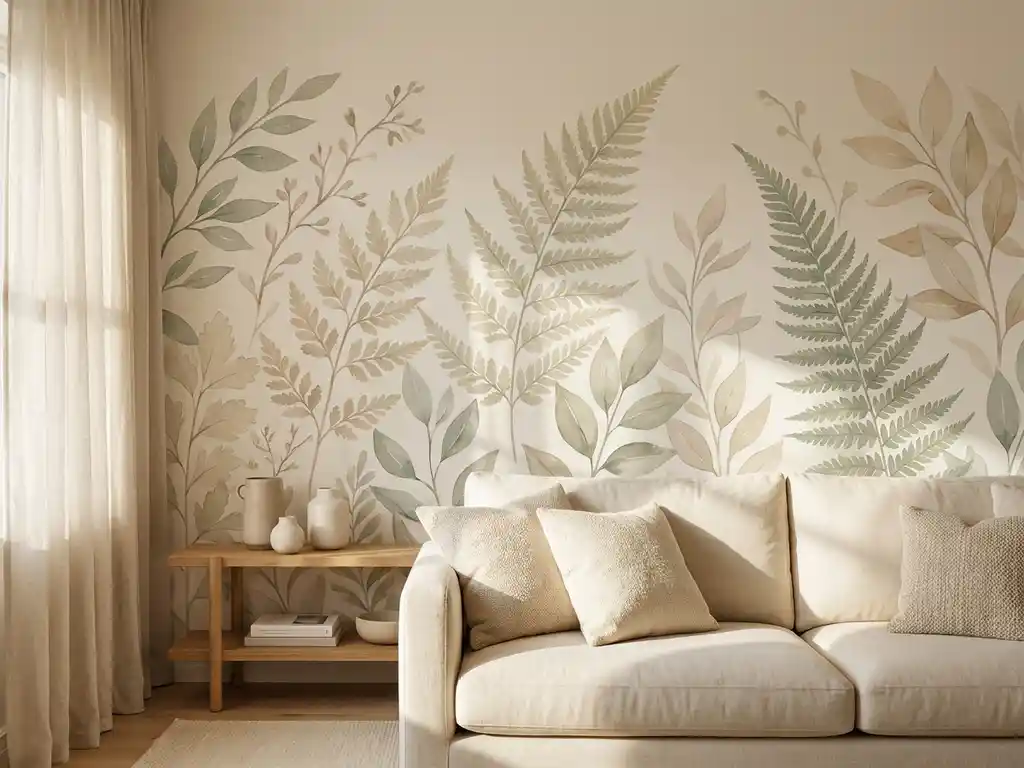
A rental apartment can be individually decorated without renovation and without permanent damage by applying self-adhesive, printed films to walls, tiles, floors, or furniture fronts. These films reliably adhere to smooth surfaces, can be removed without leaving any residue, and still allow for visually high-quality room design. The following questions and answers explain how this works in practice.
What are the options for decorating a rental apartment without renovation?
The most effective methods for decorating a rental apartment without structural modifications are self-adhesive films, furniture decals, removable wall stickers, and printed textile banners. Of these options, individually printed adhesive films offer the greatest design potential, as you can choose motifs, colors, and formats freely without changing the structural elements of the building.
Outdated tiles in the kitchen or bathroom, gloomy walls in the living room, worn-out floors or plain furniture fronts can be transformed in just a few hours with custom-made films. The result looks like a professional renovation, but is completely reversible. This is particularly relevant for tenants, because many rental agreements explicitly prohibit structural changes.
In addition to film, there are additional options such as rugs for laying, freestanding room dividers, or furniture with removable covers. However, these solutions only change the decor, not the room itself. For anyone who wants to visually redesign walls, floors, and tiles, high-quality adhesive films are a must.
What are self-adhesive films and how do they work?
Self-adhesive films are flexible plastic carriers with a printable surface and a adhesive layer on the reverse side. They are applied to smooth or slightly textured surfaces, adhere by pressure without additional adhesive, and can be removed by peeling off. In the field of interior design, they are often printed with individual motifs.
The adhesive layer is the technically crucial part. High-quality films use a so-called air channel-based adhesive, which allows air bubbles to escape during application and creates a uniform bond. Cheaper variants without this technology tend to produce bubbles and are harder to handle without bubbles.
For digital printing, these films are printed with inks based on latex, solvent, or UV-based technology. The ink bonds to the film’s coating, resulting in a color-rich, durable print image. Depending on the surface of the film—whether matte, glossy, or silk-matt—the visual appearance of the motif changes significantly.
Which surfaces can be taped with film in the rental apartment?
Self-adhesive films adhere reliably to smooth, clean, and dry surfaces. Suitable surfaces include tiles, painted walls, glass, wood, laminate, metal, and many plastic surfaces. Textured, porous, or wet surfaces reduce adhesion and should be carefully prepared before application.
Kitchen and bathroom
Kitchen wall tiles are one of the most common applications. The film is applied directly to the tiles and completely covers outdated patterns or colors. In the bathroom, it works the same way, as long as the film is suitable for wet rooms and the edges are sealed tightly to prevent water from seeping behind the film.
Floors and Walls
Floor films are designed specifically for use on laminate, tiles, or concrete. They are coated with anti-slip properties and withstand mechanical stress. Large-format motifs can be applied to walls as wall art or full-surface wallpaper, provided the substrate is smooth and well-adhering. Rigid-fiber wallpaper is less suitable because the uneven surface impairs adhesion.
How do you apply self-adhesive films without bubbles or creases?
Self-adhesive films are applied without bubbles or creases by thoroughly cleaning the surface, pulling the film up with a scraper from the center outwards, gradually peeling off the backing paper along the way. Clean preparation and smooth, even work are more important than tools or experience.
The steps in summary:
- Clean the substrate with a degreasing cleaner and let it dry completely.
- Align the film on the upper edge and temporarily fix it with masking tape.
- Peel off the carrier paper a few centimeters and press the film down with a spatula or a plastic card from the top down.
- Step by step, continue to peel off the carrier paper, always pressing down immediately at every step.
- Stitch the remaining air bubbles with a fine needle and squeeze the air out.
Films with air channels in the adhesive layer tolerate minor imperfections during application because the air itself spreads out. For simpler films without this technology, precise work is more important. For large-format applications, it is advisable to work in pairs to ensure that the film does not sag or unintentionally crease.
Can printed films really be removed without leaving any residue?
High-quality self-adhesive films can be removed without leaving any residue from most smooth surfaces if they are removed properly. The quality of the adhesive layer, the age of the film, and the condition of the substrate are crucial. In some cases, residues may appear on sensitive or already damaged surfaces.
For a clean removal, the following procedure is recommended: Slowly and at a slight angle of about 30 to 45 degrees, peel off the film, not perpendicular to the wall. Heat from a hairdryer softens the adhesive layer and makes removal easier, especially with older films. Residual adhesive can be removed with commercial isopropyl alcohol or adhesive remover.
Films that remain on a surface for several years can become more firmly attached due to UV exposure or temperature changes. To be on the safe side, it is recommended not to leave films permanently on sensitive surfaces such as freshly painted walls, but to replace or remove them after a minimum of two to three years.
Where can you get individually printed film for the rental apartment?
Individually printed films for the rental apartment can be obtained from specialized printing services and advertising technology companies that offer large-format printing. These companies print your motifs exactly to the desired formats and can advise you on the choice of material. Online stores and hardware stores also offer ready-made standard designs without individual printing.
For truly individual results, i.e. custom photos, patterns or bespoke formats, the route to the printing service provider is the better choice. There, you can tailor the surface, film type and adhesive layer to your application. A specialist company will determine whether a film is suitable for humid environments, which adhesive layer matches your substrate and which printing method provides the best color result.
Anyone who wants to apply the foil themselves should ask the printing service provider for a foil with air channels and have the motif printed with sufficient overhang so that the edges can be cut cleanly.
Individually designed rental apartment with com2C
We at com2C The print media on which your individual designs are created are developed and produced by us. Printing service providers and advertising technicians who produce your films rely on our materials because they function reliably, reproduce precise colors and are suitable for different substrates.
What this means for you as a end user:
- Films that securely adhere to smooth surfaces such as tiles, glass and laminate and can be removed without leaving residue
- Pressure media for humid environments such as kitchens and bathrooms, which withstand moisture and temperature fluctuations
- PVC-free materials from our GoGreener line for applications where PVC-free alternatives are required
- Precise color reproduction because our coatings are optimized for leading printing systems from HP, Epson, Roland, and others
- Over 20 years of experience in the development of inkjet coatings from our own laboratory in Porta Westfalica
If you have any questions about materials or would like to know which film is best suited for your specific application, we are happy to help you. Simply contact us Contact.