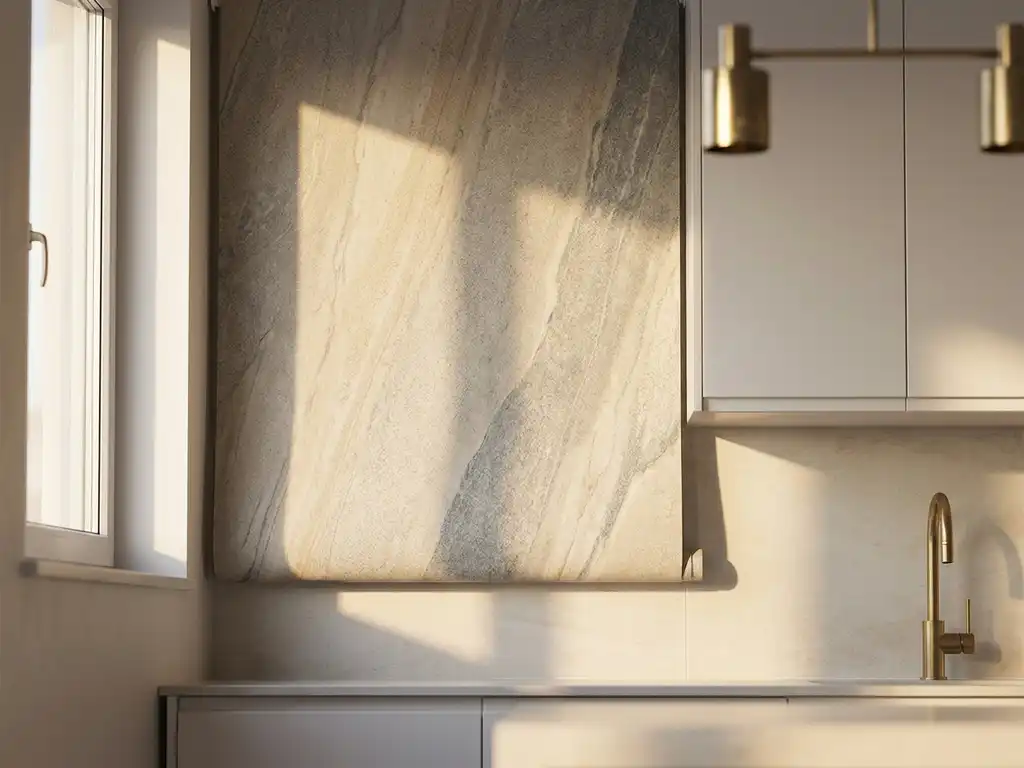
A self-adhesive roll back wall is worth considering if you want to upgrade a surface quickly, cost-effectively, and without structural modifications. It is particularly useful in rental properties, with outdated tiles, or whenever a classic renovation would be disproportionately expensive or not permitted. The following questions will help you assess whether this solution is suitable for your specific situation.
Which surfaces are suitable for a self-adhesive roll back wall?
A self-adhesive roll backsheet adheres reliably to smooth, clean and grease-free surfaces. These include tiles, glass, painted walls, wooden panels and many plastic surfaces. However, rough plastered walls, highly porous materials or surfaces with loose paint are unsuitable because the adhesion does not work permanently there.
In practice, the kitchen and bathroom are the most common areas of use. Smooth tile surfaces offer ideal conditions: they are flat, non-absorbent, and easy to clean. It is important that the surface is completely degreased and dried before application. Kitchen walls that have been exposed to cooking grease for years must be cleaned thoroughly; otherwise the adhesive strength suffers noticeably.
Bathroom walls are also suitable as long as they are not affected by permanently wet areas such as direct shower areas. In these areas, you should use films that are specifically designed for wet areas. A printing service provider or advertising technician can tell you which material is suitable for which substrate and what level of moisture resistance.
How long does a self-adhesive roll backsheet really last?
On a suitable substrate and when properly applied, a self-adhesive roll back film usually lasts several years. Many users report five years or more without visible detachment or color changes. The actual durability depends heavily on the material used, the quality of the coating, and the environmental conditions.
Heat, humidity, and direct UV radiation are the biggest influencing factors. In the kitchen, right next to the stove, high temperatures have a significant effect on the film. High-quality printing media with heat-resistant coating cope with this much better than cheap standard films. Therefore, when purchasing, it is worth specifically asking about materials designed for the kitchen area.
In the bathroom, moisture plays a crucial role. Films that were not designed for wet areas can begin to peel at the edges as soon as water penetrates permanently. Look for products that have a special adhesive layer formulated for humid environments.
Can a roll back panel be removed without leaving any residue?
Yes, a self-adhesive roll backsheet can be removed without leaving any residue in most cases if the material is designed for this and the surface underneath is intact. This is particularly relevant for tenants who must leave no traces when moving out. The prerequisite is that you pay attention to repositionable or residue-free adhesive layers when purchasing.
The removal is best achieved by pulling the film slowly and at a shallow angle. Heat, for example from a hairdryer, can help to dissolve the adhesive without leaving any residue. However, with older films or very long lay-ups, minimal adhesive residue may still occur, which can usually be removed with commercially available cleaning agents.
Important: Not every self-adhesive film is automatically removable without residue. Cheap products with aggressive adhesive layers can damage paint or plaster when removed. When purchasing or when using a contracted printing service, be sure to ask about the material's removal characteristics.
How much does a self-adhesive roll-back wall cost compared to alternatives?
A printed self-adhesive roll back wall typically costs significantly less than a new tile installation or a glass back wall, depending on size, material, and the printing service provider. While a professional tile renovation can quickly cost several hundred euros, individual film back walls are often within a range that is realistic even for smaller budgets.
For comparison: A custom-made glass backsplash is visually high-quality, but is complex to purchase and install. Laminate panels are inexpensive, but less flexible for individual designs. The self-adhesive film offers the advantage of being individually printable, meaning you can customize it with your desired design, your desired color, or a photorealistic image, without requiring any manual labor.
When calculating costs, take the time involved into account as well. You can install a film backdrop yourself, whereas tiles or glass panels usually require skilled craftsmen. This saves labor costs and significantly reduces the organizational effort.
When is a roll back wall not worth it?
A self-adhesive roll backer is not worth the money if the substrate is unsuitable, the usage conditions are extreme, or you are looking for a permanently high-quality solution for a home where long-term stability takes priority. In these cases, other materials are the better choice.
Specifically, you should avoid using a film-covered back panel if:
- the wall is heavily textured, rough, or has loose paint
- the area is permanently exposed to water, for example directly in the shower
- You are looking for a very durable solution for more than ten years without having to plan for replacement
- the surface cannot be sufficiently cleaned or prepared
- the substrate is sensitive and could be damaged by adhesive layers
Even with very high thermal loads directly on the stove, for example when the back panel sits directly behind a flame, self-adhesive films reach their limits. Here, heat-resistant materials such as glass or stainless steel are the safer choice.
If you’re unsure whether your substrate is suitable, it’s worth consulting a printing service provider or signage technician beforehand. A brief assessment can prevent you from investing time and money in a solution that won’t work in your specific situation.
Self-adhesive kitchen backsplashes from com2C: Materials that work in practice
We at com2C We develop and produce printing media specifically designed for demanding applications such as kitchen backsplashes and bathroom designs. Our materials are developed and continuously tested in our own chemical laboratory for inkjet coatings to ensure they perform reliably in practice.
What that means for you in concrete terms:
- Films with removable adhesive layers that can be removed without leaving residue, making them ideal for rental properties
- Materials suitable for wet and warm environments in the kitchen and bathroom
- Precise color reproduction for individual designs and photorealistic prints
- PVC-free options from our GoGreener line for environmentally conscious applications
- Compatibility with all common large-format printers, so that your printing service provider can process the material without any problems
If you would like to know which material is best suited for your specific situation, we are happy to help you. Simply contact us. Contact, We will help you in a concrete way.