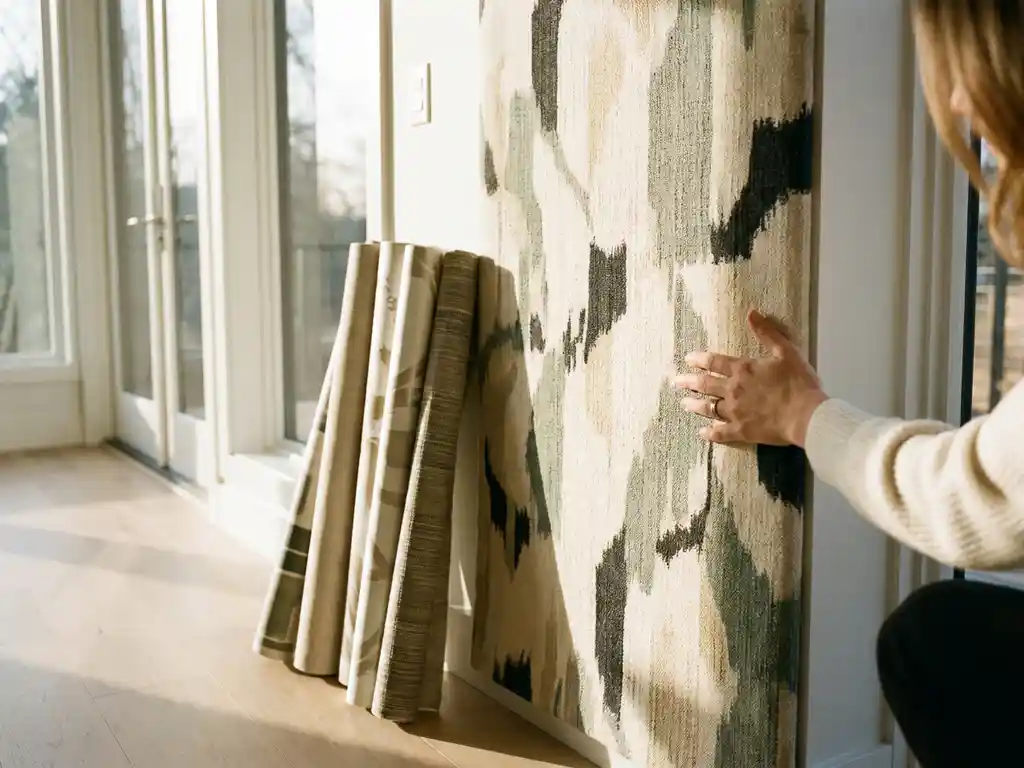
The right pressure medium for room design is chosen according to the substrate, room climate, and desired appearance. Self-adhesive films are suitable for smooth surfaces such as tiles or glass, while vinyl wallpaper adheres better on rougher surfaces. Those who want to design a rental apartment benefit especially from materials that can be removed without leaving any residue. The following questions will help you find the appropriate material for your specific situation.
Which print media are suitable for interior design?
Self-adhesive films, vinyl wallpaper, floor foils and printable textiles are particularly suitable for room design in interior design. Each of these materials has specific properties that make it suitable for specific surfaces and rooms. The choice depends on whether the design is intended to be permanent or temporary, the type of substrate present, and the visual effect you want to achieve.
Self-adhesive films are the most versatile category. They can be applied to tiles, glass, wood, and many other smooth surfaces and are available in many variants: matte, glossy, textured, or transparent. Vinyl wallpaper offers a high-quality wall finish and are particularly suitable for living areas where a textile feel is desired. Floor vinyls are specifically designed for use under foot traffic and feature anti-slip surfaces. Printable textiles, in turn, are suitable for decorative wall coverings or room dividers.
What’s crucial for interior design projects is that all these materials can be individually printed. This means: Designs, patterns, or photos can be precisely transferred onto the material, creating custom-made solutions for every room.
How are self-adhesive films different from vinyl wallpaper?
The most significant difference between self-adhesive films and vinyl wallpaper lies in the adhesion and the substrate. Films adhere directly to the surface and do not require any adhesive, whereas vinyl wallpaper is processed with wallpaper adhesive and is better suited for porous or slightly uneven walls.
Self-adhesive films are faster and easier to apply: measure, cut, and apply. They can be applied to smooth surfaces such as tiles, painted walls, or furniture surfaces. High-quality variants are bubble-free and can be removed without leaving any residue, making them particularly attractive for rental properties.
However, vinyl wallpaper offers a more robust wall covering and covers up small irregularities better. They are usually thicker and provide a higher-quality tactile effect. The installation requires a little more preparation, but the result often looks more homely and durable. For living rooms or bedrooms where elegant wall decoration is a priority, vinyl wallpaper is often the better choice.
Which printing medium is suitable for the kitchen and bathroom?
Moisture-resistant, self-adhesive films are best suited for kitchens and bathrooms. These materials resist splashes of water, steam, and cleaning agents and can be applied to tile surfaces without having to remove or re-tile the area. It is important that the film has a sealed, pore-free surface so that no moisture can penetrate.
In the kitchen, kitchen backsplashes are one of the most common applications. Here, a printed film replaces the classic tile backsplash and can be customized, whether with stone effects, wood decor, or a custom design. The film must be heat-resistant enough to withstand the temperature fluctuations in cooking areas, and should be easy to wipe clean.
Similar requirements apply in the bathroom. Films for bathrooms must be permanently moisture-resistant and must not peel off when exposed to varying temperatures. Ensure that the edges are securely glued or sealed to prevent water from seeping through the film. For floors in the wet area, only specially certified floor films should be used.
Can you use print media in rental apartments?
Yes, many print media can be easily used in rental apartments, provided they can be removed without leaving residue. Self-adhesive films with an air channel-based or repositionable adhesive layer do not leave adhesive residue on the substrate when removed, allowing the original condition to be restored.
This is a major advantage for tenants: they can customize walls, floors, or kitchen backsplashes without making structural changes. This is particularly relevant because many rental agreements prohibit permanent modifications to the building structure. A film that can be removed without leaving any residue generally is not considered a structural modification.
It is important to check the substrate before installation. On freshly painted walls or sensitive surfaces, a gentle film can also leave traces if the substrate itself is not stable. In case of doubt, it is recommended to test the adhesive on an inconspicuous area before applying the entire surface.
How do you choose the right material based on the subfloor?
The choice of the correct pressure medium depends directly on the substrate. Smooth, non-absorbing surfaces such as tiles, glass or painted walls are best suited for self-adhesive films. Rougher or slightly porous substrates such as cork wallpaper or plaster walls tolerate better with vinyl wallpaper or special adhesive films with stronger adhesive.
Smooth surfaces
Standard film adheres reliably to smooth surfaces when the surface is clean, dry, and free of grease. Tiles, glass, metal, and smooth-painted walls are ideal substrates. In this case, a medium-strength adhesive usually suffices, which also allows for residue-free removal.
Rough or textured surfaces
For structured surfaces, you either need a film with stronger adhesive or you resort to vinyl wallpaper. Rigid-core wallpaper or slightly textured walls do not provide enough contact area for a standard film. In such cases, it makes sense to smooth the substrate beforehand or choose a material designed for uneven surfaces.
What are sustainable alternatives to traditional print media?
Sustainable alternatives to traditional print media include PVC-free films, recyclable vinyl wallpaper, and solvent-free coatings. These materials reduce the use of plasticizers and pollutants and solvents. For interior design projects where environmental sustainability plays a role, these alternatives are a sensible choice.
PVC-free films are mostly made of polyester or other plastics without chlorine-containing compounds. They are just as functional as conventional vinyl films, but they emit less air pollutants and can be disposed of in a more environmentally friendly way. This is a relevant advantage for living spaces where people spend a lot of time.
Sustainability also plays a role in the printing ink. Water-based inks and UV-curing systems without volatile organic compounds are more environmentally friendly than solvent-based alternatives. Those who value a healthy indoor climate should specifically ask the printing service provider about these ink types when choosing their supplier.
Print media for interior design: What com2C has in store for you
We support print service providers and signage specialists in implementing custom-made solutions for interior design projects that really work. Whether it’s kitchen backdrops, bathroom decals, or wall design for rental apartments: We provide the materials that are technically and visually convincing.
- Self-adhesive films for smooth surfaces, easily removed without leaving residue, making them ideal for rental properties
- Moisture-resistant materials for the kitchen and bathroom that withstand cleaning agents and steam
- PVC-free alternatives from our GoGreener range
- Vinyl wallpaper for high-quality wall designs with a textile character
- Floor films with anti-slip surface for safe applications in the living area
- Compatibility with all common printing systems from HP, Epson, Roland, Mimaki and others
Our team will provide you with a technically sound assessment of which material is best suited for your specific subfloor and application. Take a look at our Interior Design Range or you can take it directly Contact, If you have a specific requirement.