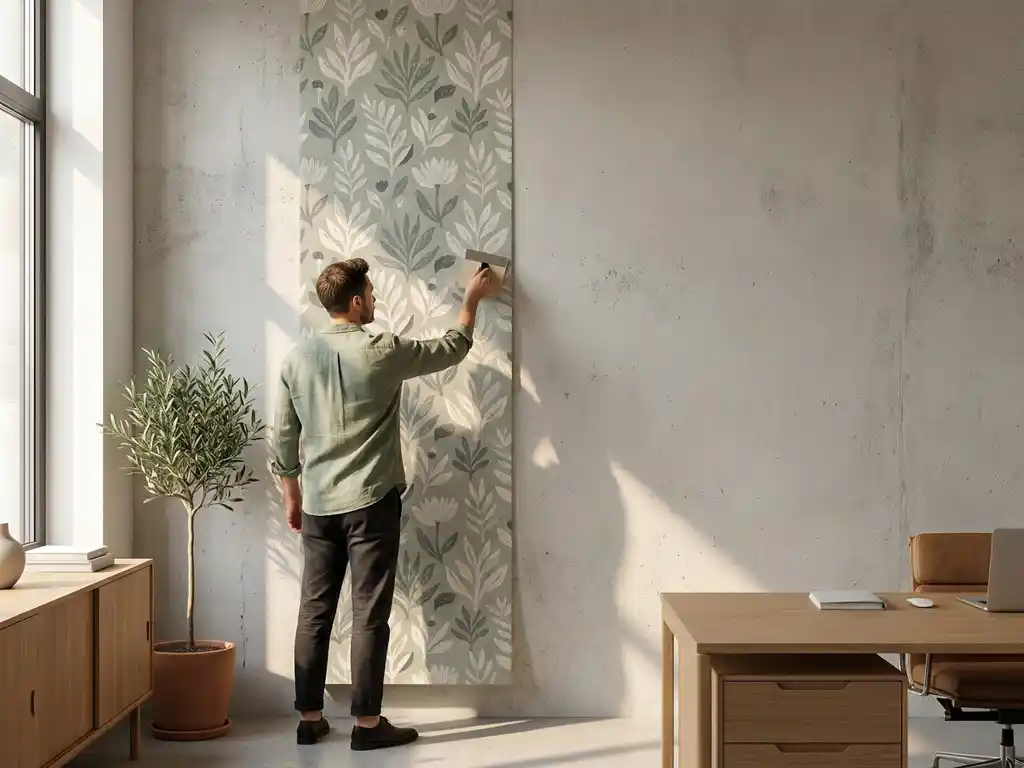
Self-adhesive wallpapers can be a sustainable choice for wall decoration if you pay attention to the right materials. Whether a product is truly eco-friendly depends primarily on the backing material used, the coating, and its recyclability. The following questions help you clearly distinguish sustainable options from less sustainable ones.
What are self-adhesive wallpapers made of and what materials are available?
Self-adhesive wallpapers consist of a backing material, a print layer, and an adhesive layer on the back. PVC film, non-woven fabric, polyester fabric, or paper-based materials are mainly used as the backing material. The adhesive layer is designed to be either permanent or repositionable, depending on the intended application.
The following main categories are available on the market today:
- PVC-based films: Widespread, inexpensive to produce, but problematic from an ecological perspective, as PVC is difficult to recycle and releases pollutants when burned.
- Non-woven wallpapers with self-adhesive layer: Made of polyester or cellulose fibers, are more breathable than PVC, and in many cases can be processed without solvents.
- Textile-based media Woven or knitted carrier materials with an adhesive coating, often used for high-end interior design.
- PVC-free polyester-based films: An increasingly common alternative that offers similar technical properties to PVC, but without chlorine-containing compounds.
The choice of material affects not only the print quality and durability, but also the ecological footprint of the entire project.
How eco-friendly are self-adhesive wallpapers compared to standard wallpapers?
Self-adhesive wallpapers are not automatically more environmentally friendly than standard wallpapers. The decisive difference lies in the material: conventional wallpapers often consist of paper or non-woven fabric without plastic content, while many self-adhesive variants are based on PVC. Products containing PVC perform significantly worse in terms of life cycle assessment.
In a direct comparison, several factors play a role:
- Resource extraction Wallpaper made of paper uses renewable resources, while PVC films are based on petroleum.
- Processing: Self-adhesive wallpapers do not require additional wallpaper paste, which saves solvents and processing chemicals.
- Disposal: PVC is difficult to recycle and burdens incineration. PVC-free alternatives or non-woven materials are much easier to dispose of.
- Lifespan: A durable, self-adhesive wallpaper that can be repositioned multiple times reduces material consumption over time.
Self-adhesive wallpapers made from PVC-free materials can certainly be ecologically on par with or even superior to standard wallpapers when production, use, and disposal are considered together.
What makes a self-adhesive wallpaper truly sustainable?
A self-adhesive wallpaper is truly sustainable when it is made from low-emission materials, allows for a long service life, and can be disposed of or recycled at the end of its life cycle without major environmental impact. Sustainability is not a single feature, but the result of multiple factors combined.
Specifically, you should pay attention to the following properties:
- PVC-free backing material: Polyester-, fleece- or paper-based backings avoid chlorine-containing compounds.
- Solvent-free adhesives: Water-based or pressure-sensitive adhesives without volatile organic compounds (VOC) improve indoor air quality.
- Certifications: Certifications such as OEKO-TEX, Greenguard, or FSC provide indications of tested freedom from harmful substances and responsible raw material sources.
- Repositionability Wallpapers that can be removed without leaving residue and reused extend the service life and reduce waste.
- Recyclability Materials that can be separated by type and recycled close the material loop.
A product that meets only one of these criteria is not yet a sustainable product. Only the combination of low-pollutant manufacturing, long usability, and clean disposal results in a credible ecological balance.
Are PVC-free self-adhesive wallpapers a better choice for interiors?
Yes, PVC-free self-adhesive wallpapers are generally the better choice for indoor spaces. Materials containing PVC can release plasticizers (phthalates) and other volatile compounds that negatively impact indoor air quality. PVC-free alternatives made of non-woven fabric or polyester avoid these emissions, making them particularly suitable for continuously used indoor spaces such as offices, living areas, or children's rooms.
Furthermore, they offer PVC-free materials further practical benefits:
- They are often more breathable, which reduces mold growth behind the wallpaper.
- Many PVC-free products are lighter and easier to process.
- In many cases, they can be printed with water-based inks, which makes the entire printing process lower in emissions.
- Disposal is simpler, as no chlorine-containing compounds are released.
For professional applications in large-format printing, this means that PVC-free wall murals allow you to offer your clients a product that is technically convincing and at the same time safer for health.
How long do self-adhesive wallpapers last and can they be removed without leaving residue?
Self-adhesive wallpapers generally last for several years with proper application and a suitable substrate. For indoor applications without direct sunlight, lifespans of three to five years are realistic. Removability depends heavily on the adhesive used and the substrate: repositionable adhesives generally leave no residue on smooth, clean surfaces.
For residue-free removal, the following points are important:
- Substrate preparation: Der Untergrund sollte sauber, trocken und fettfrei sein. Poröse oder ungestrichene Wände können die Haftung des Klebstoffs beeinflussen und das Entfernen erschweren.
- Klebstofftyp: Druckempfindliche, repositionierbare Klebstoffe sind speziell für einfache Entfernung entwickelt. Permanente Klebstoffe sind für Langzeitanwendungen gedacht und hinterlassen beim Entfernen häufig Rückstände.
- Entferntechnik: Langsames, gleichmäßiges Abziehen in einem flachen Winkel schont den Untergrund und die Tapete.
- Lagerung und Verarbeitung: Zu lange gelagerte oder bei falschen Temperaturen verarbeitete Tapeten können stärker haften als vorgesehen.
Für temporäre Installationen, Messen oder Showrooms empfehlen sich ausdrücklich repositionierbare Varianten, die mehrfach verwendet werden können und damit den Materialverbrauch senken.
Welche selbstklebenden Tapeten eignen sich für nachhaltigen Großformatdruck?
Für nachhaltigen Großformatdruck eignen sich selbstklebende Tapeten aus PVC-freien Materialien, die mit wasserbasierten oder Latex-Tinten bedruckbar sind. Diese Kombination aus schadstoffarmem Trägermaterial und umweltfreundlichem Tintensystem reduziert den ökologischen Fußabdruck des gesamten Druckprozesses spürbar. Vliesbasierte und polyesterbasierte Medien ohne Weichmacher sind dabei die am häufigsten eingesetzten Optionen.
Beim Einsatz im professionellen Großformatdruck sollten Sie auf folgende Eigenschaften achten:
- Ink compatibility: Das Medium muss mit dem eingesetzten Tintensystem harmonieren, ob Latex, UV oder wasserbasiert. Eine geeignete Inkjet-Beschichtung sorgt für scharfe Druckergebnisse und gute Farbwiedergabe.
- Dimensional stability: Für großformatige Wandinstallationen ist eine geringe Dehnung des Materials wichtig, damit Nähte und Muster sauber passen.
- Schadstofffreiheit: Materialien ohne VOC-Emissionen sind für Innenraumanwendungen wichtig, insbesondere wenn die Tapeten in öffentlichen Gebäuden oder Büros eingesetzt werden.
- Verarbeitungsbreite: Für Großformatdrucker relevante Rollenbreiten und Kerndurchmesser sollten auf die eingesetzten Drucksysteme abgestimmt sein.
Drucker, die auf Nachhaltigkeit setzen, profitieren davon, ihren Kunden dokumentierbare Vorteile bieten zu können: schadstoffarme Materialien, rückstandslose Entfernbarkeit und eine klare ökologische Alternative zu PVC-basierten Produkten.
Nachhaltiges selbstklebendes Wallpaper von com2C
Wir entwickeln und produzieren selbstklebende Tapeten, die technisch funktionieren und gleichzeitig eine klare ökologische Alternative zu PVC-Standardmaterialien bieten. Unser selbstklebendes Wallpaper PVC-frei ist speziell für den professionellen Großformatdruck entwickelt und auf die Anforderungen von Digitaldruckern, Werbetechnikern und Messebauern abgestimmt.
Was wir Ihnen konkret bieten:
- PVC-freie Trägermaterialien ohne Weichmacher, geeignet für Innenraumanwendungen mit hohen Anforderungen an die Raumluftqualität
- Kompatibilität mit wasserbasierten und Latex-Tintensystemen führender Druckerhersteller wie HP, Epson, Roland und Mimaki
- Repositionierbare Klebstoffoptionen für temporäre Installationen, Messen und Showrooms
- Eigene Inkjet-Beschichtungen aus unserem chemischen Labor für präzise Druckergebnisse und gute Farbwiedergabe
- Technische Beratung, die über den reinen Produktverkauf hinausgeht: Wir helfen Ihnen, das richtige Material für Ihre spezifische Anwendung zu finden
Wenn Sie nachhaltige Druckmedien einsetzen möchten, ohne Kompromisse bei Qualität oder Verarbeitbarkeit einzugehen, sprechen Sie uns gerne an. Wir unterstützen Sie bei der Materialauswahl und stehen für ein Consultation zur Verfügung.