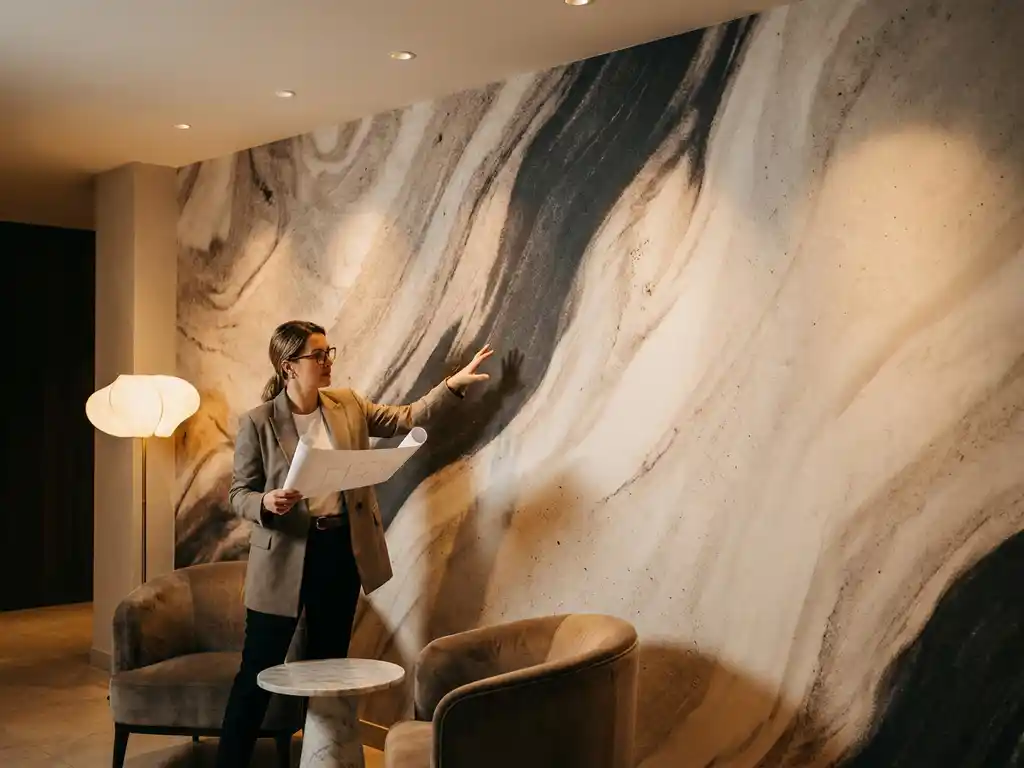
Non-woven wallpaper lasts between 10 and 15 years indoors under normal conditions. The actual lifespan depends heavily on the quality of the material, the workmanship during hanging, and the environmental conditions. The following sections answer the most important questions regarding durability, application, and care.
What does the durability of a non-woven wallpaper depend on?
The durability of non-woven wallpaper depends primarily on three factors: the quality of the material, proper installation, and the environmental conditions at the location. Anyone who manages these three points can expect a long and stable lifespan.
Grammage plays an important role in material quality. Heavier fleeces with a higher density are generally more robust and tear-resistant than lighter variants. The coating also influences durability: a high-quality inkjet coating ensures that the printing inks penetrate deep into the material rather than merely adhering to the surface. This protects the printed image from abrasion and UV-induced fading.
The application is at least just as important. Bubbles, uneven adhesive application, or improperly prepared walls significantly reduce durability. Non-woven wallpapers are usually applied with adhesive directly to the wall, not to the material. Anyone who performs this step carefully lays the foundation for a long-lasting bond.
Added to this are environmental factors such as humidity, temperature, and exposure to light. Rooms with strong temperature fluctuations or permanently high humidity put more stress on the material than stable indoor conditions.
How long does a non-woven wallpaper last indoors?
Indoors, non-woven wallpaper lasts between 10 and 15 years with proper installation and normal living conditions. High-quality materials with a stable coating can even exceed this timeframe if the wall remains dry and the room temperature stays constant.
In commercial areas such as offices, hotels, or exhibition spaces, the service life is often shorter because the material is subjected to heavier wear and tear. Here, professionals typically expect 5 to 8 years before replacement makes sense. In living spaces with moderate use, a lifespan of over a decade is realistic.
It is also important how the wallpaper is cared for. Non-woven wallpapers can generally be wiped dry or slightly damp. Aggressive cleaning agents or heavy scrubbing will damage the surface and noticeably shorten its lifespan. Anyone who cleans the wallpaper gently on a regular basis will preserve the print quality for significantly longer.
Can non-woven wallpaper also be used outdoors?
Standard non-woven wallpapers are not suitable for outdoor use. They are designed for stable indoor conditions and are sensitive to moisture, UV radiation, and temperature fluctuations. Outdoors, they would swell, peel off, or fade within a short time.
For temporary outdoor applications, there are special materials that are more weather-resistant. Anyone who still wants to use a non-woven wallpaper in a covered outdoor area should ensure that the material is not exposed to direct rain or strong sunlight. Even then, a significantly shorter service life must be expected.
For permanent outdoor advertising or facade design, other materials such as weatherproof films or special banner fabrics are the better choice. Non-woven wallpapers clearly show their strengths indoors.
How does the printing method affect the lifespan?
The printing method has a direct impact on the durability of the print on non-woven wallpaper. Latex and UV inks are considered particularly durable because they form a stable, abrasion-resistant layer after printing. Water-based inks are more sensitive and require a correspondingly high-quality protective layer in the material.
Solvent printing also yields durable results, but non-woven wallpapers must be specially coated for this process in order to absorb the solvents in the ink without damaging the non-woven structure. An unsuitable coating leads to poor ink absorption, color variations, and a shorter lifespan of the printed image.
As a general rule, the better the coordination between the print medium and the ink system, the longer the printed image retains its color fidelity and abrasion resistance. Anyone using non-woven wallpaper for demanding projects should always check whether the material is approved for the respective printing process.
What prematurely shortens the shelf life of non-woven wallpaper?
Several factors can significantly reduce the durability of a non-woven wallpaper. The most common causes are faulty installation, unfavorable environmental conditions, and inappropriate cleaning.
- Damp or unprepared walls: Walls with residual moisture or poorly adhering old paint do not provide a stable base. The wallpaper will then peel off prematurely, often within the first few weeks.
- Too little or unevenly applied paste: Areas without sufficient paste form bubbles or peel at the edges. This affects not only the appearance, but also the stability.
- Permanently high humidity: Bathrooms or kitchens without adequate ventilation are problematic installation locations. Condensation attacks the adhesive and can promote mold under the wallpaper.
- Direct sunlight: UV radiation causes colors to fade, especially in printed images with water-based ink without UV protection.
- Aggressive cleaning agents: Solvent-based cleaners attack the coating and make the material brittle.
Anyone who takes these points into account from the start will avoid the most common mistakes and maximize the full lifespan of the material.
How do you remove a non-woven wallpaper without damaging the wall?
Non-woven wallpapers can generally be peeled dry and in one piece from the wall. This is one of the biggest practical advantages over conventional paper wallpapers. You grab the wallpaper by a corner or seam, carefully loosen it, and pull it evenly and slowly off the wall.
It is important not to pull jerkily. Pulling it off too quickly can cause plaster or paint to come off as well, especially if the surface was not adequately prepared or the wallpaper has been up for a very long time.
If there are any residues of the paste film on the wall, they can easily be removed with warm water and a sponge. The wall should then dry before being repapered or painted.
In the case of very old wallpaper or highly absorbent surfaces, it can help to spray the wallpaper lightly with water before peeling it off to dissolve the paste bond. In most cases, however, this is not necessary because non-woven wallpapers are designed precisely for this easy peelability.
Non-woven wallpapers by com2C: Quality that lasts
Anyone who uses non-woven wallpaper professionally knows that material quality makes all the difference. We develop and produce our Non-woven wallpapers from com2C with high-quality inkjet coatings that are tailored to standard printing processes. The result is materials that are color-accurate, durable, and easy to process.
- Compatible with all leading printing systems: Our non-woven wallpapers work reliably with latex, UV, solvent, and water-based ink systems from HP, Epson, Roland, Mimaki, Durst, and other manufacturers.
- PVC-free materials: Our GoGreener line offers eco-friendly alternatives without compromising on quality or workability.
- In-house coating development: We test and optimize our coatings in our own chemical laboratory to ensure that ink absorption and color reproduction remain consistently accurate.
- Technical consulting included: We support you in selecting the right materials for your specific printing process and application area.
If you have any questions about our non-woven wallpapers or are looking for the right material for your next project, we look forward to hearing from you Consultation.